Trust Wallet’s Christmas Compensation Plan: What the Browser Extension Incident Teaches the Entire Crypto Industry
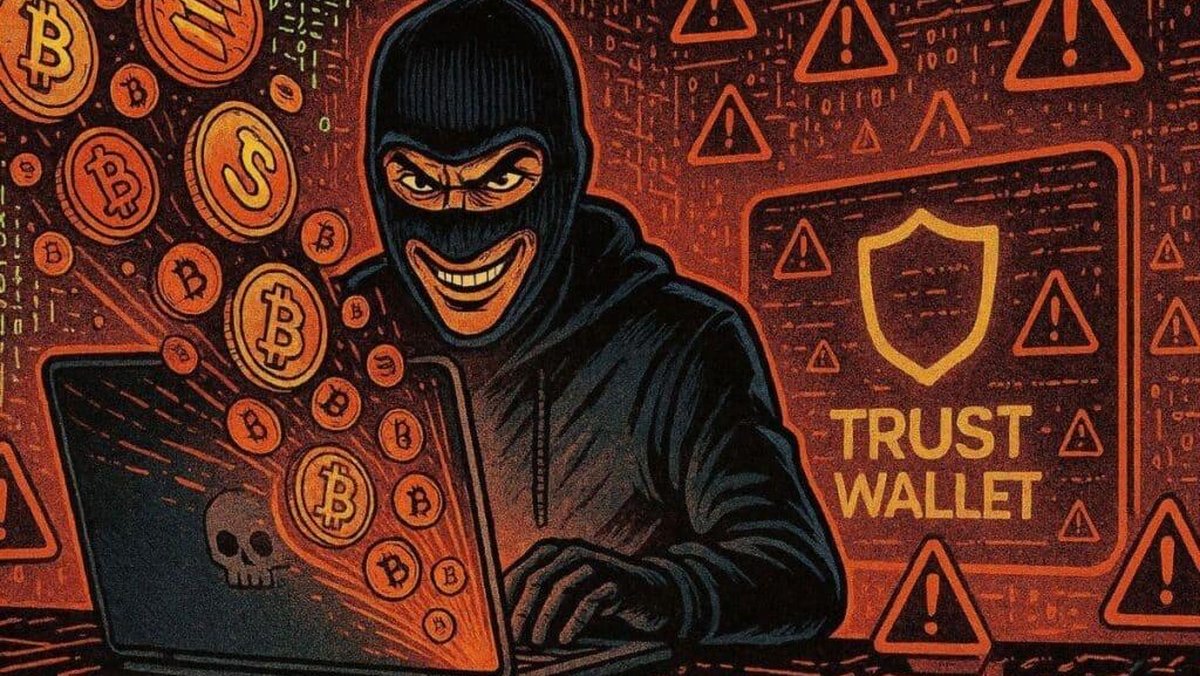
The 2025 holiday season delivered an unwelcome surprise for a subset of Trust Wallet users. A malicious version of the Chrome browser extension briefly went live, capturing seed phrases and enabling unauthorized transfers across multiple blockchains. Estimated losses reached around 7 million USD, affecting assets such as Bitcoin, Ether and Solana.
Now, Trust Wallet has announced a formal compensation program that promises to reimburse affected users 100% of their losses. The company has published an official form where victims can submit details about their accounts and transactions. Funding for the payouts will come from the SAFU reserve associated with Binance, the parent company of Trust Wallet.
On the surface, this is a story about a serious incident followed by a decisive response. But beneath it lies a much broader lesson for wallets, exchanges and users: self-custody tools are only as strong as the entire chain of software, distribution and device security around them. The Trust Wallet case is a real-world example of what happens when that chain is broken—and how the industry might respond in a more mature way.
1. What Trust Wallet Is Offering: A Closer Look at the Compensation Process
Trust Wallet’s announcement is unusually clear and concrete for a consumer crypto product. Rather than vague promises of support, the team has opened a structured claims process with specific eligibility criteria.
Affected users are asked to submit a request through an official support form, providing the following information:
- Contact email and country of residence;
- The address of the compromised wallet;
- The address or addresses that received the funds (the attacker’s wallets);
- Transaction hashes documenting the outgoing transfers;
- Any additional context that helps verify the claim.
Trust Wallet has stated that 100% of verified losses will be reimbursed. According to public comments from Binance co-founder Changpeng Zhao (CZ), compensation will be financed using the Secure Asset Fund for Users (SAFU), a reserve originally designed to cover unexpected security incidents on Binance’s exchange platform.
While users understandably focus on the reimbursement itself, the way it is structured matters just as much. By requiring on-chain evidence and detailed information, Trust Wallet is attempting to balance two goals:
- Make victims whole in a timely and transparent manner;
- Prevent opportunistic claims that could drain funds meant for genuine users.
In other words, the compensation program is part customer-care initiative, part forensic exercise—one that will likely inform future design of wallet security and incident playbooks across the industry.
2. How the Malicious Extension Slipped Through
The most striking aspect of this case is that the issue did not originate in Trust Wallet’s mobile application or core cryptographic libraries. Instead, the problem appeared in a specific version of the desktop browser extension for Chrome, labelled v2.68, which was released on 24 December.
According to the project’s post-mortem, attackers obtained the API key for Trust Wallet’s Chrome Web Store account. With that key, they were able to publish a modified build of the extension without going through the company’s usual internal release pipeline. In effect, the official distribution channel was used to deploy an unauthorized version of the software.
The compromised extension did several things at once:
- It embedded a tampered open-source analysis library that quietly captured sensitive data when users interacted with the wallet interface.
- Most critically, the altered code collected recovery phrases (seed phrases) from some users and transmitted them to a remote server controlled by the attacker.
- Once in possession of those phrases, the attacker could recreate the wallets elsewhere and initiate transfers of funds to their own addresses.
It is important to note that this was not a flaw in the cryptography of Trust Wallet or in the underlying blockchains. The incident was essentially a supply-chain compromise and a distribution-channel misuse—a type of risk that is becoming more common across the software world, not just in crypto.
3. Who Was Affected—and Who Was Not
Trust Wallet’s communication has emphasised the narrow scope of the incident. Only a specific group of users met all the conditions necessary to be exposed:
- They were using the Chrome browser extension on desktop, not the mobile app or other wallet interfaces.
- They had the compromised v2.68 extension installed.
- They interacted with the extension and entered their wallet credentials before 18:00 (Vietnam time) on 26 December, when mitigation actions started.
Users of the mobile application, hardware-wallet integrations, or earlier / later versions of the extension were not affected by this particular issue. The extension has since been updated multiple times, with the project recommending that everyone upgrade to at least v2.89, which includes additional safeguards.
On-chain analysis from independent firms indicates that roughly 7 million USD worth of digital assets were moved during the incident. Approximately 4 million USD appears to have been routed through various centralised services—such as ChangeNOW, FixedFloat and KuCoin—while around 2.8 million USD remains in addresses associated with the attacker, according to tracing shared by blockchain-analysis companies.
While any loss is serious for individuals, the overall scale is still relatively contained compared with some of the large-scale exchange failures of previous cycles. The key difference here is that the affected platform is a self-custody wallet, which users often choose precisely because they want more control over their funds. That makes the psychological impact of this type of incident especially strong.
4. Why Trust Wallet’s Response Matters
From a purely contractual standpoint, most non-custodial wallets make it clear that users are responsible for safeguarding their own keys. In that sense, Trust Wallet could have argued that the compromise of a browser extension—especially via a third-party distribution channel—did not obligate the company to repay lost funds.
Instead, the team chose to accept responsibility and offer full compensation. This decision sets an important precedent on several fronts:
• Reputational repair: In a crowded wallet market, reputation is a primary asset. Covering user losses signals that the project values long-term trust more than short-term financial savings.
• Industry benchmark: Other wallet providers and infrastructure projects now face a higher bar. When a major player demonstrates that full compensation is possible, it becomes harder for others to dismiss similar incidents as simply “user risk”.
• Regulatory optics: Authorities observing the sector can point to this response as evidence that crypto companies are capable of self-regulation and user protection, which may influence future policy debates.
The involvement of Binance’s SAFU reserve is also notable. Originally designed to cover trading-platform incidents, it is now being used to address losses linked to an affiliated non-custodial product. This blurs the line between exchange and wallet, hinting at a future where large ecosystems offer cross-product safety nets rather than treating each service as a silo.
5. Technical and Human Lessons from the Incident
Beyond the compensation, the Trust Wallet event offers several important lessons about how self-custody tools should evolve.
5.1 Browser extensions are powerful—but fragile
Browser extensions occupy a unique space: they run with significant privileges inside an environment—your browser—that is constantly parsing untrusted content from the internet. This makes them convenient for interacting with Web3 applications, but also creates a large attack surface.
Key takeaways:
- Distribution keys must be guarded like private keys. The exposure of the Chrome Web Store API key effectively handed over the “release button” to an attacker.
- Multi-party approval for releases. Even if an API key is compromised, additional human or cryptographic checks (for example, requiring signatures from multiple maintainers) could block unauthorized updates from going live.
- Runtime integrity checks. Extensions can verify their own code against a known hash or remote attestation service, making it harder for altered builds to operate unnoticed.
5.2 Open-source libraries are a double-edged sword
The malicious extension reportedly relied on an open-source analysis library that had been modified to capture sensitive inputs. This highlights a familiar dilemma: open-source components accelerate development and allow broad review, but they also provide a starting point for attackers to craft convincing imitations.
Practical measures include:
- Pinning specific versions of external libraries and checking their hashes during build;
- Running independent code audits on third-party modules that touch critical flows such as seed-phrase entry;
- Maintaining a software bill of materials (SBOM) so that any unusual change in the dependency tree is flagged.
5.3 Seed phrases should be treated like radioactive material
At the user level, the incident reinforces a message that has been repeated for years: never type your seed phrase into a browser extension unless you are explicitly restoring a wallet, and even then only on a trusted device and known build. Any request for a recovery phrase during ordinary use—such as signing a transaction or connecting to a dApp—should be considered a red flag.
Longer term, the industry may need to reduce reliance on plain seed phrases altogether by leaning more on hardware devices, multi-party computation, account abstraction and other techniques that separate the act of authorising transactions from direct exposure of recovery material.
6. Guidance for Users: How to React and How to Prepare
If you are a Trust Wallet user, there are two separate questions to ask yourself: Was I affected? and What should I do next?
6.1 Determining whether you were exposed
You may be within the affected group if all of the following apply:
- You used the Trust Wallet Chrome extension on desktop in late December 2025;
- Your extension version was 2.68 during that period;
- You opened the extension and interacted with your wallet before 18:00 Vietnam time on 26 December;
- You subsequently observed unknown transfers from your addresses.
If this describes your situation, the next step is to gather transaction hashes and wallet addresses and submit a claim via Trust Wallet’s official support channels. Using unofficial links or messages received via private channels is strongly discouraged, as they may themselves be attempts to exploit worried users.
6.2 Security hygiene going forward
Regardless of whether you were affected, this is a good moment to revisit basic wallet-security practices:
• Update software promptly. Make sure your extension is upgraded to the latest version (currently v2.89 or higher). The same goes for your browser and operating system.
• Consider hardware support. Where possible, connect your wallet to a hardware device so that private keys never leave the secure element.
• Segregate high-value holdings. Keep larger balances in “cold” setups that are rarely exposed to the internet, using browser-based wallets only for day-to-day amounts.
• Be wary of unexpected prompts. If an interface asks for your recovery phrase in a context that does not make sense, close it immediately and double-check with official documentation.
7. What the Incident Signals for the Future of Self-Custody
The Trust Wallet case arrived at a moment when the industry is still debating how to reconcile self-custody with user protection. On one side, the ethos of personal responsibility is central to digital assets. On the other, mass adoption requires guardrails that resemble those in traditional finance.
This incident nudges the balance slightly toward the latter. When a non-custodial product, backed by a large ecosystem, decides to make users whole after a distribution-channel compromise, it suggests a future where:
- Wallet providers treat incident response and user restitution as core responsibilities, not just public-relations choices;
- Large platforms maintain reserve funds or insurance-like structures to cushion the impact of rare but severe events;
- Regulators may come to expect higher standards of transparency and consumer protection from any service that touches retail users, regardless of custody model.
For builders, the message is clear: security is now a product feature, not an afterthought. For users, the case is a reminder that even in self-custody, there are meaningful differences between projects in how they handle adversity.
8. Conclusion: Turning a Difficult Holiday into a Teachable Moment
The December 2025 browser-extension incident was an uncomfortable episode for Trust Wallet and a stressful one for affected users. Yet the way the situation is being handled—through transparent communication, technical remediation and a 100% compensation plan—may ultimately strengthen the project’s relationship with its community.
More broadly, the case illustrates a set of realities the crypto ecosystem can no longer ignore:
- Supply-chain risk and distribution-channel abuse are as critical as smart-contract bugs.
- Self-custody does not mean users must be left alone when something goes wrong.
- Clear processes, reserve funds and cross-company collaboration can limit the damage of even high-impact incidents.
As crypto continues to move from niche experiment to everyday financial infrastructure, episodes like this will help determine which projects earn long-term trust. For now, the Trust Wallet response stands as an example of how a difficult situation can be handled in a way that prioritises users, recognises shared responsibility and turns a seasonal setback into a learning experience for the entire industry.
Disclaimer: This article is for educational and analytical purposes only and does not constitute financial, legal or security advice. Users should follow official communications from Trust Wallet and Binance for the latest information on the compensation program and recommended security practices.