
The Quiet Theme Behind Today’s Loud Headlines: How Fee-Funded Buybacks, Prediction Markets, and Geopolitics Are Rewiring Crypto’s “Value Story” in 2026
The past 24 hours delivered the kind of crypto newsfeed that feels like six different worlds colliding: a protocol launching buybacks funded by fees, tokens discussing supply reduction, prediction markets expanding into new asset classes, a hardware-wallet brand caught in a third-party data incident, and geopolitics spilling into oil and Bitcoin narratives. It’s tempting to treat these as disconnected bullets.
But if you zoom out, there’s a single thread running through nearly all of it: crypto is arguing—again—about what “value” means when the market grows up. Not “price,” not “narrative,” but value: how it’s created, how it’s protected, and how it’s distributed. The market is still speculative, yes, yet it increasingly rewards projects that can explain their cash-flow logic, their distribution strategy, and their operational controls in one coherent sentence.
1) Lighter’s fee-funded buyback is less about “pump” and more about a new credibility test
Today’s headline: Lighter ($LIT) is kicking off a buyback program using protocol fees. On the surface, this sounds like a familiar playbook—reduce circulating supply, signal confidence, improve tokenholder alignment. The deeper significance is that fee-funded buybacks are becoming a shorthand for “this protocol can defend itself without constantly selling new tokens.” That’s a maturity marker.
In older cycles, growth was often subsidized by inflation: emit tokens, attract liquidity, hope the flywheel becomes real later. In a more selective market, the question is harsher: when incentives fade, does the protocol still earn? A buyback funded by actual fee revenue is one way of answering: “we have a business model, not just a marketing budget.”
Still, buybacks don’t magically turn a token into an equity-like claim. They are a mechanism, not a guarantee. What matters is the quality of the underlying revenue: whether fees are durable, whether they rely on sustainable user activity, and whether governance can change the rules in ways that surprise participants.
What to watch if you’re evaluating fee-funded buybacks (educational checklist):
- Revenue quality: Are fees coming from repeated, useful activity—or from one-off speculative bursts?
- Buyback transparency: Is there a published policy on timing, size, and execution (or is it discretionary and opaque)?
- Conflict risk: Could insiders influence buyback timing around announcements, unlocks, or liquidity changes?
- Governance durability: Can the community reverse the program overnight, and if so, under what conditions?
2) Supply management is becoming the “earnings call” of token markets
Alongside Lighter, the broader tape includes multiple supply-side stories: a proposal to cancel 300 million WOO tokens (a meaningful share of circulating supply), and Venice ($VVV) planning to reduce annual emissions. These are different projects with different contexts, but they rhyme: markets are increasingly treating token supply policy like a proxy for financial discipline.
In traditional finance, investors listen for margin guidance and capital allocation. In token markets, you don’t get audited earnings calls in the same way—so supply policy becomes a noisy substitute for “management competence.” A burn or emission cut is not automatically bullish; it’s a signal that the project understands dilution as a cost, not a feature.
However, supply management only works when paired with demand creation. Reducing emissions can remove sell pressure, but it cannot create product-market fit. A token can be perfectly scarce and still irrelevant if distribution is weak or the product is a niche. The market is learning to separate “token engineering” from “user growth.” Both matter, but they are not interchangeable.
3) Prediction markets are expanding—and the product is quietly changing shape
Prediction markets used to be framed as a fringe corner of crypto: clever, occasionally accurate, and often politically controversial. Today’s developments point to something more practical: Polymarket and Parcl discussing real estate prediction markets, using housing price indices as the underlying reference. That’s a subtle but important evolution.
When prediction markets attach themselves to an index rather than a single headline event, they start to look less like “bets” and more like a new kind of financial interface: a crowdsourced expectations layer. If these markets are built responsibly, the user value can extend beyond gambling. They can become signals—imperfect but informative—about what communities expect inflation, housing, or regional price pressure to do next.
There are also second-order effects. As prediction markets mature, they pull in new needs: credible oracles, dispute resolution, market integrity tooling, and guardrails against manipulation. In other words, they create demand for crypto infrastructure that isn’t purely speculative. That is one reason this trend matters in a “grown-up” market.
The key risk to keep in mind: markets that reference real-world indices can be useful, but they also raise questions about data sources, transparency, and user protections. The more these products resemble financial instruments, the more they invite scrutiny—and the more they need clear rules and robust controls.
4) The Ledger incident is a reminder: crypto’s biggest failures are often operational, not cryptographic
Another headline in the last 24 hours: Ledger saw customer data exposure that appears tied to a third-party payments partner (Global-e), not Ledger’s core systems. Reports describe leaked names and contact details, while emphasizing that seed phrases, private keys, on-chain balances, and payment card data were not compromised.
This distinction matters. The market tends to group all “breaches” into the same bucket, but operational risk is layered. A hardware wallet can be perfectly secure cryptographically and still create user harm through data exposure—because leaked contact info fuels phishing, impersonation, and social engineering. In practice, many losses happen not because encryption fails, but because people are tricked.
Educational safety reminders for users after any customer-data incident:
- Treat urgent emails and “verification requests” as suspicious, especially those asking you to connect a wallet or enter recovery words.
- Use official channels you navigate to yourself (not links in messages) for support and announcements.
- Consider compartmentalizing: dedicated email addresses and phone numbers for financial accounts reduce blast radius.
- Remember: legitimate support will not ask for your recovery phrase.
5) Bitcoin at ~$94K and “$250B added in 2026” is a mood indicator—but the mechanics matter more than the mood
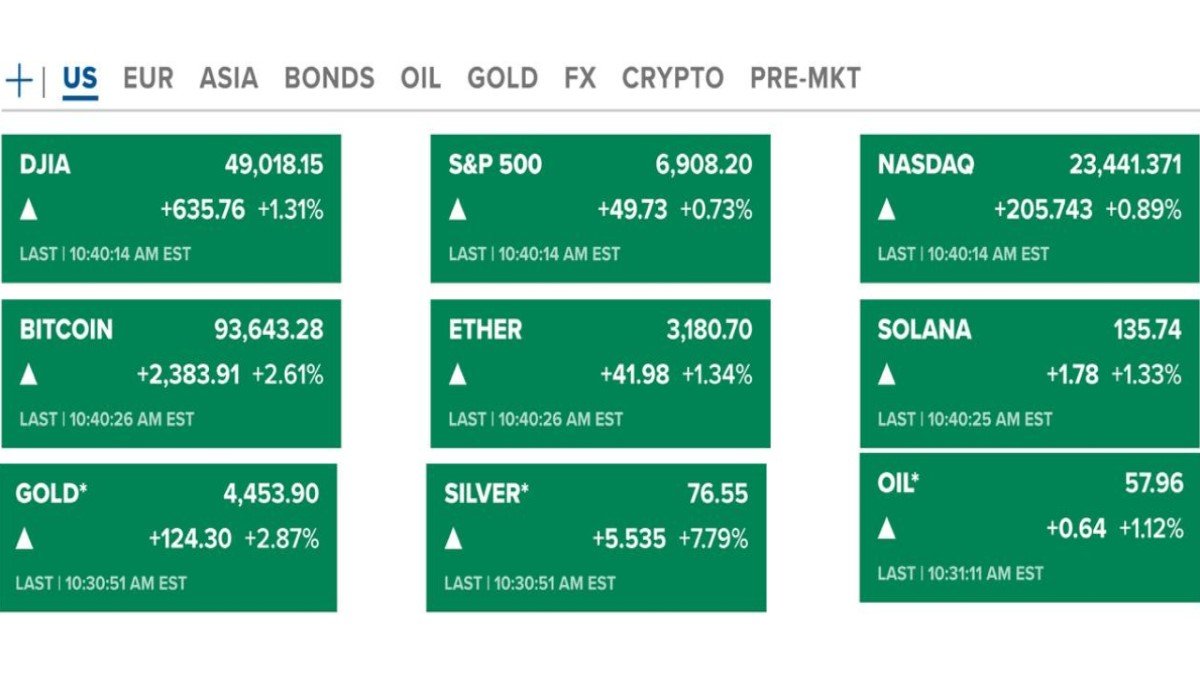
The market recap includes Bitcoin trading around $94,000 and commentary that roughly $250 billion has been added to total crypto market capitalization so far in 2026. These are attention-grabbing numbers, but they can mislead if we treat them as proof of broad-based strength.
A healthier way to read them is as a sentiment and liquidity check. When the market adds hundreds of billions in capitalization quickly, you want to know what kind of bid is driving it: spot demand vs. derivatives leverage, long-only allocations vs. short-term rotations, organic volume vs. one venue’s concentrated flows. This is where “headline bullishness” can hide fragility.
We also saw mention of Bitcoin short liquidations (~$110M in the last hour). Liquidations tell you the market is moving fast, but not necessarily that it’s sustainable. They are like weather—useful to notice, dangerous to worship.
6) The “Strategic Bitcoin Reserve” narrative collides with forfeiture mechanics
One of the most interesting tensions today is political rather than technical: reports suggest the U.S. Department of Justice may have sold a relatively small amount of seized BTC (roughly $6.3M) associated with a Samourai Wallet case, with commentary that this could conflict with the Trump-era framing of a Strategic Bitcoin Reserve.
Even if you set aside the specifics (which may still be disputed), the structural issue is real: governments don’t handle Bitcoin like a single trader. They handle it through agencies, legal frameworks, court orders, forfeiture processes, and operational policies that often lag the messaging. “Reserve” language is forward-looking branding; forfeiture is backward-looking legal housekeeping. When the two collide, the market learns something important: state-level Bitcoin policy is rarely one coherent lever. It’s a patchwork.
If 2026 is a year where more governments talk about Bitcoin strategically, expect more of these mismatches. Markets will respond not to slogans, but to process clarity: Who custodies? Which agency decides? Under what authority? And how transparent is the flow?
7) Venezuela, oil stocks, and the reminder that crypto still trades liquidity first
Another cluster of headlines keeps pulling markets back to geopolitics: Maduro’s U.S. court appearance and denial of allegations; oil stocks rising after the capture; and reports that the Trump administration may meet top U.S. oil executives to discuss reviving Venezuela’s energy sector. There’s also speculation that the U.S. could seize Venezuela’s crypto reserves.
Here’s the sober market lesson: in moments when geopolitics spikes, Bitcoin can behave like two different assets depending on the liquidity regime. In a calm, risk-on tape, Bitcoin can rise alongside equities, gold, and even oil. In a true liquidity crunch, Bitcoin often sells off with other risk assets—even if the long-term narrative is “hard money.” The short term is about forced positioning and collateral constraints. The long term is about adoption and monetary preference. They are not the same trade.
8) Corporate crypto exposure is shifting from “bravado” to portfolio policy
We also saw headlines about Michael Saylor’s Strategy buying an additional 1,286 BTC (~$116M). Whether you view that as visionary or aggressive, it represents a consistent theme in 2026: Bitcoin exposure is increasingly expressed through corporate balance sheets and institutional channels, not only through retail spot buying.
That matters because it changes volatility mechanics. Corporate treasuries can become sticky holders, but they can also become reflexive sellers if financing conditions tighten. In other words, corporate adoption can stabilize or destabilize depending on how it’s funded. The market’s next phase of maturity is learning to ask: is this demand financed by durable cash flow, or by cyclical capital markets?
Conclusion
If today’s news felt chaotic, that’s because crypto is in a transition phase where multiple worlds overlap: token markets that want to look like disciplined capital allocators, products (like prediction markets) that are starting to resemble financial infrastructure, and geopolitical narratives that still move liquidity across every asset class.
The signal hiding inside the noise is simple: 2026 is rewarding credibility. Credibility in tokenomics (fee-funded buybacks vs. endless incentives). Credibility in product design (prediction markets anchored to transparent indices). Credibility in operations (third-party risk, phishing defenses, and customer protection). The market still speculates—but it increasingly penalizes projects that can’t explain where value comes from and how it survives when the spotlight moves on.
Frequently Asked Questions
Is a protocol buyback the same as a stock buyback?
No. A stock buyback reduces share count and can mechanically increase per-share ownership of earnings. A token buyback can reduce circulating supply, but tokenholders typically do not have the same legal claim structure as equityholders.
Does token burning or emission reduction guarantee better performance?
No. Supply discipline can reduce dilution and sell pressure, but long-term outcomes depend on whether the product creates sustainable demand and user value.
Are prediction markets “just gambling”?
They can be used that way, but they can also function as expectation tools—especially when markets reference transparent indices. The value depends heavily on design, integrity controls, and user protections.
What should users do after any customer data leak?
Assume phishing attempts will increase. Verify communications through official channels you navigate to yourself, and never share recovery phrases or private keys.
Disclaimer: This article is for informational and educational purposes only and does not constitute financial, investment, legal, or tax advice. Cryptoassets are volatile and involve risk. Always do your own research and consider your personal circumstances and local regulations before making financial decisions.