Strategy’s Pivot: How Perpetual Preferred Shares Turn a Bitcoin Treasury Into a Yield Factory
For years, the shorthand story around Strategy was simple: borrow money, buy Bitcoin, and ride the cycle. That framing was never completely wrong, but it misses what’s changed recently. In 2025–2026, Strategy’s funding playbook started to look less like a one-track “debt to BTC” pipeline and more like a deliberately engineered capital stack built to last through multiple market regimes.
The centerpiece of that shift is the company’s move toward perpetual preferred shares across several series. If you squint, it resembles a public-company version of a structured desk: the firm holds a large, volatile asset with no maturity date (Bitcoin) and then manufactures different cash-flow profiles—fixed, variable, euro-denominated, convertible—so that different types of institutional buyers can participate without all taking the same risk in the same wrapper.
The hidden mismatch in the old model
Between 2020 and 2024, Strategy’s Bitcoin accumulation was often funded through instruments with a clock attached: debt, notes, and other liabilities that eventually mature. That’s a perfectly rational approach when markets are liquid and refinancing is cheap. The problem is not that Bitcoin is volatile; it is that debt is time-sensitive.
Bitcoin is an indefinite-horizon asset. Debt is not. When you fund “forever” with something that comes due, you create a specific kind of vulnerability: even if your long-term thesis is correct, you can still be forced into bad decisions when capital markets shut, spreads widen, and the calendar stops being your friend. This is the classic duration mismatch—solvency colliding with a repayment schedule.
Why perpetual preferreds are more than a financing trick
Perpetual preferred stock sits in the narrow corridor between debt and common equity. It typically pays a dividend and ranks ahead of common stock in the capital stack, but—crucially—it can be structured without a maturity date. That “no principal due date” feature is not cosmetic. It removes the maturity wall that turns a perfectly survivable drawdown into a liquidity crisis.
In practice, perpetual preferreds let Strategy raise large sums that behave like long-term capital. Instead of promising to repay principal on a set date, the company promises a dividend, with terms that can include step-ups or governance consequences if payments are missed. This gives investors a defined cash-flow expectation while allowing the issuer to avoid the single biggest enemy of Bitcoin-treasury strategies: refinancing risk arriving precisely when BTC sentiment is worst.
A product shelf, not a one-off: five series, five investor needs
Strategy’s preferred-share lineup is best understood as a “product shelf.” Rather than pushing every buyer into the same security, the company can match demand to different risk tolerances, currencies, and mandates. That matters because large allocators are not a single tribe: some want predictable income, some want price stability near par, some want a currency match, and some want equity-style upside with partial downside cushioning.
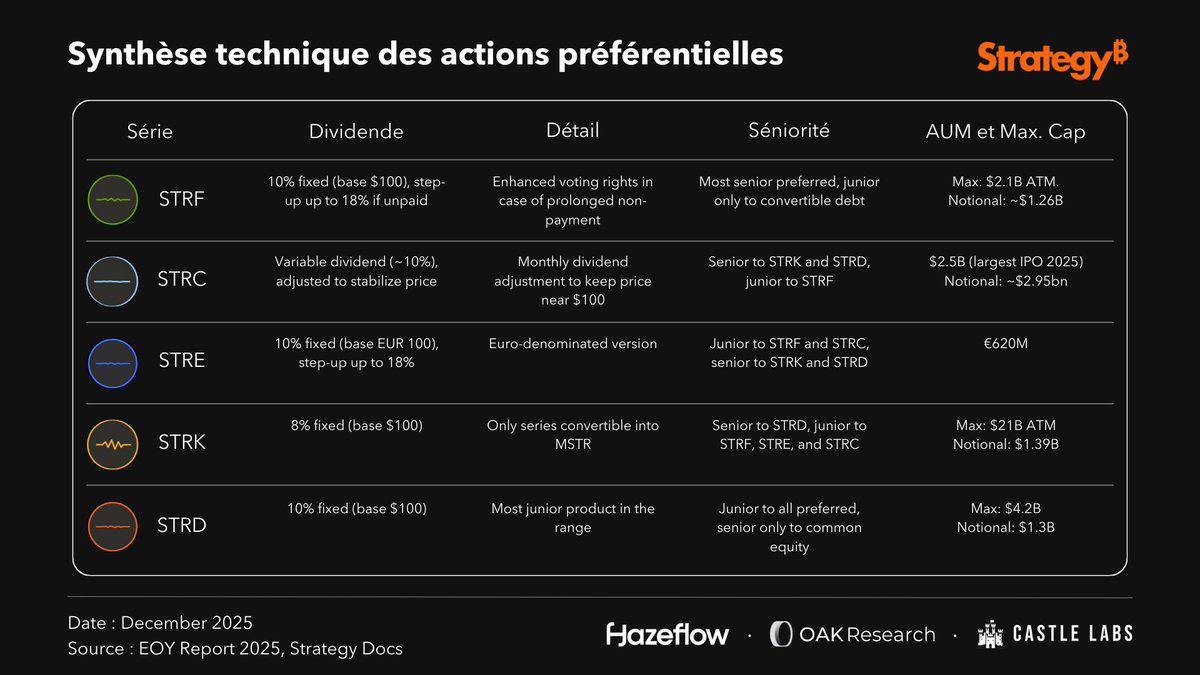
The EOY 2025 summary (attributed to OAK Research and Strategy documentation) shows five series—STRF, STRC, STRE, STRK, STRD—each with distinct dividend mechanics and seniority. Reading them functionally (not as ticker trivia) reveals what Strategy is trying to become: a Bitcoin-heavy balance sheet that can be “sliced” into multiple investable profiles.
• STRF (Senior income): Fixed dividend (noted as 10% with step-up provisions if unpaid), positioned as the most senior preferred, with enhanced voting rights in prolonged non-payment scenarios. It is the closest thing in the stack to “income-first” capital.
• STRC (Stability-seeking income): Variable dividend (around ~10%) with a stated goal of adjusting monthly to keep the market price near a reference level (e.g., $100). Functionally, it aims to behave like a yield instrument with reduced price drift.
• STRE (EUR tranche): A euro-denominated version (base EUR 100), with a similar fixed-dividend/step-up concept. This is a nod to non-USD liabilities and global demand that prefers currency alignment.
• STRK (Convertible convexity): Lower fixed dividend (noted as 8%) and structured as the only series convertible into the common equity. This appeals to investors who want income plus an embedded path to upside if Strategy’s equity rerates.
• STRD (Junior yield): Higher stated dividend (noted as 10%) but explicitly the most junior product in the preferred range—meaning it is likely to be more sensitive in stress, even if it looks attractive in calm markets.
Across series, the message is consistent: Strategy is building a capital stack with multiple levers—seniority, currency, convertibility, and payout mechanics—so it can tap different pockets of institutional demand without relying on a single fragile funding channel.
Calling it a “Bitcoin bank” is useful—if you define the metaphor
Strategy is not a bank in the legal sense. There are no insured deposits and no traditional loan book generating interest income. But the “Bitcoin bank” metaphor is still directionally useful because it points to a real transformation function: Strategy is turning one underlying exposure into several cash-flow shapes that resemble familiar TradFi instruments.
A traditional bank transforms short-term deposits into long-term loans. Strategy, instead, transforms long-duration Bitcoin exposure into a spectrum of securities that different investors can hold: senior income, near-par stability, euro denomination, convertible upside, and junior yield. It is a balance-sheet refinery, with Bitcoin as the “reserve asset” and public capital markets as the distribution channel for products built on top of that reserve.
Where the dividend “yield” really comes from
This is the part that separates financial understanding from hype: Bitcoin does not pay coupons. When you see an 8–10% dividend attached to a Bitcoin-adjacent security, the payout does not originate from Bitcoin itself. It originates from the issuer’s broader financial capacity—operating cash flows, cash reserves, and (often) ongoing market access.
That is not automatically negative; it is simply the reality of corporate finance. The preferred dividend is a cost of capital, not “BTC yield.” Investors are effectively betting that Strategy can manage its balance sheet—through cycles—to keep the dividend credible. In benign regimes, that credibility can be reinforced by a rising equity valuation, tight credit spreads, and strong demand for the preferred series. In risk-off regimes, the key question becomes how resilient the payout policy remains when the market’s willingness to fund new issuance fades.
Why institutions might buy these securities
Institutional participation in “crypto” is often discussed as if it’s only about spot ETFs or custody. In reality, mandates and operational constraints matter. Some allocators cannot hold spot BTC, cannot custody directly, or cannot hold highly volatile common equities—but they can hold preferred shares, quasi-fixed-income instruments, or securities with clearer legal and accounting treatment.
Preferred shares can fit neatly into yield mandates and liability-matching strategies. A fixed or managed dividend can be easier to underwrite than pure equity beta, and the seniority in the capital stack provides a different risk profile than common stock. For some buyers, this is less about worshipping Bitcoin and more about acquiring a new type of credit-like exposure that happens to be anchored to a Bitcoin-heavy balance sheet—an exposure that can diversify a portfolio without forcing a rewrite of internal policies.
The market-structure angle: tightening float without a maturity-driven exit
One underappreciated feature of perpetual funding is behavioral: it reduces the likelihood of forced selling tied to repayment schedules. In older corporate treasury experiments, the risk was not only “BTC down”; it was “BTC down when debt is due.” Perpetual preferreds don’t eliminate stress, but they can soften the calendar pressure that creates sharp, mechanical liquidation events.
If large buyers can hold Bitcoin indirectly through long-lived corporate structures, the tradable float can become stickier. That doesn’t guarantee a permanent bull market, but it can change the texture of drawdowns. Fewer maturity walls mean fewer “must-sell” events. The market can still fall—sometimes violently—but the probability of a corporate unwind being triggered by a specific date may decline, which matters for long-term volatility distribution.
The trade-off: risk moves around, it doesn’t disappear
Removing maturity risk does not remove risk. It relocates it. The focal point shifts from “Can they refinance on time?” to “Can they sustain dividends and market confidence?” Dividend provisions like step-ups or voting-right enhancements matter because they define what happens under stress: the contract anticipates the possibility of missed payments.
Complexity is another trade-off. Multiple series with different seniority can create strategic tension during downturns. Management decisions about liquidity, dividend policy, and capital raises will have second-order effects on how each series prices risk. In calm markets, a multi-series stack is a feature: it broadens the investor base. In turbulent markets, it can become a bug: pricing becomes more sensitive to governance uncertainty and the market’s perception of “who gets paid first.”
A simple lens for 2026: Strategy is building a Bitcoin-linked yield curve
Here’s a clean way to think about what’s happening: Strategy is attempting to build a Bitcoin-linked yield curve in public markets. Different series behave like different points on that curve—some more senior and “bond-like,” some more equity-adjacent with conversion optionality, some designed to hug a par price through adjustable payouts. Investors choose where they want to sit on the curve depending on their appetite for risk and their need for cash-flow certainty.
If this approach proves durable, it could become a template for other corporate treasuries. Not every firm can replicate it—Strategy’s brand, market access, and scale are unique—but the concept is portable: use perpetual capital to hold a reserve asset indefinitely, then issue tranches that satisfy different institutional requirements. That would be a meaningful step toward Bitcoin’s broader “financialization,” not just via ETFs but via the machinery of corporate capital markets.
Conclusion
Strategy’s shift from dated debt toward multiple series of perpetual preferred shares is not a footnote—it is a statement about survivability. The company is trying to hold Bitcoin “forever” while funding that stance with capital that behaves closer to “forever,” and then offering institutions several ways to participate through familiar instruments.
That’s why the “debtor to Bitcoin bank” framing resonates. The firm is not becoming a bank in the regulatory sense, but it is becoming a balance-sheet manufacturer of cash-flow profiles, attempting to convert Bitcoin volatility into a menu of investable securities. Whether it succeeds will depend less on slogans and more on disciplined liquidity management, transparent disclosure, and the ability to keep investor trust intact across cycles.
Frequently Asked Questions
What is a perpetual preferred share in plain English?
It is a class of stock that typically pays a dividend and ranks ahead of common equity for payouts, but it does not have a fixed maturity date that forces the issuer to repay principal on a schedule.
Are preferred dividends guaranteed like bond coupons?
No. Depending on the terms, dividends may be suspended or deferred. Investors should read the offering documents to understand what happens if dividends are missed (for example, whether rates step up or voting rights change).
Is Strategy paying “Bitcoin yield”?
Not directly. Bitcoin itself does not generate coupon-like income. The dividend comes from the company’s broader financial capacity and balance-sheet management, not from an inherent yield on BTC.
Why issue multiple series instead of one?
Different investors want different trade-offs—seniority vs. upside, fixed vs. variable payouts, USD vs. EUR denomination, and convertibility. Multiple series let Strategy reach a wider set of mandates without forcing everyone into the same risk profile.
Does this reduce Bitcoin’s volatility?
It can reduce one specific forced-selling channel tied to debt maturities, but it does not eliminate volatility. It may also introduce new pricing channels through equity sentiment, dividend expectations, and market-access risk.
This article is for educational purposes only and does not constitute financial, legal, or investment advice.