A 30x Taker Buy/Sell Spike on Bybit Doesn’t Just Mean ‘Bullish’—It Reveals Who’s Being Forced to Pay Up
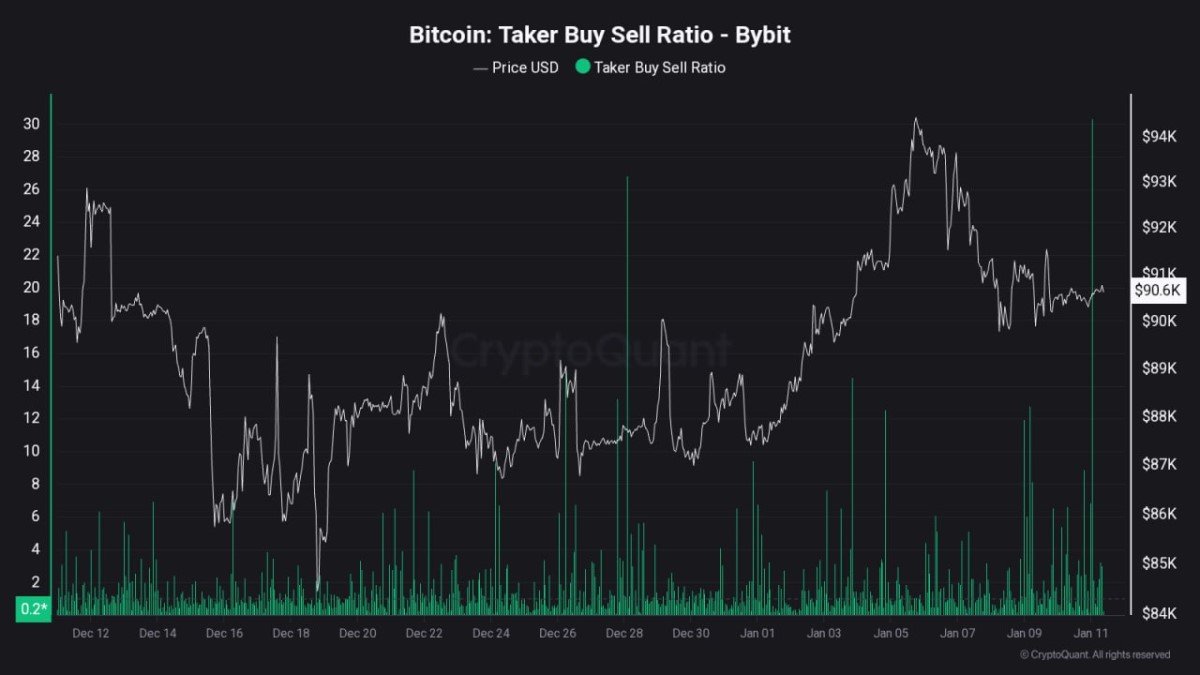
Bybit’s Bitcoin taker buy/sell ratio reportedly surged to ~30.33, a level that—on its face—looks like pure, overwhelming buy pressure. In the language of market microstructure, it means one thing very clearly: aggressive buyers were repeatedly crossing the spread to get filled, while aggressive sellers were comparatively scarce.
But here’s the part most “headline” takes miss: a taker-buy stampede is not a synonym for sustainable demand. It is a snapshot of how price was discovered in that moment—through urgency, not patience. And urgency can come from confidence… or from forced exits.
What the taker buy/sell ratio actually measures
Before interpreting a number like 30, we need to define the object we’re staring at. “Taker” flow refers to orders that remove liquidity—market orders (or aggressive limit orders) that hit resting bids/asks. When taker buys dominate, it means traders are choosing speed over price improvement, lifting offers rather than waiting to be filled.
That’s why this metric is emotionally compelling: it feels like a live vote of confidence. Yet it’s also why it’s dangerous to oversimplify. In derivative markets, “taker buy” can represent at least three different intentions, and two of them can be structurally fragile.
Think of the taker buy/sell ratio as a thermometer. It tells you the market’s temperature (urgency), not the diagnosis (why the fever exists). The diagnosis requires context.
Why a reading near 30 is extreme—and why extremes are double-edged
A ratio in the high single digits is already a loud message: aggressive buying is dominating executions. A print around 30 is closer to a “liquidity event” than a normal day. It suggests either (a) a wave of market buys, (b) a shortage of sell liquidity at the touch, or (c) both at once.
In a well-balanced market, liquidity providers (makers) usually absorb urgency and keep spreads and slippage contained. When you see a spike like this, it often implies the opposite: the market is temporarily one-sided. That one-sidedness can fuel a sharp move—yet it can also set up a reversal if the move was powered by forced flow that finishes quickly.
So the right question isn’t “Is this bullish?” It’s: Who is buying, and what happens when they stop?
The three hidden stories behind “aggressive buying”
Here is a practical framework that usually explains most extreme taker-buy spikes. Each story has a different implication for what comes next.
Story 1: New longs entering (risk-on initiation)
These are traders opening fresh leveraged longs or adding exposure because they believe price is breaking out. This can be constructive—if it is accompanied by improving liquidity conditions and broad participation, not just a single venue’s burst.
Story 2: Shorts getting forced out (short covering / liquidation)
In derivatives, a trader closing a short position typically buys back contracts—often via market orders when stress rises. That shows up as taker buying. In other words: some of the “buy pressure” may be the market paying a tax for being offsides.
Story 3: Hedged flow (basis, arbitrage, or options hedging)
Large players can route hedging through perps while buying or selling elsewhere (OTC, spot, or via structured products). This can generate intense taker flow without the same “directional conviction” retail assumes. It’s still real flow, but it’s not always a vote on future price—it can be a vote on execution efficiency.
All three stories can produce the same headline metric. Only one of them reliably supports multi-day continuation by itself.
How to tell which story you’re in—without guessing
You don’t need insider data to separate these scenarios. You need a small checklist that focuses on market plumbing: what did price do, what did positioning do, and how did the market pay for liquidity?
1) Price response: did BTC actually move, or just churn?
If the ratio spikes but price barely lifts, it can imply heavy sell absorption (someone is happily supplying into the urgency). That can be healthy (redistribution to stronger hands) or risky (a ceiling forming). What matters is follow-through: does price hold gains after urgency fades?
2) Open interest behavior: did leverage build or unwind?
This is the cleanest filter in derivatives markets:
• Price up + Open interest up often suggests new longs initiating.
• Price up + Open interest down often suggests short covering/liquidations (positions are being closed).
• Price flat + Open interest up can imply crowding—fresh leverage without immediate payoff.
3) Funding and basis: did the market start charging for longs?
A sustained, rising funding rate can confirm that long demand is persisting beyond the initial burst. But it’s also a warning label: when the market begins to charge a premium to stay long, continuation requires even more buying to keep the structure stable.
4) Cross-venue confirmation: is this a Bybit-only heartbeat?
Exchange-specific ratios can spike due to local liquidity conditions, market-maker inventory limits, or venue-specific positioning. If other major venues show muted flow, treat the signal as “important, but local.” If multiple venues echo it, it’s more likely to reflect a broader regime shift.
Put simply: the ratio is the spark. The structure (OI, funding, and follow-through) tells you whether the spark found dry wood.
What a 30x spike implies about liquidity right now
Even without additional metrics, a reading like 30 suggests something important about liquidity: at least temporarily, price discovery migrated to the takers. That happens when makers step back, widen spreads, or reduce size at the touch—often because uncertainty rises or inventories become unbalanced.
This matters because liquidity regimes change how “safe” leverage is. In tight-liquidity regimes, small shocks can cause outsized moves, and liquidation cascades can appear suddenly. In better-liquidity regimes, the same positioning can be absorbed with less drama. A violent taker imbalance is often a sign you’re not in the second regime—at least not yet.
If the market is transitioning back into a healthier regime, you typically see taker intensity cool down while price remains supported—meaning buyers no longer need to pay up aggressively to keep the market bid.
A more nuanced takeaway: aggressive buying is a strong signal—but not a full narrative
It is tempting to treat an extreme taker buy/sell ratio as a simple green light. But mature market analysis is less about cheering for the number and more about asking: What type of demand is this?
New long initiation can support a trend. Forced short covering can create spectacular bursts that fade once the pain trade completes. Hedged flow can look bullish on a chart while being neutral in intent. The ratio doesn’t tell you which one occurred; it tells you the market was forced to clear at higher urgency than usual.
In other words, the most honest interpretation of the 30.33 print is: someone needed exposure now. The next chapter depends on whether that “need” repeats tomorrow when conditions are calmer.
Conclusion
Bybit’s Bitcoin taker buy/sell ratio near 30 is a rare kind of signal: it’s loud, mechanical, and difficult to ignore. It tells us that aggressive buyers—whether eager longs, squeezed shorts, or hedgers—were the dominant force at the moment of execution.
But the market doesn’t reward loudness; it rewards durability. The durable version of this story is not “buyers controlled the tape for a moment,” but “buyers continued to support price after urgency cooled.” If that happens, the spike becomes evidence of a regime shift. If it doesn’t, it becomes evidence of a one-off liquidity event—exciting, but not self-sustaining.
Frequently Asked Questions
Is a high taker buy/sell ratio always bullish?
Not always. It indicates aggressive buying at execution, but that buying can be new longs, short covering, or hedging. Only the first case is consistently bullish over multiple sessions by itself.
Why can short covering look like strong buying?
Closing a short requires buying back contracts—often quickly when price rises. Those buy-to-close orders can be market buys, which inflate the taker-buy side even though the intent is to exit risk rather than add new risk.
Can this be exchange-specific noise?
Yes. Liquidity depth, market-maker behavior, and positioning differ across venues. A Bybit spike is meaningful, but it’s best interpreted alongside broader market measures rather than in isolation.
What confirms the signal is durable?
Typically: price holding gains after the spike, healthy liquidity returning (less need to cross the spread), and positioning metrics (like open interest and funding) aligning with sustained demand rather than a one-time squeeze.
Disclaimer: This article is for educational and informational purposes only and does not constitute financial, legal, or investment advice. Crypto markets are volatile, and leverage can amplify both gains and losses.