
How the Digital Asset PARITY Act Could Rewrite Everyday Crypto Taxes in the US
The weakest part of the crypto experience for many US users is not the technology. It is the tax form.
Every swap, every on-chain payment, every time a user receives staking rewards or relocates assets between platforms, the question arises: is this a taxable event, and if so, how should it be reported? Current rules were written for a world of occasional stock trades, not millions of low-value transactions happening in seconds across multiple chains.
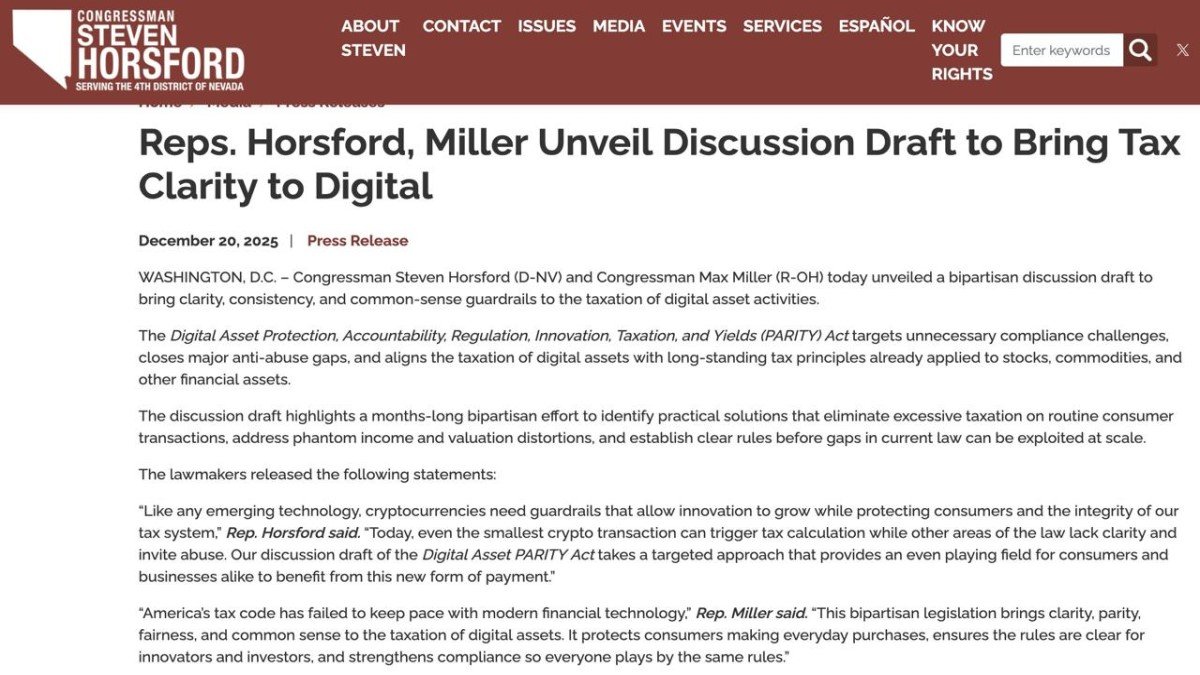
That is the background for a new bipartisan discussion draft unveiled in Washington: the Digital Asset Protection, Accountability, Regulation, Innovation, Taxation, and Yields (PARITY) Act. The goal is ambitious but simple to describe: bring clarity and consistency to how the US tax system treats digital assets, while keeping guardrails strong enough to protect consumers and the integrity of the tax base.
This article walks through the main ideas of the proposal, explains what they mean in practice, and looks at how they might change behaviour for stablecoin users, long-term holders, professional traders and institutional investors. As always, this is an educational overview, not tax advice.
1. Why a New Tax Framework for Digital Assets Is on the Table
Lawmakers from both parties describe a basic problem: the current US tax code was not designed for self-custodial wallets, stablecoins or on-chain rewards. The result is a patchwork of guidance where relatively small digital-asset activities can create surprisingly complex reporting obligations.
Today, a US resident who buys a coffee with a dollar-linked stablecoin is, in theory, meant to track the exact cost basis and any small gain or loss at the moment of payment. Someone who participates in staking or validation may owe tax on newly created tokens the moment they are credited, even if those tokens cannot easily be sold or if the price later falls. Traders can often realise a capital loss and immediately rebuy the same token without triggering the same wash-sale rules that apply to stocks.
These gaps make it harder for regular consumers to use crypto in day-to-day life and harder for institutions to model risk. They also create opportunities for aggressive tax strategies that legislators would prefer to close in a transparent way rather than through retroactive enforcement.
The Digital Asset PARITY Act is an attempt to move from improvisation to a coherent framework. The draft is not final law, but it offers a rare, detailed look at how Congress is thinking about digital-asset taxation over the next decade.
2. A De Minimis Exemption for Everyday Stablecoin Payments
2.1 The problem: every coffee is a potential tax event
One of the clearest features of the draft is a capital-gains exemption for small stablecoin payments. The core idea is straightforward:
- For USD-pegged stablecoins used as payment for goods or services, gains or losses on transactions under 200 USD would not be taxed.
- The exemption focuses on price movement around the peg, not speculative trading. It is meant for regular consumer payments, not large-scale investment activity.
- The provision is designed to apply to transactions after the end of 2025, giving regulators and industry time to adjust.
Right now, even a one-cent fluctuation in the value of a dollar stablecoin can technically create a taxable gain or loss whenever it is spent. In practice, many users do not track this, but the legal uncertainty undermines the case for using stablecoins at the point of sale. Merchants and payment processors worry that their customers will face an administrative burden that simply does not exist with conventional card payments.
2.2 How a 200 USD threshold could change behaviour
The de minimis rule aims to turn stablecoins into a more practical payment rail:
- Retail users would be able to pay small invoices, online subscriptions or remittances with a dollar-linked token without stocking a spreadsheet of micro-gains and losses.
- Merchants could accept stablecoin payments with less concern that their customers are stepping into a complex tax situation.
- Stablecoin issuers and fintechs could design consumer-facing wallets that treat certain transactions as functionally equivalent to card payments or bank transfers.
Importantly, the exemption does not turn stablecoins into a tax shelter. It is limited in size, tied to a narrow use case, and does not change how large transfers, speculative activity or capital gains from other tokens are treated. Instead, it recognises that the administrative cost of taxing tiny basis-point moves on small stablecoin payments outweighs the revenue benefit.
3. A Five-Year Deferral Window for Staking and Mining Rewards
3.1 The timing problem for on-chain rewards
Another major piece of the PARITY draft deals with rewards from staking and validation. Under current interpretations, newly received tokens can be taxed as income at the moment they are credited, even if they are illiquid or drop in value before the holder has a chance to sell. This creates a mismatch between taxable income on paper and cash flow in reality.
The proposal introduces a deferral period of up to five years for certain types of digital-asset rewards. In broad terms:
- Eligible rewards from staking or similar network activities would not be taxed immediately upon receipt.
- Instead, tax would be due later, either when the assets are disposed of or when the deferral window closes, and they would be treated as ordinary income at that point.
The logic is simple: if a user is helping to secure a network or validate transactions, but has not yet converted any of the resulting tokens into purchasing power, it may be fairer to tax them when that value is actually realised.
3.2 Why deferral matters for builders and long-term participants
A multi-year deferral could have several effects:
- Lower entry barriers for individuals who want to participate in network security without hiring a specialist accountant.
- Greater clarity for venture funds and institutional validators, who can model the timing of taxable events instead of facing uncertainty about whether every new token is immediately subject to tax.
- A better fit with long-term holding strategies, since many participants plan to keep a portion of their rewards locked up for extended periods rather than trading constantly.
Of course, deferral is not a tax holiday. If the market rises sharply during the deferral window, the taxable amount when the assets are finally recognised could be significant. The key shift is the ability to synchronise tax obligations with liquidity events instead of with the raw mechanics of block production.
4. Extending Wash-Sale Rules and Offering Mark-to-Market Elections
4.1 Bringing parity with traditional securities
The PARITY draft also addresses another long-running asymmetry: under current law, an investor can sell a token at a loss, claim that loss for tax purposes and immediately repurchase the same token, because existing wash-sale rules generally apply to stocks and similar instruments rather than to digital assets.
The new proposal would extend those rules to crypto positions. If enacted, this would mean:
- Investors who sell a token at a loss and repurchase it within a specified window would no longer be able to claim the loss immediately.
- Losses would instead be deferred and incorporated into the cost basis of the new position, just as they are with many traditional securities.
From a policy perspective, this closes a gap between how two economically similar activities are treated. From an investor perspective, it reduces the scope for aggressive loss-harvesting strategies that rely purely on quick round-trip transactions.
4.2 A professional path: mark-to-market accounting
At the same time, the draft recognises that full-time traders operate differently from long-term investors. For those who qualify as professional traders, the act would allow an election to use mark-to-market accounting for digital assets, similar to existing options in other markets.
Under a mark-to-market regime:
- Positions are treated as if they are sold and repurchased at fair market value at the end of each tax year.
- Gains and losses are recognised annually, simplifying tracking but potentially creating more volatility in taxable income.
This approach can make sense for trading firms that already maintain detailed records and prefer a clean, year-by-year income picture. It is less suitable for casual investors, which is why the proposal frames it as an elective treatment for those who actively choose it rather than a default for everyone.
5. Clarifying the Tax Status of Lending and Passive Staking
Another source of confusion in digital-asset taxation has been the treatment of lending and passive protocol-level staking. When assets are lent out or delegated, is that a taxable event? Are funds that stake tokens at the protocol level engaged in a business, or are they simply managing investments?
The PARITY draft takes several steps in this area:
- Certain forms of crypto lending would be treated as non-taxable at the moment of the loan, reflecting the idea that the lender still retains economic exposure to the asset.
- Passive staking at the protocol level by investment funds would be clarified as not constituting a separate operating business in itself, reducing concern that routine participation in network security might trigger a different tax profile.
This kind of clarification matters especially for institutional investors and funds governed by complex rules. If staking were viewed as operating a business, it could change how income is reported or how certain investors are allowed to participate. Explicit recognition that protocol-level participation can remain within an investment framework provides more comfort to allocators who want to support networks without taking on unintended regulatory exposure.
6. What This Means for Different Parts of the Ecosystem
6.1 Everyday users and merchants
For regular users, the most tangible change would be the small-transaction exemption for dollar stablecoins. Combined with faster settlement and lower fees, this would make spending stablecoins feel less like a niche experiment and more like a serious alternative to card networks for certain use cases.
Merchants, particularly online service providers, could see stablecoins as a viable way to receive payments from global customers without asking them to manage a complex tax log. The reduction in paperwork may matter as much as the reduction in fees.
6.2 Long-term holders and network participants
For long-term holders of Bitcoin, Ether and other major assets, the proposal is less about changing overall tax levels and more about stabilising the timing of obligations. Deferral of staking or validation rewards gives them room to participate in securing networks without worrying that a volatile token price will create a tax bill that is out of sync with actual liquidity.
These changes also send an important signal: participating in network security is a legitimate economic activity that policymakers want to encourage in a responsible way. When law recognises this explicitly, it becomes easier for regulated entities to explain their strategies to boards, auditors and clients.
6.3 Trading firms and liquidity providers
Professional traders may focus on the combination of extended wash-sale rules and the mark-to-market election. The former reduces scope for purely tax-driven round trips, while the latter offers a cleaner way to recognise income for firms that are already trading at high frequency.
In a sense, this mirrors the broader theme of the PARITY Act: align digital-asset treatment with existing principles from traditional markets, rather than inventing entirely new concepts. Where there are differences, they are largely driven by the technical features of crypto (for example, the need to handle self-custodied staking rewards) rather than by a desire to single the sector out.
6.4 Policymakers and revenue authorities
For tax authorities, there is a trade-off. Small stablecoin payments under 200 USD would no longer generate reportable gains or losses, but they would also no longer clog the system with tiny and difficult-to-audit entries. In exchange, the government gets clearer rules for larger and more material transactions, as well as new tools to ensure that sophisticated actors are treated consistently with their peers in other markets.
The bigger picture is about bringing digital assets fully into the mainstream tax framework, reducing the temptation for either over-enforcement or complete neglect. A clear rulebook is easier to follow and easier to supervise.
7. Strategic Implications for US Competitiveness
The Digital Asset PARITY Act does not exist in a vacuum. It follows efforts like the GENIUS Act for stablecoins and broader discussions about market-structure bills that would define the boundary between commodity-style digital assets and those that look more like securities.
Taken together, these initiatives suggest a shift in tone: from seeing crypto as an outlier that must be constantly contained, to seeing it as one more layer of financial technology that deserves clear, predictable rules. For entrepreneurs, investors and developers deciding where to base their operations, that tone matters.
If the US can pair strong consumer protections with pragmatic tax rules, it stands a better chance of remaining a hub for tokenisation, stablecoin issuance and on-chain capital markets. If the rules remain ambiguous or excessively burdensome, activity may continue to drift to other jurisdictions that move faster.
8. Open Questions and Next Steps
It is important to emphasise that the PARITY Act is currently a discussion draft. Many details could change as it moves through committees, hearings and negotiations, and there is no guarantee that every provision will survive intact.
Key open questions include:
- How exactly the 200 USD threshold for stablecoin payments will be implemented and documented in practice.
- Which specific forms of staking and validation will qualify for the five-year deferral and how mixed-use scenarios will be handled.
- The precise criteria for professional traders to elect mark-to-market treatment and how that interacts with existing rules in other markets.
- How the new rules will coordinate with state-level regulations, international treaties and existing guidance from agencies such as the IRS and the Treasury Department.
Even so, the direction of travel is clear. Legislators are no longer debating whether digital assets deserve a place in the tax code; they are debating how to integrate them in a way that is fair, administrable and supportive of responsible innovation.
9. What Individuals Can Do Now
For now, existing tax rules still apply. But individual users and builders can start preparing by:
- Reviewing how they currently track cost basis, gains and losses, especially for stablecoins and staking rewards.
- Following updates on the legislative process so they understand when any new rules would take effect.
- Thinking about how a de minimis threshold or a deferral window could change their usage patterns if and when such provisions become law.
Most importantly, participants should remember that clarity is itself a form of progress. Whether tax treatment is more favourable or less favourable than hoped, knowing the rules in advance makes it easier to plan, to innovate and to allocate capital rationally.
Disclaimer: This article is for educational and informational purposes only and does not constitute tax, legal or investment advice. Digital assets are volatile and involve risk. Always consult a qualified tax professional or financial adviser before making decisions that could affect your obligations or financial position.