2026 and the Extinction Era of Worthless Tokens: What 2025 Airdrops Taught the Market
Every cycle has a moment when the crowd realizes the party rules have changed. In 2025, that moment arrived quietly—not as a single crash, but as a slow, repetitive pattern: token after token launched, liquidity spiked, social feeds lit up… and price bled out for weeks and months afterward.
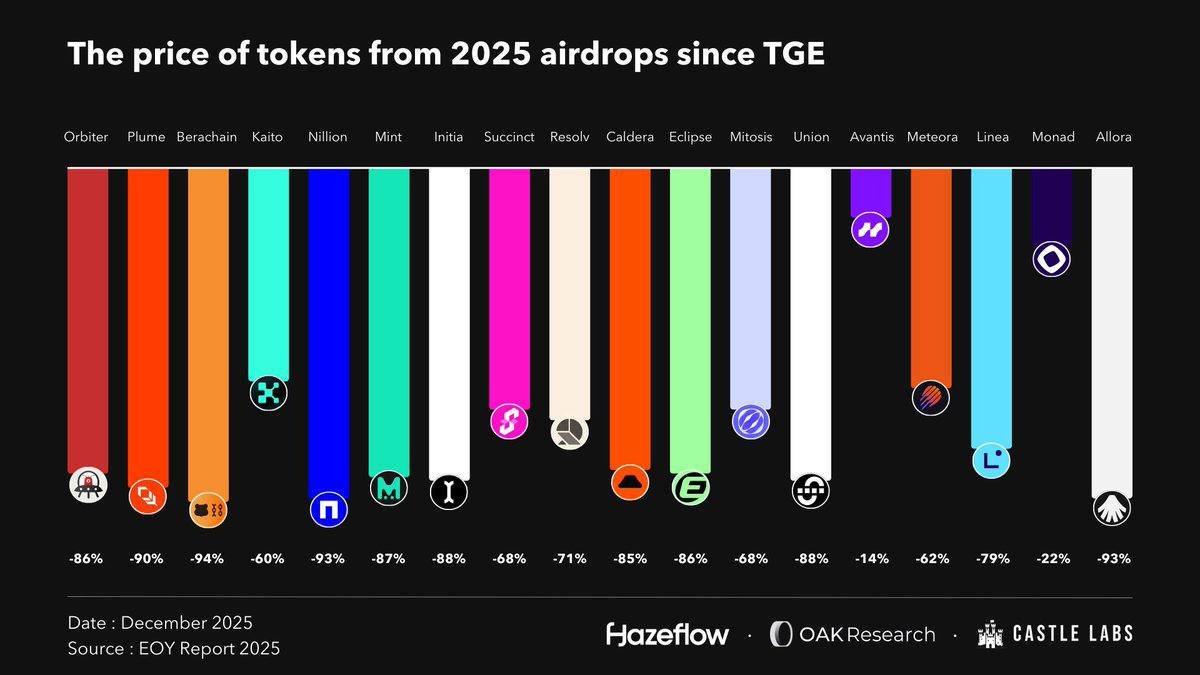
The chart circulating in late December (from an end-of-year compilation) is brutal in its simplicity: many of the headline airdrop tokens from 2025 sit deep underwater since TGE, with declines that cluster around “down a lot” rather than “down a little.” When a market starts repeating the same verdict across dozens of launches, it’s no longer noise. It’s a filter.
The 2025 airdrop scoreboard is not just about price—it’s about credibility
It’s tempting to frame the post-TGE drawdowns as a normal “crypto is volatile” story. But the distribution of outcomes matters. The visual is not a bell curve with a few losers and a few winners—it’s a gravity well, pulling most of the cohort downward.
Across the highlighted set, several tokens appear to be down roughly 60% to 90%+ from TGE levels, while only a small minority show relatively shallow drawdowns (for example, a token near -14% and another around -22%). Even without perfect precision, the pattern is the message: the market didn’t misprice one project—it repriced a model.

And that model is what people casually called the “meta airdrop”: farm points, inflate activity metrics, distribute tokens widely, and hope narrative + listings convert attention into a durable valuation. In 2025, the market ran the experiment repeatedly—and the results increasingly looked like the same failed lab report.
Why the “Meta Airdrop” broke: three structural forces most people ignored
The simplest explanation is “airdrops create sell pressure.” That’s true, but it’s also incomplete. Sell pressure has always existed. What changed is how prepared participants became to sell, how quickly they could hedge, and how little fundamental value the token captured once the initial excitement faded.
Think of 2025 as the year the market industrialized extraction. Farming became systematic, hedging became accessible, and token value capture often remained aspirational. Put those together and you don’t get a one-off dump—you get a repeatable unwind.
1) “Users” weren’t users—they were temporary employees of the points economy.
A large share of airdrop participation behaved less like product adoption and more like a short-term job: do tasks, maintain eligibility, optimize wallets, collect tokens, exit. TVL and volume can be “real” on-chain and still be economically synthetic if the only reason they exist is an incentive schedule. When the incentive ends, the activity doesn’t just decline—it evaporates.
2) Pre-market hedging turned TGEs into scheduled volatility events.
Once perps markets, OTC deals, and liquid hedging pathways exist, the TGE becomes less like “price discovery” and more like “inventory release.” Many recipients arrive at listing day with a plan: hedge first, decide later. That doesn’t mean they hate the project; it means they are rational under uncertainty. The market used to reward blind conviction. In 2025, it rewarded risk management.
3) Tokens often launched as “governance theater” with weak cashflow logic.
A token that doesn’t clearly claim value is not a financial asset; it’s a sentiment instrument. When rates are high, liquidity is selective, and attention is exhausted, sentiment instruments decay quickly. If the token doesn’t plausibly connect to fees, margins, buy-and-burn, profit share, or indispensable utility, the market treats it like a marketing expense—because functionally, that’s what it is.
The uncomfortable truth: TGE used to be good news—now it’s a risk disclosure
For years, crypto trained people to treat a token launch as the “moment of arrival.” It was the banner event: exchange listings, new charts, community victory laps. But markets don’t stay sentimental. They evolve into systems that punish predictable behavior.
By late 2025, many traders and allocators started reacting to TGEs the way credit analysts react to new debt issuance: not “congratulations,” but “what are the terms, what’s the maturity wall, and who is forced to sell?” That is a profoundly different posture. It signals that the market is no longer playing the same game as the project’s launch narrative.
In an extinction era, the token isn’t the prize at the end of building—it’s a liability you must justify. Launching a token becomes similar to taking a company public: you inherit a permanent responsibility to the market. If you can’t sustain the story with fundamentals, the chart becomes your reality check.
What survives in 2026: protocols that treat tokens like equity, not confetti
“Only protocols with real revenue survive” is a catchy line, but it can be misleading if it’s interpreted lazily. Plenty of protocols generate fees that don’t accrue to token holders. And plenty of “revenue” is cyclical, dependent on short-term leverage or mercenary liquidity.
The real survival trait is credible value capture with defensible demand. In other words: can the protocol earn money without bribing the user, and can token holders plausibly benefit in a way that’s aligned with long-term health rather than short-term extraction?
Here are the characteristics that tend to separate survivors from “airdrop fossils”:
• Revenue quality, not just revenue quantity. Fees generated from recurring usage (payments, settlement, risk management, infrastructure) tend to be sturdier than fees dependent on mania-driven leverage.
• A token sink that is economic, not ceremonial. Staking that exists purely to reduce circulating supply is not a business model. Token sinks work when they are attached to real utility (security, access, collateral, governance that matters) or when they share economics in a way that does not cannibalize the protocol.
• Supply discipline that respects the market’s memory. If unlocks are front-loaded, opaque, or misaligned with growth, investors stop viewing them as “emissions” and start viewing them as “scheduled selling.” 2025 taught the market to pay attention to calendars.
• Governance that actually governs. Token holders increasingly discount governance promises when major decisions are effectively centralized or when DAOs function as a rubber stamp. Governance must translate into control over parameters that matter (fees, risk limits, treasury deployment), or it becomes a vibe.
A practical framework: five questions to ask before you treat a token as “valuable”
This is not a checklist for speculation. It’s a way to avoid confusing attention with value—especially in a post-airdrop world where the market has become far less forgiving.
1) Who is the natural buyer?
If the only reliable buyer is “the next person on social media,” the token is fragile. Natural buyers are users who need the asset for something structural: settlement, collateral, access, security, or governance over economics.
2) What is the token’s claim on outcomes?
Not “roadmap,” not “vision,” but outcomes. Does the token’s role improve as the protocol succeeds, or does success happen in parallel while the token remains decorative?
3) Can the protocol grow without subsidizing behavior?
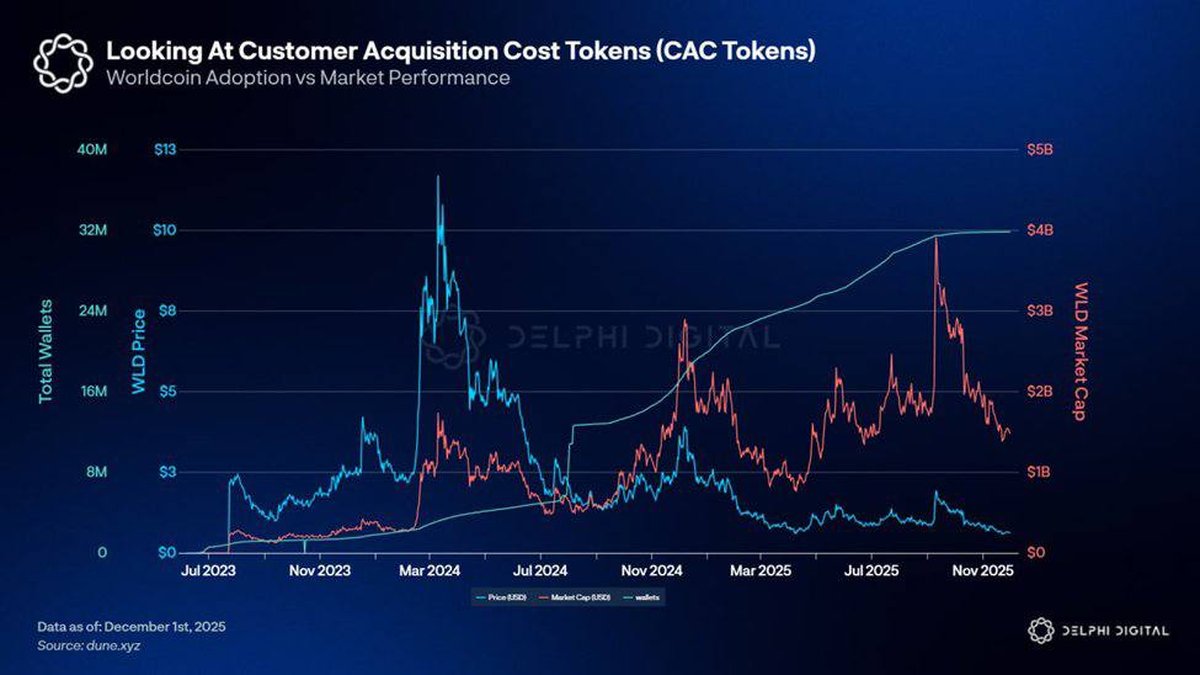
In 2025, subsidies often created impressive graphs—and disappointing realities. If growth collapses when incentives end, that’s not adoption; that’s a temporary contract.
4) Where is the supply overhang?
Look at cliffs, unlock cadence, team/investor allocation, and whether there are structured reasons holders might sell (taxes, treasury needs, hedges). Markets increasingly price these mechanics early.
5) Is the token a tool—or a trophy?
Trophies are awarded once and then sit on a shelf. Tools get used repeatedly. In 2026, the market is paying more for tools.
The paradox of 2026: the best crypto products may ship without a token
One of the most interesting second-order effects of the 2025 airdrop hangover is that tokens may become less common among serious teams. If launching a token invites regulatory complexity, community expectations, and permanent market scrutiny, some builders will decide it’s not worth it.
That doesn’t mean tokens disappear. It means the bar rises. Tokens are no longer the default growth hack; they are a financing and governance choice with consequences. In a mature market, not every successful network needs its own monetary asset—and pretending otherwise is how you end up with “value-less tokens” competing for the same exhausted attention.
Conclusion
2025 delivered a sharp warning: the market is tired of tokens that exist primarily to monetize narrative. When most headline airdrops trend heavily negative post-TGE, it’s not just a bad season—it’s the market installing a new quality control system.
2026 looks like an extinction era not because crypto is “dead,” but because the easiest business model—launch a token and call it progress—stopped working. What survives is not the loudest story, but the clearest economics: real demand, real revenue quality, and a token design that behaves more like ownership in a productive system than a receipt from a marketing campaign.
Frequently Asked Questions
Does poor post-TGE performance mean a project has no future?
Not necessarily. Prices can overshoot both directions. But persistent underperformance often indicates a mismatch between token design and durable demand, or an oversupply problem the market can’t ignore.
Why did airdrops become less effective as a growth strategy?
Because participation became professionalized. Many users optimized for extraction (farm → claim → hedge/sell), which can inflate short-term metrics while harming long-term trust and price stability.
What does “real value” mean in token terms?
It usually means some combination of defensible utility, credible value capture, aligned supply schedules, and a clear set of natural buyers who need the token for structural reasons—not just narrative reasons.
Disclaimer: This article is for educational and informational purposes only and does not constitute financial, investment, or legal advice. Digital assets are volatile and involve risk, including the possible loss of principal. Always do your own research and consider your risk tolerance.