Liquidity, Governance, and Hard Assets: What Today’s Headlines Say About the Next Phase of Crypto
The past 24 hours once nữa delivered a strange mix of signals across crypto and traditional markets. On-chain, a leading perpetuals venue confirmed a large token unstake for team distribution. In DeFi, Uniswap executed one of the biggest protocol burns in its history. Miners and treasuries continued to reposition, with Bitmine staking the equivalent of 1 billion USD in ETH in just two days. Outside crypto, silver pushed to a new all-time high near 80 USD and even surpassed Nvidia by market capitalization, while political and geopolitical headlines added another layer of complexity.
Individually, each story looks like a local event. Taken together, they describe a market entering a more mature, but also more demanding, phase: one where governance decisions have immediate economic consequences, where investors weigh token unlocks against real cash flows, and where crypto sits alongside gold, silver, and macro policy as part of the same capital allocation puzzle.
1. Hyperliquid’s Team Unstake: Supply Overhang or Healthy Transparency?
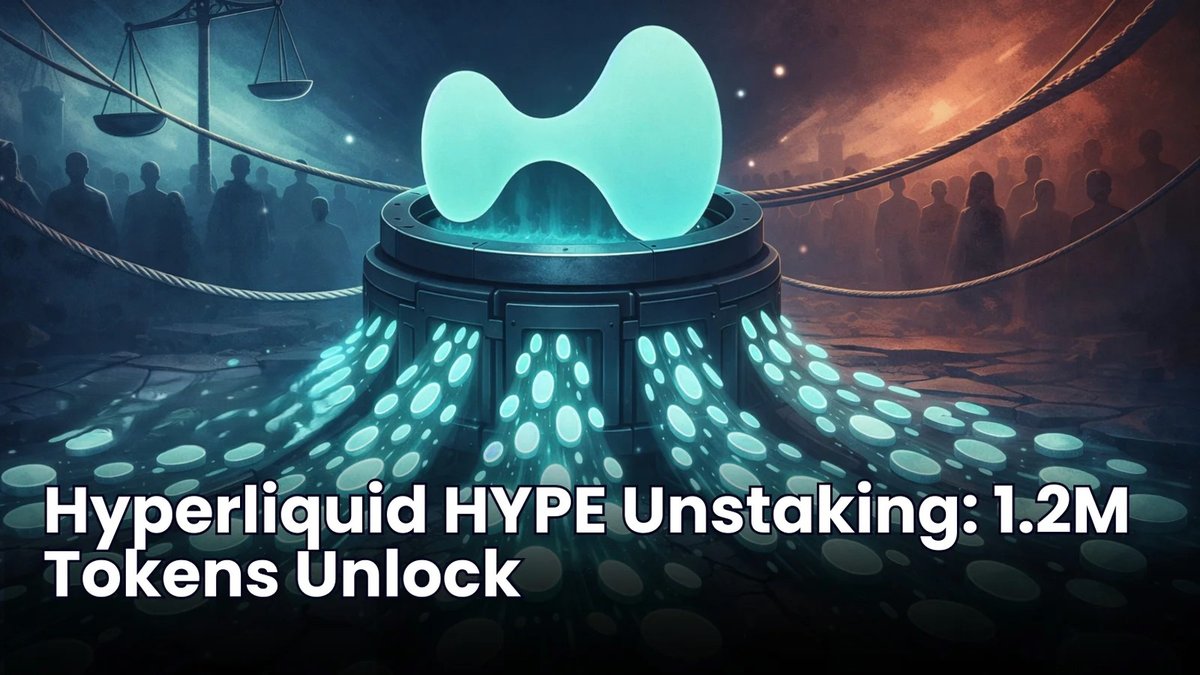
The first big crypto headline is highly specific but conceptually important. Hyperliquid confirmed that 1.2 million native tokens have been unstaked for distribution to the team on 6 January, with subsequent distributions (if any) also planned for the 6th of each month.
From a purely mechanical perspective, unstaking increases flexibility: these tokens can move, be sold, re-staked under new conditions, or used for incentives. For traders, however, the immediate association is often "supply overhang": if a large insider allocation becomes liquid, there is a risk that some portion eventually reaches the market, especially if prices remain attractive relative to early valuations.
There are several analytical angles worth separating:
• Vesting credibility: When a derivatives venue is willing to publish dates and amounts in advance, it is implicitly inviting the market to price in that information. That is usually a healthier situation than opaque cliffs or surprise transfers.
• Alignment vs. short-term pressure: Team distributions are not inherently negative. Participants who work on infrastructure need compensation. The key question is whether the pace and size of distributions match long-term commitments and revenue growth, or whether they front-load risk onto public holders.
• Derivatives loop: On a venue built around perpetual futures, any perceived supply event can feed into positioning. Traders may use perps to hedge or even speculate around unlock dates, reinforcing volatility if funding and open interest become one-sided.
For now, the Hyperliquid update is best viewed as governance and transparency data, not a deterministic price trigger. It reminds investors that token economics for infrastructure projects are still evolving, and that studying unlock schedules, staking rules, and internal allocations is now a core part of fundamental analysis.
2. Uniswap’s UNIfication Burn: Community-First Token Economics in Action
If Hyperliquid’s news is about potential extra supply, Uniswap’s headline is about intentional removal of supply. After the UNIfication proposal received approximately 99.9% approval, the protocol executed a burn of 100 million UNI from the treasury, a stockpile worth roughly 592 million USD at the time of the transaction.
This is not a simple marketing gesture. The burn follows a broader redesign of Uniswap’s incentive structure in which:
- Protocol fees are activated on selected v2 and v3 pools, redirecting a portion of swap fees to the protocol rather than only liquidity providers.
- Interface fees from Uniswap Labs are set to zero, shifting perceived value away from the company layer and toward the protocol.
- Sequencer fees from Unichain, after costs, are earmarked for the same burn mechanism, tying activity on expansion networks to UNI’s long-term supply curve.
The message to the market is clear: Uniswap wants UNI to reflect the economic performance of the protocol more directly. That does not mean it behaves like a stock or pays dividends, but it does mean token holders can track a concrete link between volumes, fee flows, and the rate at which supply is retired over time.
At a higher level, this is a governance milestone. For years, UNI was criticized as a "pure governance token" with limited economic connection to the protocol it governed. The decision to burn such a large amount from the treasury, together with the fee changes, signals that mature DeFi projects are now willing to adjust their tokenomics in response to community expectations and competitive pressure.
3. Security, Trust, and the Cost of Data Breaches
The second major governance-related story comes from centralized infrastructure rather than on-chain protocols. Coinbase disclosed that law enforcement in India has arrested a former customer support employee in connection with a large internal data leak that affected nearly 70,000 users. According to the company’s filings, the total impact of the incident is estimated at 307 million USD, including remediation and customer compensation.
This episode is a textbook example of a broader risk that often gets less attention than smart contract audits: insider and operational risk. Even if cryptography and custody systems are robust, sensitive information such as names, addresses, phone numbers, and identity documents can still be exposed when human factors are compromised.
From an educational perspective, the lesson is twofold:
- For users, security is not only about private keys. Where you store your KYC information and how platforms manage access to staff and contractors are just as important.
- For exchanges and service providers, regulatory compliance increasingly includes not only technical controls but also governance around vendors, offshore teams, and data access.
When a data breach translates into hundreds of millions of dollars in cost and a class-action lawsuit from shareholders, it reinforces why investors are now reading risk disclosures and incident reports as carefully as they read product roadmaps.
4. Bitmine, Ethereum, and the Staking Signal from Institutions
While some headlines deal with risk, others highlight growing conviction. Bitmine, one of the largest institutional holders of ETH, staked 342,560 ETH in just two days, the equivalent of roughly 1 billion USD at current prices. That brings its total staked share to around one tenth of its reported Ethereum position, which already exceeds several million ETH.
This move is important for three reasons:
• Time horizon: Staking is not an irreversible decision, but it does reflect a willingness to lock capital into the protocol’s consensus mechanism for a meaningful period in exchange for yield. It is hard to square this with a near-term exit narrative.
• Signaling to other institutions: When a top holder visibly participates in staking, it normalizes the idea that ETH is not only a trading asset but also a productive asset in institutional portfolios.
• Market psychology: In a market worried about "big sellers", large-scale staking can offer psychological support even if some unstaked or liquid holdings remain available for sale.
Together with other headlines – such as Kazakhstan’s central bank approving a pilot for tokenized gold, QR-based crypto payments, and a national stablecoin called KZTE – the Bitmine decision supports a broader narrative: major entities are not retreating from blockchain; they are integrating it more deeply into their monetary and treasury experiments.
5. Silver at 80 USD and Macro Signals: Hard Assets Back in the Spotlight
Beyond crypto, metals were once again at the center of attention. Silver jumped around 3% on a price gap and pushed to a fresh all-time high near 80 USD per ounce. More symbolically, it has now overtaken Nvidia to become the second largest asset in the world by market capitalization, sitting just behind gold. This follows a multi-week trend of persistent strength in precious metals.
These moves are happening against a backdrop of:
- Persistent concern about currency purchasing power, particularly as investors reassess the long-term trajectory of the US dollar.
- Political messaging around trade and tariffs. President Trump continues to emphasize that tariffs are creating "GREAT WEALTH", reinforcing the idea that trade policy will remain a central variable in the next phase of the cycle.
- Major geopolitical negotiations, including comments that he and President Zelensky have reportedly agreed on roughly 95% of a peace framework, even though the remaining issues may be the hardest to resolve.
For crypto investors, silver’s ascent is not just an interesting macro chart. It illustrates that capital is actively searching for perceived stores of value amid policy uncertainty. Bitcoin at around 90,000 USD now trades in the same conversation as gold and silver, and some investors explicitly frame it as "digital gold", while others see it as a higher-beta complement to the metals complex.
The fact that one of Bitcoin’s most visible advocates, Michael Saylor, is again hinting at additional purchases with quotes like "Back to Orange", only reinforces the perception that large players still view BTC as a core treasury asset rather than a short-lived trend.
6. Retail Platforms, Incentives, and the Battle for User Mindshare
At the other end of the spectrum from central banks and institutional treasuries, retail-focused platforms are also competing aggressively for user attention. Robinhood announced a giveaway of 750,000 USD worth of Bitcoin, adding gamified incentives on top of its existing crypto trading offering.
Promotions like this have two key implications:
- Onboarding and education: While giveaways are marketing tools, they also bring new users into contact with crypto assets. The long-term value of those users depends on whether platforms pair promotions with clear, responsible education about risk, custody, and taxation.
- Competitive pressure on fees and product design: As more retail brokers treat Bitcoin and other assets as standard offerings, pressure mounts on specialized exchanges to differentiate through better tools, deeper liquidity, or safer infrastructure rather than just token listings.
In combination with Visa’s recent survey data about Gen Z using crypto payments and stablecoins for everyday spending, the Robinhood campaign is another reminder that crypto has moved from a niche speculation tool to part of mainstream financial user experience, even if adoption quality remains uneven.
7. Token Unlocks, AAVE Movements, and Flow’s Controversial Rollback
The micro-structure of token supply also features prominently in today’s tape. Two notable unlocks are approaching:
- SUI: an upcoming unlock of 0.55% of supply, worth roughly 78.9 million USD, scheduled for 1 January.
- ENA: an unlock of 0.63% of supply, around 20.1 million USD, planned for 2 January.
Unlocks do not automatically translate into selling, but they change the opportunity set. Early stakeholders gain the option to rebalance or diversify, and sophisticated traders may position around these events in both spot and derivatives markets. The key analytical questions are: who is receiving the unlocked tokens, what is their historical behavior, and how concentrated is ownership?
In parallel, ParaFi moved approximately 30 million USD worth of AAVE to Coinbase. On-chain, movements to centralized exchanges are often interpreted as potential preparation for distribution, but they can also reflect treasury management, over-the-counter settlement, or collateral reallocation. As always, context matters: one transaction cannot fully define a long-term stance, but tracking these flows helps investors understand how large holders navigate liquidity and risk.
Perhaps the most controversial governance story among these micro headlines is the decision by the Flow Foundation to roll the network back to a prior state after a security incident that reportedly led to around 3.9 million USD in losses. Some partners, including deBridge, criticized the rollback for lacking coordination and raising broader systemic concerns.
From a systems perspective, this is a powerful reminder that not all blockchains make the same trade-offs between immutability and intervention. On some networks, governance actors retain the ability to reverse certain states in response to emergencies. That can protect some users in the short run, but it also raises difficult questions about precedent, neutrality, and the threshold for intervention.
8. Lighter’s Community Allocation and the Search for Fairer Token Designs
While some projects face criticism over how they respond to crises, others are trying to differentiate through upfront design choices. Lighter’s CEO announced that 50% of the total LIT supply will be allocated to the community, with more details on the token generation event (TGE) expected soon, alongside a multi-chain margin lending system and a mobile application.
There are two reasons why this matters beyond the specific token:
- Token distribution as a competitive edge: After several years in which many launches were criticized for high fully diluted valuations and small floats, community-focused allocations are increasingly viewed as an advantage, not a burden.
- Product and token alignment: For a protocol working on margin lending across chains, broad distribution can help create a more diversified base of stakeholders who are directly invested in the long-term safety and usage of the lending system.
Investors should still scrutinize vesting schedules, lockups, and governance rights. However, the LIT announcement is another example of a growing awareness that token economics are not only about raising capital, but about building durable communities around real products.
9. Geopolitics, Peace Talks, and the Bitcoin Narrative
Overlaying all of these micro events is a shifting geopolitical backdrop. Comments that President Trump and President Zelensky have agreed on roughly 95% of a peace framework suggest that markets will increasingly need to price not only war risk, but also the timing and credibility of any de-escalation path.
At the same time, the messaging around tariffs creating "GREAT WEALTH" signals that trade policy will remain a key tool, with potential implications for supply chains, inflation expectations, and currency flows. These factors indirectly shape the environment in which Bitcoin trades as a macro asset. A BTC price around 90,000 USD is no longer just a reflection of crypto-native enthusiasm; it is entangled with interest rate expectations, commodity cycles, and political risk premia.
This is one of the main differences between earlier Bitcoin cycles and the current phase. Crypto is no longer insulated from global macro. Large entities from public companies to sovereign institutions are involved. As a result, today’s headlines cannot be read in isolation: an unstake on a derivatives exchange, a burn on a DeFi protocol, and a comment about tariffs now sit on the same decision tree for many allocators.
10. How a Long-Term Investor Might Read Today’s Tape
For traders, the temptation is always to zoom in on the most dramatic story of the day. A more sustainable approach is to ask what all of these developments say collectively about where the market is heading.
• Governance is becoming more economically meaningful. From Uniswap’s UNI burn to Flow’s rollback, we see that protocol decisions can either deepen or challenge trust. Reading governance forums is no longer optional due diligence.
• Hard assets and crypto are increasingly viewed through the same lens. Silver at 80 USD and Bitcoin around 90,000 USD are part of the same conversation about inflation, currency risk, and policy credibility.
• Institutional positioning remains active, not retreating. Bitmine’s 1 billion USD staking move, Robinhood’s BTC giveaway, and Kazakhstan’s tokenization pilot all point to experimentation rather than exit.
• Supply calendars matter. Hyperliquid’s team unstake, SUI and ENA unlocks, and AAVE transfers highlight that token flows and vesting schedules can shape short-term liquidity, even when long-term narratives are constructive.
For long-term participants, the key is not to react to every headline, but to build a framework that connects governance quality, token economics, macro conditions, and user adoption. Today’s news flow, from Hyperliquid’s internal token movements to Uniswap’s community-centric burn and silver’s historic rise, offers plenty of data points for that framework.
Disclaimer: This article is for educational and analytical purposes only and does not constitute investment, legal, or tax advice. Digital assets and other financial instruments carry significant risk and may not be suitable for every investor. Always conduct your own research and consider consulting an independent professional before making financial decisions.