Russia’s Record Gold Reserves: Inside a 42% "Hard Asset" Strategy
Russia has quietly reached a historic milestone: the value of its official gold reserves now exceeds $310 billion, and gold accounts for around 42% of the country’s total international reserves. Data from the Bank of Russia for the end of November 2025 show international reserves of about $735 billion, of which roughly $311 billion is attributed to monetary gold at market prices, implying a gold share above 42% – the highest ratio since the mid-1990s.:contentReference[oaicite:0]{index=0}
In tonnage terms, Russia holds more than 2,300 tonnes of gold, placing it firmly in the global top five, behind only the United States, Germany, Italy and France. Public datasets built from IMF and World Gold Council figures estimate Russia’s holdings at around 2,330–2,340 tonnes in 2025, slightly ahead of China’s reported level.:contentReference[oaicite:1]{index=1} With gold prices near all-time highs after a multi-year rally driven by inflation concerns and geopolitical tension, that tonnage translates into a much larger share of the country’s wealth than in previous decades.:contentReference[oaicite:2]{index=2}
On paper, the story looks simple: Russia bought a lot of gold, gold became more expensive, and gold now dominates its reserves. The underlying strategy, however, is more complex. Moscow has been re-engineering the composition of its reserve assets for more than a decade, shifting away from foreign currencies and into metal that cannot be frozen by foreign central banks as easily as bank deposits or government bonds. This shift is not happening in isolation; it is part of a broader global trend in which many central banks are reassessing what “safe” reserves look like in an era of financial sanctions, contested trade routes and volatile politics.:contentReference[oaicite:3]{index=3}
From Modest Holdings to a Strategic Pillar
Two decades ago, Russia’s gold reserves were unremarkable. In the early 2000s, holdings were under 400 tonnes and represented a relatively small slice of the country’s overall reserves. Incremental purchases began after the global financial crisis of 2008, when many emerging markets started to question the long-term reliability of large foreign-currency positions. Over the 2010s, the Central Bank of Russia emerged as one of the most active official buyers in the world, regularly adding dozens of tonnes per year.:contentReference[oaicite:4]{index=4}
That accumulation accelerated after 2014, when relations between Russia and Western economies deteriorated and concerns about the security of foreign assets grew. Several research papers and World Gold Council datasets classify Russia as an “active diversifier”: a central bank that has lifted the share of gold in reserves by more than five percentage points over two decades through consistent purchases.:contentReference[oaicite:5]{index=5} The logic was straightforward. If a significant portion of sovereign wealth is held as deposits or securities denominated in another country’s currency, it can become vulnerable to policy decisions made elsewhere. Gold, while not immune to price swings, is physically tangible and does not depend on a foreign issuer’s promise to pay.
By the late 2010s, Russia had already exceeded 2,000 tonnes of gold and was catching up with long-time heavyweights such as France and Italy. A temporary pause in official purchases around 2020–2021 did little to change the strategic direction. Domestic mining output ensured that newly extracted gold could still end up under official control, either directly or indirectly, while the metal’s market value continued to climb.:contentReference[oaicite:6]{index=6}
How 42% Came About: Three Moving Parts
The current figure of roughly 42% of reserves held in gold is the product of three interacting forces:
• Years of net gold accumulation. Persistent purchases since the late 2000s mean Russia now owns over 2,300 tonnes of bullion, versus less than 400 tonnes at the turn of the century.
• A powerful price effect. Gold prices have more than doubled over the past few years, with spot briefly surpassing $3,000 per ounce in 2025 amid economic uncertainty and heightened geopolitical risk.:contentReference[oaicite:7]{index=7} Rapid price appreciation lifts the value of existing holdings even if tonnage stays flat.
• Shifts in the rest of the reserve portfolio. Foreign-currency reserves have fluctuated as sanctions, reserve freezes and trade dynamics reshaped where and how Russia can hold liquid assets. A smaller or more constrained foreign-currency pool automatically increases the relative weight of gold.
Bank of Russia data illustrate this interaction clearly. Between the end of 2024 and November 2025, total international reserves rose from about $609 billion to roughly $735 billion, but the gold component jumped from around $196 billion to more than $310 billion.:contentReference[oaicite:8]{index=8} That increase reflects both higher prices and a gradual reallocation toward metal. As a result, gold’s share of reserves, which hovered around one-third earlier in the decade, has climbed above 40%, a level not seen since the mid-1990s according to Russian press reports.:contentReference[oaicite:9]{index=9}
Why Gold? The Logic of "Hard Assets" in a Fractured World
Gold plays a particular role in central bank portfolios because it is one of the few assets that combines no issuer risk with longstanding global recognition. Unlike a bond, gold is not someone else’s liability; it does not depend on a debtor’s ability or willingness to repay. In stable times, that can make gold look old-fashioned compared with interest-bearing securities. In periods of tension and uncertainty, the absence of counterparty risk becomes a feature rather than a bug.
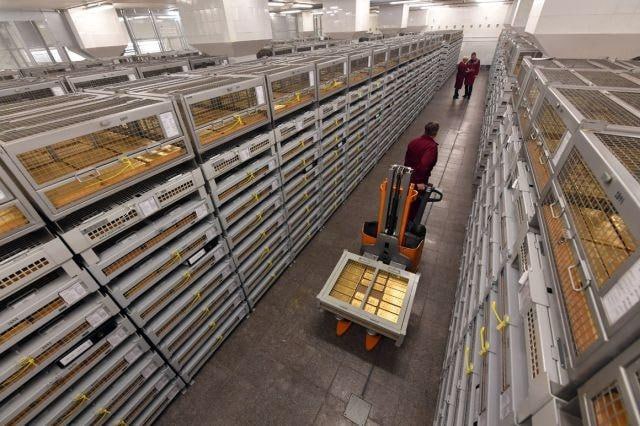
Russia’s emphasis on what officials describe as “hard assets” fits into this logic. In a world where financial sanctions, reserve freezes and restrictions on cross-border payments have become more frequent, holding a large pool of metal stored in domestic vaults offers a sense of control. Gold can be pledged as collateral, used in swap arrangements with friendly partners, or sold gradually to obtain foreign currency when needed. It is not a panacea, but it is harder to unilaterally immobilise than deposits at a foreign bank.
The shift also reflects broader central bank behaviour. Global gold holdings by official institutions have risen steadily since the global financial crisis, surpassing 32,000 tonnes in 2024 and continuing higher in 2025.:contentReference[oaicite:10]{index=10} Surveys of reserve managers show that many now see gold as a way to diversify away from concentrated exposure to a handful of currencies, and as insurance against “tail risks” in the international financial system. Russia’s decision to give bullion such a prominent place in its balance sheet can be read as an amplified version of this global trend.
How Russia Compares With Other Major Holders
Despite its record figures, Russia is not the largest holder of official gold; in tonnage terms it ranks around fifth. Data compiled from Trading Economics and IMF sources for 2025 show the United States leading with 8,133 tonnes, followed by Germany (3,352 tonnes), Italy (2,452 tonnes) and France (2,437 tonnes), with Russia close behind at roughly 2,336 tonnes.:contentReference[oaicite:11]{index=11} The difference lies less in absolute quantity and more in how central gold is to each country’s overall reserve strategy.
For the United States, gold is a legacy asset that sits alongside a dominant reserve currency; its value is enormous, but the dollar’s role in global finance means U.S. policymakers rarely have to choose between holding gold and holding their own sovereign debt. For Russia, by contrast, gold is a core part of a diversification effort away from foreign-currency assets it does not control. Other emerging markets are somewhere in between: India, Turkey and several Gulf states have increased their gold holdings in recent years but still maintain large portfolios of conventional foreign-exchange reserves.:contentReference[oaicite:12]{index=12}
In that sense, Russia can be seen as an early adopter of an extreme version of a broader pattern: central banks incrementally adding metal to mitigate currency and counterparty risk. Whether other countries move as far along that path will depend on their exposure to financial sanctions, their domestic political priorities and their tolerance for the trade-offs that come with holding so much of national wealth in a non-yielding asset.
Benefits of a Gold-Heavy Reserve Portfolio
A large gold position offers several advantages for a country operating under geopolitical stress:
• Resilience against external financial pressure. Physical gold stored domestically is considerably harder to restrict or immobilise than deposits or securities held in foreign jurisdictions.
• Diversification away from single-currency risk. Holding a significant share of reserves in metal reduces dependence on any one foreign currency or bond market, which can be helpful when exchange-rate or interest-rate cycles are uncertain.
• Potential support for the domestic currency. Large gold assets can underpin confidence in a central bank’s balance sheet and, indirectly, in the national currency, especially if policymakers signal a willingness to use gold as part of their broader toolkit.
• Option value in extreme scenarios. In a very adverse global environment, a stock of bullion can serve as collateral in bilateral arrangements, or as a backstop for essential imports, in ways that are difficult to replicate with immobilised or disputed foreign-currency assets.
All of these benefits are conditional rather than automatic. They depend on how the assets are managed, where they are stored, the legal frameworks governing potential transactions and, crucially, the willingness of trading partners to accept gold as payment or collateral in practice. Still, the appeal of a tangible, portable reserve that sits outside the direct control of other states is clear from the behaviour of many central banks, not just Russia’s.:contentReference[oaicite:13]{index=13}
The Trade-Offs: Liquidity, Volatility and Opportunity Cost
Gold’s strengths are also the source of certain weaknesses. Compared with short-dated government bonds or high-quality foreign-currency deposits, bullion is less liquid in large size for day-to-day operations. Converting tens of billions of dollars’ worth of metal into cash quickly, without roiling markets or drawing attention, is not trivial. Central banks can use over-the-counter transactions, swaps and structured deals to manage this, but those arrangements take time to negotiate and execute.
There is also price volatility. While gold is often seen as a store of value over long horizons, year-to-year price moves can be substantial. The same rally that pushed Russia’s gold reserves above $310 billion could reverse if global risk sentiment improves or interest rates rise more than expected. A sharp downturn in the gold price would shrink the value of reserves without any change in underlying tonnage. For a country that relies heavily on those reserves for financial stability, that is a meaningful risk.
Finally, a gold-heavy portfolio carries an opportunity cost. Gold does not generate regular income in the way that interest-bearing securities do. When yields on safe assets are low, that may not matter much. If global rates normalise at higher levels, holding such a large share of wealth in non-yielding form could mean giving up a steady flow of interest income that might otherwise help cover fiscal gaps or support domestic programmes.
These trade-offs do not invalidate the strategy, but they make it clear that gold is not a free lunch. The choice to allocate 40% or more of national reserves to metal reflects a preference for resilience over income, and for autonomy over maximum financial efficiency.
What Russia’s Move Signals for the Global System
Russia is not the only country reassessing its mix of reserve assets. Over the last three years, central banks worldwide have purchased more than 1,000 tonnes of gold annually, a pace that exceeds most years since the 1960s.:contentReference[oaicite:14]{index=14} In value terms, gold has even overtaken the euro as the second-largest official reserve asset globally, according to the European Central Bank, thanks to the combination of high prices and sustained buying.:contentReference[oaicite:15]{index=15}
Several factors underpin this behaviour: concerns about inflation, doubts about long-term fiscal trajectories in advanced economies, and a perception that reserve currencies can be used more actively in foreign policy. For countries that feel on the periphery of existing financial architectures, holding more gold is a way to hedge against these uncertainties. Russia’s record-high gold share makes those motivations more visible, but many other reserve managers express similar views in more cautious terms.
One open question is how far this trend can go before it begins to reshape the functioning of the international monetary system. If more countries follow Russia in shifting a large portion of reserves into metal, demand for government bonds denominated in major currencies could soften at the margin. That would not overturn the system overnight – the U.S. dollar still dominates global reserves and transactions – but it could gradually change who finances whom, and on what terms. For now, the shift is incremental rather than revolutionary, but the direction is clear: diversification and redundancy are back in fashion.
Scenarios for the Years Ahead
Looking ahead, several scenarios could emerge from Russia’s current position:
• Gold remains central and continues to grow in value. If geopolitical tensions stay elevated and investors worldwide continue to favour gold, prices could remain high or rise further. In that environment, Russia’s gold-heavy reserve strategy would look vindicated, providing both financial ballast and political symbolism.
• Stabilisation with gradual rebalancing. If global conditions calm and yields on conventional reserve assets become more attractive, Russia might decide to stabilise or slowly reduce gold’s share of reserves, using price gains to rebuild more diversified foreign-currency holdings while keeping a large but not dominant bullion position.
• Adverse price swing. A sustained decline in the gold price would reduce the domestic currency value of reserves and test the resilience of a balance sheet so heavily tilted toward one asset. Policymakers would then face hard choices about whether to accept the loss, sell metal to rebalance, or wait out the downturn.
Which path becomes reality will depend on global macro conditions as much as on domestic policy. What is clear today is that Russia has chosen to anchor its financial buffer in a tangible asset that sits largely outside others’ jurisdiction – a choice that may influence how other countries, especially those with similar geopolitical concerns, think about their own reserve strategies.
Takeaways
Russia’s record gold reserves, now worth more than $310 billion and representing roughly 42% of total international reserves, are more than a statistical curiosity. They embody a deliberate shift toward hard assets in response to a world where financial channels can be disrupted and where traditional assumptions about reserve safety are being questioned.
For students of macroeconomics and policy, the episode is a case study in how a country can use its natural resource base, domestic mining industry and central bank balance sheet to build a different sort of financial shield. For other central banks, it is a reminder that diversification is not just about holding a mix of currencies; sometimes it is about stepping outside the currency system altogether, at least for a portion of national wealth.
Disclaimer: This article is intended for informational and educational purposes only. It does not constitute investment, financial or legal advice, and it does not recommend any specific asset, strategy or service. Gold and other assets mentioned can fluctuate in value and may not be appropriate for every investor or institution. Decisions about reserve management or personal investment should be based on individual objectives, constraints and professional guidance where appropriate.