Solana’s Alpenglow in 2026: When “Speed” Stops Being a Marketing Word and Becomes a Design Constraint
Blockchain discussions often treat “speed” like a single number—TPS, block time, or a catchy slogan. Alpenglow forces a more honest conversation: not about how many transactions a chain can accept, but how quickly the network can agree on what actually happened. That difference—throughput versus finality—is the line between a fast demo and dependable infrastructure.
Solana’s 2026 upgrade roadmap centers on Alpenglow, a proposed overhaul that introduces two core components: Votor (a new voting/finality mechanism) and Rotor (a redesigned data-dissemination path). The promise is dramatic: finality that moves from multi-second territory toward the sub-second domain. The analysis that matters, though, is not “how fast can it go,” but “what must be true for that speed to be real—and safe.”
Latency is the product (and everything else becomes a trade-off)
In mature systems, users rarely complain that “the database isn’t decentralized enough.” They complain that an action feels delayed, uncertain, or reversible. Finality latency is the hidden cost of that uncertainty. If your payment, swap, or game action might be reorged—or if you must wait several seconds to be confident—it changes how products are designed. Teams add retries, buffers, and UX tricks. Users learn not to trust the first confirmation.
That’s why Alpenglow is best understood as a product decision disguised as protocol engineering. If Solana can deliver reliable sub-second finality at global scale, it reduces the need for “optimistic” UX shortcuts and shrinks a whole category of application complexity. But the faster you try to go, the more the network starts to resemble a race against physics, geography, and adversarial conditions—not just against other chains.
What Alpenglow actually changes (in plain terms)
Alpenglow is positioned as a major replacement of legacy components in Solana’s core protocol. In simple language: it rethinks how a block is proposed, how it spreads, how validators communicate votes, and how the network turns those votes into a proof of agreement. The headline outcome is shorter time-to-finality, but the mechanism is more interesting than the metric.
Instead of leaning on heavier, slower coordination patterns, the proposal emphasizes direct voting and efficient aggregation—so the network can reach a decision with fewer “round trips” and less communication overhead. The goal is not merely to push data faster, but to compress the decision process itself—so “agreement” arrives quickly enough to feel like normal internet infrastructure, not a delayed settlement system.
Votor: finality as a two-lane highway, not a single road
The easiest way to understand Votor is to stop imagining consensus as one long, uniform process. Votor treats finality like a highway system with two lanes running in parallel. In good network conditions, a “fast lane” closes the decision quickly. If conditions deteriorate—validators offline, latency spikes, or the network becomes less responsive—a “fallback lane” still gets you to a safe conclusion, just with extra steps.
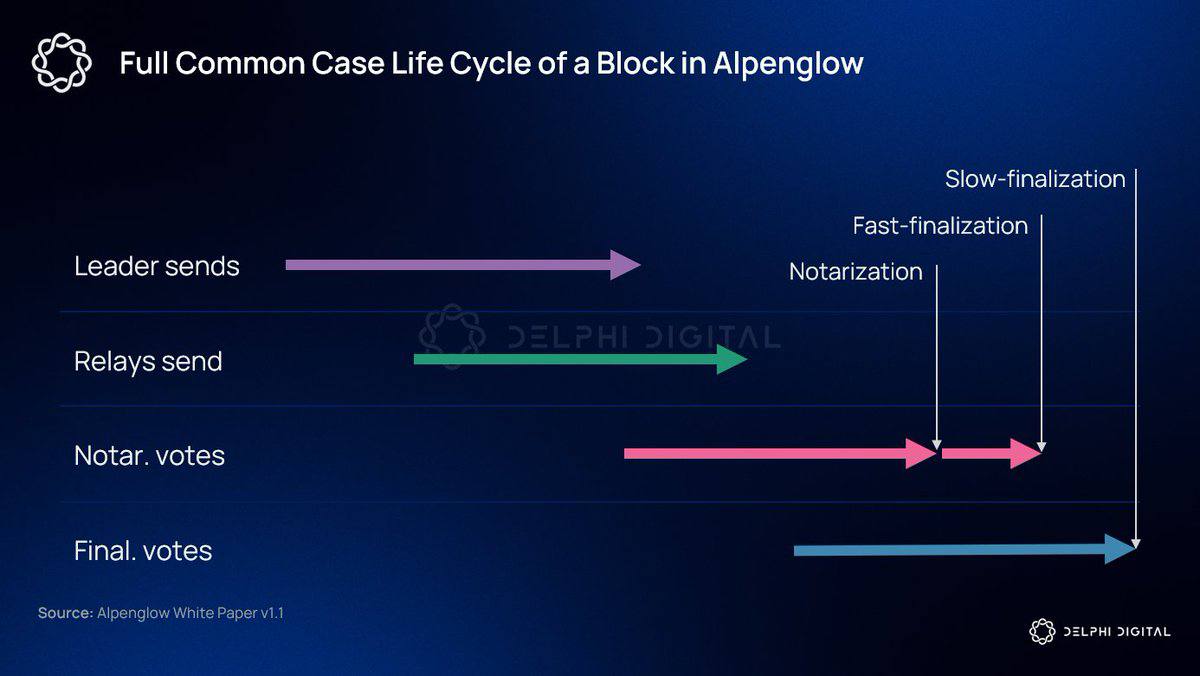
Conceptually, the system separates the idea of “this block is being acknowledged” from “this block is finalized.” That’s why you’ll see language like notarization and finalization. Notarization is the network signaling that a block is broadly seen and supported; finalization is the stronger guarantee that the chain has committed to it. This separation matters because it allows the network to keep moving while still preserving a higher-confidence endpoint.
In practical terms, Votor’s design is often described like this:
• Fast-finalization path: a higher participation threshold can finalize in a single round under favorable conditions.
• Fallback path: a lower participation threshold can still finalize, typically requiring more than one round, prioritizing robustness over speed.
That structure is not “speed for free.” It’s speed purchased by assuming the common case is healthy—while building a safer exit ramp when it isn’t.
Rotor: the part people ignore—until the network gets real
Many performance debates obsess over voting logic while underestimating the plumbing: how blocks actually travel across a global validator set. Rotor is about that plumbing. If you want sub-second finality, you can’t treat data propagation as an afterthought. Votes can only converge once a large portion of the stake has received the relevant block and can validate it.
Rotor’s core intuition is almost uncomfortable in its simplicity: the “speed of light problem” dominates, so you must minimize the number of network hops and avoid needless broadcast chatter. The design direction described publicly emphasizes a more direct communication pattern and relay selection strategies that aim to move data quickly without relying on heavy, noisy gossip. In theory, this can pull propagation latency down toward the natural floor imposed by geography.
Here’s the nuance most headlines skip: a relay-based fast path can make the network feel instantaneous, but it also concentrates responsibility on who relays are, how they’re selected, and how resilient the system remains when some of those relays fail. Rotor is not just a speed feature—it’s a decentralization stress test.
The real question: what does Solana “pay” for faster finality?
Every consensus upgrade is a negotiation with reality. You can reduce latency by tightening coordination, but tighter coordination can amplify the impact of network asymmetries—some validators have better bandwidth, better peering, better hardware, and better locations. If a design unintentionally rewards those advantages too heavily, decentralization can erode even as performance improves.
Alpenglow’s core risk is not that it aims for fast finality—it’s that fast finality can become a magnet for subtle centralization. When applications start depending on near-instant settlement, the ecosystem naturally prefers the path of least friction. That can create social pressure to optimize for the “fast lane” even when conditions suggest caution. Healthy protocol design anticipates that human tendency and builds guardrails.
Key trade-offs worth watching (educational checklist):
• Validator diversity vs. performance expectations: do smaller validators remain competitive as the system optimizes for low-latency coordination?
• Relay selection transparency: can the network explain and audit how relays are chosen—and how attacks or outages are handled?
• Operational complexity: does the new design simplify reality for operators, or shift complexity into harder-to-debug network behaviors?
• Upgrade risk: “biggest change” upgrades tend to fail in edge cases, not the common case. Test coverage and staged rollout matter more than slogans.
What sub-second L1 finality could unlock (without overhyping it)
It’s tempting to treat sub-second finality as a victory lap: “now we can do everything.” A more realistic view is that it unlocks a different class of design constraints. When finality becomes fast and predictable, developers can build flows that feel closer to real-time systems: tighter feedback loops, fewer “pending” states, and less reliance on off-chain coordination.
The most credible benefits show up where uncertainty is expensive: high-frequency interactions, on-chain order routing, time-sensitive settlement, and consumer apps that can’t afford to ask users to “wait a bit.” But the upside is not only speed—it’s the possibility of reducing application-layer hacks built to compensate for slow finality. In that sense, fast finality can improve reliability by letting apps be simpler and more honest about their state.
How to evaluate Alpenglow in 2026 like an engineer, not a fan
If you want to track Alpenglow responsibly, ignore the loudest numbers and focus on the evidence trail. Simulation results are useful, but production networks have messy characteristics: uneven latency, correlated outages, and incentive-driven behavior. The “median finality” number means less than the distribution’s tail—because real incidents live in the tail.
A practical evaluation framework is to watch for repeated, independently verified outcomes: stable performance under stress, clear failure modes, and transparent rollback strategies. The best sign of maturity is not perfect speed; it’s the ecosystem being candid about where speed breaks and how the protocol behaves when it does.
Signals that matter more than headlines:
• Testnet results under adversarial and degraded conditions, not only best-case demos.
• Independent audits and formal reasoning about safety/liveness assumptions.
• Clear operator guidance: networking requirements, monitoring, incident playbooks.
• Client and implementation diversity—because monoculture is the quiet enemy of resilience.
Conclusion
“100x faster” is a story. Alpenglow is a design philosophy: treat latency as a first-class constraint and re-architect the system to meet it. Votor reframes finality as a dual-path process that can be extremely fast in the common case while preserving a robust fallback. Rotor acknowledges the uncomfortable truth that consensus speed is often bounded by the network, not by clever cryptography.
If Alpenglow succeeds, the win won’t just be a number on a chart. It will be a shift in what developers assume is possible on a layer-1: fewer UX illusions, fewer probabilistic workarounds, and a tighter bridge between on-chain settlement and real-time product design. The hard part is proving that the speed comes with durability—because in infrastructure, what matters is not how fast you are when everything is fine, but how well you behave when it isn’t.
Frequently Asked Questions
Is Alpenglow guaranteed to deliver sub-second finality on mainnet?
No outcome is guaranteed until it is implemented, tested broadly, and observed in production conditions. Public materials describe targets and simulation-based expectations, but real networks add operational overheads and adversarial edge cases.
Why does finality matter more than “fast confirmations”?
Fast confirmations can improve user experience, but finality is the stronger guarantee that the network won’t later reverse the result. Applications that handle time-sensitive value transfer care deeply about when they can treat an action as settled.
Does faster finality automatically mean more decentralization?
Not automatically. Faster coordination can increase pressure toward better-connected infrastructure. A well-designed protocol can mitigate this, but it’s a key trade-off to measure as the upgrade progresses.
Disclaimer: This article is for educational purposes only and does not constitute financial, investment, or legal advice. Protocol proposals and timelines can change, and performance targets may differ between simulations, testnets, and mainnet conditions.