Week Ahead: When Markets Stop Guessing and Start Measuring (Jobs Data, Fed Signals, and Post-Headline Positioning)
Some weeks feel like a debate. Everyone has a story, and markets trade the story. Other weeks feel like a measurement. Next week leans toward measurement: the U.S. labor market is about to be scanned from multiple angles—private payrolls, job openings, claims, and the official jobs report. When those lenses line up, markets tend to move with conviction. When they contradict, markets tend to move in whiplash.
Layered on top is the aftertaste of a geopolitical headline cycle (the U.S.–Venezuela situation) that can keep volatility elevated even if the macro numbers are “normal.” That combination matters because it forces two different kinds of positioning to collide: short-term headline hedges versus medium-term rate expectations. If you’re trying to make sense of price action, the key is not predicting every tick—it’s knowing which inputs the market will treat as decisive.
Monday, Jan 5: The Market’s “Digestion Day”
Monday has no major economic releases, which sounds like a quiet day—until you remember that “no data” doesn’t mean “no information.” It simply means the market’s attention is free to focus on whatever is unresolved: positioning after the U.S.–Venezuela developments, energy implications, and whether risk appetite returns once the first wave of reactions has passed.
This is often when you see the market reveal what it actually cares about. If headlines were the main driver, you may see volatility fade as traders lock in profits and reduce exposure. If the headline is interpreted as structurally meaningful—especially via energy supply, defense spending expectations, or risk premia—then Monday can become a staging ground: investors adjust portfolios ahead of the week’s labor data rather than waiting for it.
What to watch (conceptually):
• Energy sensitivity: are oil-linked assets moving independently of broader equities, or are they dragging risk sentiment with them?
• Rates vs. risk: are bond yields driving the day, or are equities and credit moving on “risk-on/risk-off” flows?
• Volatility behavior: does volatility compress as uncertainty is absorbed, or stay bid as traders expect more shocks?
Tuesday, Jan 6: Fed Speaker Day (Richmond Fed President Tom Barkin)
Fed speeches rarely deliver a single “aha” quote that changes everything. Their real value is subtler: they help markets estimate the reaction function. In other words, what does a Fed official consider important right now—employment softness, inflation persistence, financial conditions, or something else?
Tom Barkin’s remarks matter more this week because they land ahead of multiple labor datapoints. When a Fed speaker talks before jobs numbers, markets listen for a framework: what would count as “cooling,” what would count as “re-acceleration,” and what would be dismissed as statistical noise? Even a cautious tone can influence expectations if it signals that the bar for policy changes is moving.
A practical way to interpret Fed commentary:
• If the speech emphasizes patience and “waiting for confirmation,” markets may treat mid-week data as less likely to force an immediate repricing.
• If it emphasizes risks of doing too little or too much, markets may become more data-sensitive—reacting harder to surprises.
• If it emphasizes financial conditions, then equities and credit spreads can become part of the Fed narrative, not just inflation and jobs.
Wednesday, Jan 7: ADP, Job Openings, Factory Orders (The “Context” Day)
Wednesday is the kind of day that confuses people who only watch headlines. You’ll get multiple releases that are imperfect individually, but powerful collectively because they provide context for Friday’s official employment report. The market doesn’t need these numbers to be precise; it needs them to be directionally consistent.
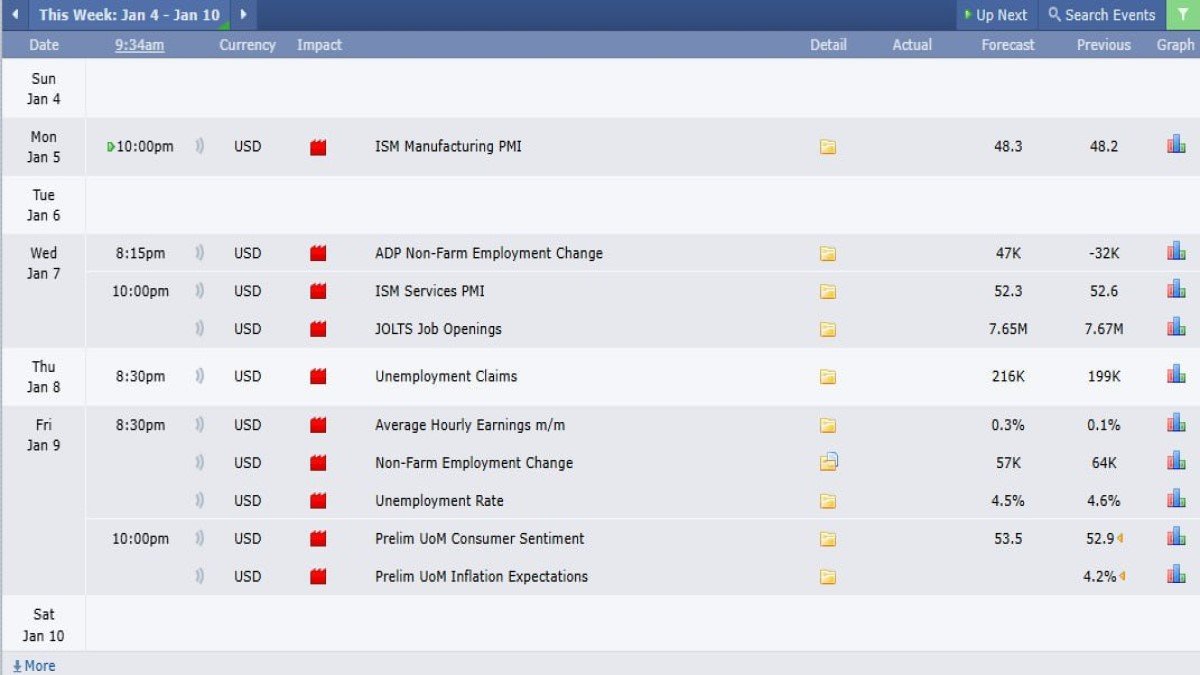
The calendar you provided includes: ADP employment (forecast 45,000 vs prior -32,000), U.S. job openings, and factory orders (forecast -1.2% vs prior 0.2%). The important point isn’t whether each print is “good” or “bad,” but whether they tell one coherent story about hiring demand, labor churn, and production momentum.
How to read the trio without overreacting:
• ADP (private payrolls): treat it as a sentiment indicator for labor, not a reliable preview of Friday’s number. When ADP and Friday diverge, it doesn’t mean one is “fake”—it means payroll measurement is noisy.
• Job openings: this is the labor market’s “pressure gauge.” High openings relative to hires can imply tightness; falling openings can suggest demand is easing. What matters is trend consistency over multiple months, not a single print.
• Factory orders: this is about real economy pulse. A weak print can reinforce a “cooling” narrative, but it can also reflect inventory cycles and timing. Look for alignment with broader growth indicators rather than treating it as a standalone verdict.
Wednesday’s risk is narrative whiplash. If ADP is strong while job openings soften, markets can split into two interpretations: “labor is resilient” versus “labor demand is easing.” When that happens, expect Thursday and Friday to become the deciding rounds.
Thursday, Jan 8: Initial Jobless Claims (The Market’s Weekly Lie Detector)
Jobless claims are not glamorous, but they are frequent—and frequency is power. Because claims are weekly, they are one of the fastest ways markets detect a shift in labor conditions. They’re also sensitive to seasonality, holidays, and administrative noise, which means you should treat any one week as a data point, not a prophecy.
Still, Thursday often acts like a “pre-Farm Payrolls rehearsal.” If claims jump unexpectedly, markets start pricing higher odds that Friday’s report will confirm softening. If claims remain contained, markets become more willing to believe resilience narratives—even if ADP was mixed.
Two useful mental models for claims:
• Trend model: markets care whether claims are drifting higher over several weeks. A single spike is less important than a staircase.
• Confidence model: claims can change how confident traders feel about Friday. They don’t always predict the print, but they influence how aggressively markets position into it.
Friday, Jan 9: The U.S. Jobs Report + Unemployment Rate + Barkin Again
Friday is the main event: the official U.S. jobs report (forecast 54,000 vs prior 64,000) and unemployment rate (forecast 4.7% vs prior 4.6%), plus another Barkin appearance. This is the day markets stop debating “what might be happening” and start updating probability maps: soft landing, slowdown, or re-acceleration.
Here’s the trap: many observers treat the headline payroll number as the whole story. Professionals rarely do. They read the labor report like a balance sheet: multiple line items, each with implications. Payrolls can be influenced by seasonal quirks and revisions. Unemployment can move for “good” reasons (more people entering the labor force) or “bad” reasons (job losses). The market reaction depends on the composition.
How Friday can move markets in three distinct ways:
• “Cooling, but orderly”: payroll growth slows modestly and unemployment inches up without signs of stress. Markets may treat this as supportive for rate stability and risk assets—depending on inflation context.
• “Softening turns to stress”: a weaker payroll print plus a more meaningful unemployment uptick can shift sentiment toward growth concerns. This can support bonds while pressuring risk appetite.
• “Resilience surprises”: stronger-than-expected payrolls or stable unemployment can revive the idea that conditions are still tight. That can lift yields and pressure rate-sensitive assets—especially if markets were leaning toward a dovish interpretation.
Then comes the second layer: Fed interpretation. If Barkin speaks after the report, the market listens for whether the data meaningfully changes the Fed’s stance. The most impactful outcome isn’t a dramatic quote—it’s confirmation that the Fed’s reaction function remains consistent.
Why This Week Matters More Than the Calendar Suggests
This is not a week packed with dozens of releases. It’s a week where a few releases sit on top of elevated headline uncertainty. That combination tends to create “two-speed markets.” In two-speed markets, macro-sensitive assets respond to rates and growth signals, while headline-sensitive assets respond to geopolitics, energy headlines, and risk premia. When both forces fire at once, correlation patterns can break temporarily.
It also matters because employment data often acts as a proxy for something bigger: confidence. In uncertain environments, investors lean on stable indicators. Jobs data is one of the few macro series that can still swing sentiment rapidly, because it connects directly to consumption, corporate earnings durability, and the Fed’s dual mandate.
A simple “signal hygiene” rule for the week:
• Don’t treat ADP as a verdict—treat it as a hint.
• Don’t treat a single claims print as a trend—treat it as a checkpoint.
• Do treat Friday as a synthesis—because markets will.
Conclusion
Next week is not about finding the perfect forecast. It’s about avoiding the most expensive mistake markets punish: confusing noise for signal. Monday will tell you whether the market is still emotionally trading headlines. Tuesday will show you what the Fed wants you to pay attention to. Wednesday and Thursday will set expectations and confidence. Friday will force the repricing—because when the labor report arrives, the market has to choose which story is real enough to bet on.
If there is a single takeaway, it’s this: the market doesn’t trade morality, and it doesn’t trade certainty. It trades probabilities. This week’s calendar is essentially a probability update engine—especially for rates, risk appetite, and how investors digest geopolitical risk through the lens of growth and policy.
Frequently Asked Questions
Why do markets care about ADP if it’s not always accurate?
Because it arrives before the official report and can shift positioning. Markets use ADP less as a predictor and more as a “risk check” for how wrong their expectations might be.
Are weekly jobless claims more important than monthly payrolls?
They serve different purposes. Payrolls are broader and more comprehensive, while claims are faster and better at capturing sudden shifts. Claims can influence confidence going into the payroll report even when they don’t predict the exact headline number.
Why do Fed speeches matter when the data is what counts?
Because data matters through the Fed’s interpretation. Markets are constantly estimating how the Fed will respond to new information. Speeches help clarify what the Fed is prioritizing and what it may look past.
How does geopolitical news influence an economic-data week?
It can raise volatility and shift attention to energy prices, risk premia, and defense-related spending expectations. That can change how markets interpret “normal” macro data because baseline uncertainty is already elevated.
Disclaimer: This article is for educational purposes only and does not constitute financial, investment, or legal advice. Economic data can be revised, and market reactions can be volatile. Always consider multiple sources and your own risk tolerance before making decisions.