Taiwan Quietly Joins the Top 10 Government Bitcoin Holders: Why It Matters
When people talk about government exposure to Bitcoin, they usually think of the United States, Germany or smaller states that have made Bitcoin part of their national narrative. Yet a growing portion of public sector holdings comes not from deliberate investment decisions, but from law enforcement and the courts. Taiwan is the latest example.
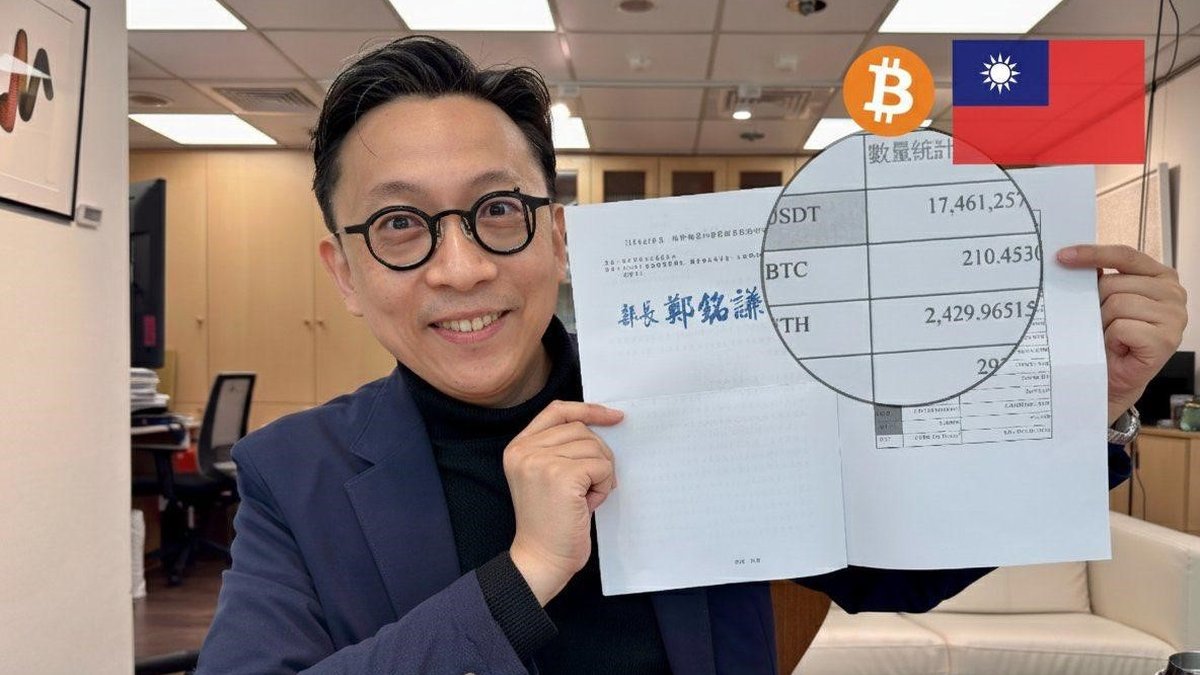
The island’s Ministry of Justice has revealed that it currently holds more than 210 BTC, acquired through legal seizures in financial and crypto related cases rather than through intentional purchases. At prevailing prices, that stash is worth roughly 18 million United States dollars. In absolute terms this is not a huge reserve, but it is already enough to place Taiwan around the top ten globally among governments holding Bitcoin.
On a worldwide basis, states collectively control over 640,000 BTC, most of it captured by enforcement agencies during investigations and later transferred into government custody. That represents a non trivial share of the circulating supply, and it is growing. Taiwan’s announcement is a useful lens through which to examine several important questions: how do governments end up with Bitcoin, what do they typically do with it, and what does this mean for investors and for the asset’s long term narrative as a form of neutral money?
1. How Governments End Up Holding Bitcoin
Taiwan’s 210 plus BTC is not the result of a treasury committee deciding to diversify reserves into digital assets. Instead, it is the outcome of standard legal processes. When a court finds that digital assets were obtained or used in connection with financial misconduct or other serious offenses, it can order those assets to be confiscated. Once seized, they are transferred under the control of the relevant state authority, in this case the Ministry of Justice.
This pattern is similar around the world. Law enforcement agencies in the United States, Germany, the United Kingdom and other jurisdictions have taken control of large Bitcoin wallets after dismantling illicit marketplaces, shutting down unlicensed money services or resolving large scale financial investigations. Because Bitcoin transactions are recorded on an open ledger and can be traced with increasingly sophisticated analytics, large balances linked to such cases often end up being consolidated under government control.
In other words, most state Bitcoin holdings today are an unplanned byproduct of enforcement, not a deliberate macro investment strategy. Yet once coins are in the hands of public institutions, decisions about how to manage or dispose of them can have real market consequences.
2. Taiwan’s Position in the Global Sovereign Bitcoin Map
By itself, 210 BTC is a small fraction of Bitcoin’s total circulating supply, which is measured in millions of coins. What makes Taiwan’s number noteworthy is the context. Global government holdings around 640,000 BTC are concentrated in a handful of countries. Many others either hold no digital assets or have not disclosed their balances. In that landscape, a reserve in the low hundreds of BTC is enough to make Taiwan a meaningful mid sized player among state holders.
There are several takeaways from this:
• Bitcoin has quietly become part of law enforcement balance sheets. Even without explicit strategies, courts and ministries are now managing digital assets alongside more traditional seized property such as cash, vehicles or real estate.
• Concentration of supply is shifting. A portion of Bitcoin that once sat in private wallets now belongs to public institutions that may eventually liquidate or hold it. This adds a new class of actors to the supply and demand equation.
• Transparency is uneven. Taiwan’s disclosure is relatively clear: the holdings come from completed cases and are under the Ministry of Justice. In other countries, public communication is less precise, making it harder for markets to assess potential sale overhangs.
Seen this way, Taiwan is not an outlier but a sign of a broader trend: as Bitcoin matures, more of it ends up entangled with formal legal and regulatory systems.
3. Hold, Auction or Liquidate? The Policy Choices Ahead
One of the most important unresolved questions is what Taiwan will ultimately do with its Bitcoin. The Ministry of Justice has not yet announced whether it plans to hold the coins, auction them off or convert them through another channel. Each option has distinct implications.
If the government holds the coins for an extended period, it effectively becomes a passive participant in the Bitcoin ecosystem. That would slightly reduce the amount of BTC available to private markets and could be framed as a form of indirect exposure to the asset’s long term trajectory, even if there was never a formal investment mandate.
If the coins are auctioned or sold in an orderly fashion, Taiwan would follow the practice used by several other jurisdictions. Public auctions have advantages: they are transparent, they can attract institutional bidders, and they allow the state to convert digital assets into local or foreign currency that can be used for general budgetary purposes or for victim compensation where applicable.
If liquidation is handled in a less structured way, for example via gradual sales through exchanges without clear communication, it could add uncertainty to the market. Participants may worry about hidden selling pressure. That risk is one reason why many observers favor open auction processes with clear rules and published results.
In practice, legal frameworks and administrative capacity often determine which path is chosen. Taiwan’s public disclosure is a positive first step, but the design of its eventual disposition strategy will be closely watched by both legal experts and market participants.
4. What Large State Holdings Mean for Bitcoin’s Supply Dynamics
At first glance, state controlled Bitcoin balances might seem irrelevant from a trading perspective. After all, 640,000 BTC held by governments is still only a slice of total circulating supply. Yet the distribution of those holdings matters.
Several key points stand out:
• Government balances are relatively price insensitive in the short term. Ministries and courts do not usually react to every market fluctuation. They hold coins until legal processes are complete and administrative decisions are made. This can temporarily remove coins from active circulation.
• Auctions can create time limited supply shocks. When a jurisdiction decides to sell a large tranche of BTC, the announcement alone can influence sentiment. However, transparent auctions often attract strong institutional demand, and coins typically end up in hands that are more long term oriented.
• Growing state involvement normalizes Bitcoin. The more ministries, treasuries and courts interact with BTC as an asset to be managed, the less exotic it appears within public finance. That does not mean every government will adopt it as legal tender or a reserve asset, but it does embed Bitcoin more deeply into institutional routines.
For Taiwan specifically, 210 BTC is too small to move global prices by itself, but it adds to a mosaic in which public sector actors have a non trivial influence over the timing and form of supply entering the market.
5. The Regulatory Message Behind Taiwan’s Disclosure
Beyond the numbers, Taiwan’s announcement sends a regulatory signal. By publicly stating that its Bitcoin holdings arise from resolved criminal matters, the Ministry of Justice is drawing a line between legal, registered crypto activity and behavior that clearly violates existing law.
This reinforces several points for market participants:
• Compliance is no longer optional. Exchanges, custodians and service providers interacting with Taiwanese residents are expected to meet know your customer and anti money laundering standards. Activities that bypass these requirements risk enforcement and asset seizure.
• Digital assets are fully within the reach of traditional law. The fact that Bitcoin sits on a decentralized ledger does not place it outside the jurisdiction of courts. Once linked to an identified party and a recognized offense, coins can be confiscated just like other forms of property.
• Transparency can support market trust. By confirming the existence and origin of these holdings, authorities reduce the space for speculation and rumor about hidden balances.
For investors, this is a reminder that the long term adoption of crypto depends not only on technology and macro trends, but also on how clearly the boundary between compliant and non compliant behavior is defined and enforced.
6. The Global Picture: 640,000 BTC Under Public Control
When you zoom out, Taiwan’s 210 BTC becomes part of a much larger puzzle. Global estimates suggest that governments collectively control more than 640,000 BTC, with the largest balances held by a small number of jurisdictions that have carried out high profile enforcement actions over the past decade.
This total is significant for several reasons:
- It represents a material share of the free float that is effectively in “pause mode” until agencies decide to sell or redistribute the assets.
- It demonstrates that public institutions are already, whether they intend it or not, major stakeholders in the Bitcoin economy.
- It sets a precedent for how future enforcement actions will be handled. Each large seizure adds to the stock of state controlled coins and forces fresh decisions about auctions, custody and reporting.
Over time, the pattern that emerges may influence how comfortable treasuries and central banks feel about actively holding or even acquiring Bitcoin for policy purposes. Once internal processes and custody solutions are established for seized assets, the barrier to deliberate allocation can be lower, even if many years pass before such steps are considered.
7. Lessons for Long Term Investors
For long term participants in the crypto market, Taiwan’s disclosure highlights a few educational takeaways that go beyond the specific number of coins involved.
First, it is a reminder that Bitcoin’s ownership structure is evolving. Early on, holdings were dominated by retail users and a small group of large early adopters. Today, the picture includes public companies, exchange traded products, and a growing list of states that hold Bitcoin because of legal outcomes.
Second, it underscores the importance of distinguishing between structural and tactical forces. Structural forces include who ultimately controls supply (households, funds, governments) and what constraints they face. Tactical forces include short term liquidations, derivatives positioning and market sentiment. Government holdings sit mainly in the structural bucket; their impact tends to show up in slow moving shifts, not intraday volatility.
Third, it illustrates that regulation and adoption are intertwined. As authorities around the world gain hands on experience with custody, traceability and auctions, their understanding of the asset deepens. That can, in the best case, support more balanced regulatory frameworks that protect users without shutting down innovation.
8. What To Watch Next in Taiwan and Beyond
Looking ahead, several developments will be worth tracking in Taiwan and in other jurisdictions with sizable state controlled Bitcoin reserves:
• Policy statements on asset management. Will ministries or finance departments publish guidelines on how seized digital assets are held, hedged or sold? Clear policies can reduce uncertainty and support market stability.
• Auction formats. If Taiwan decides to auction part of its holdings, the choice between open bidding, institutional placement or exchange based sales will influence both price impact and public perception.
• Integration with victim compensation. In cases where individuals or businesses suffered losses, governments may choose to direct some proceeds from Bitcoin liquidation toward restitution. That would add a social dimension to the management of state controlled BTC.
• International coordination. As more states hold digital assets, there may be discussions about best practices for custody, security and disclosure. Frameworks that allow information sharing without compromising investigations could emerge.
Each of these steps would nudge Bitcoin further into the mainstream of public finance, even if no explicit reserve allocation is ever announced.
9. A New Role for Bitcoin in Public Balance Sheets
Taiwan’s 210 plus BTC does not yet transform its fiscal position, nor does it signal a formal embrace of Bitcoin as a strategic asset. What it does reveal is that digital assets are becoming part of the everyday machinery of government: seized in investigations, held in secure wallets, potentially auctioned or repurposed according to law.
For the crypto ecosystem, this is both a challenge and an opportunity. It is a challenge because it means that behavior which once operated in regulatory grey zones is now monitored and, where necessary, sanctioned. It is an opportunity because each successful case of custody, auction and reporting proves that Bitcoin can function within existing legal frameworks rather than outside them.
As more ministries of justice, finance departments and courts disclose their holdings, investors will gain a clearer picture of how much BTC is under public control and how those coins flow back into private hands over time. Taiwan’s announcement is one chapter in that story, and a reminder that even relatively modest numbers can carry outsized symbolic weight when they show how deeply Bitcoin has penetrated the global financial system.
Disclaimer: This article is for educational and informational purposes only and does not constitute investment, legal or tax advice. Digital assets involve risk, and readers should conduct their own research and consult qualified professionals before making financial decisions.