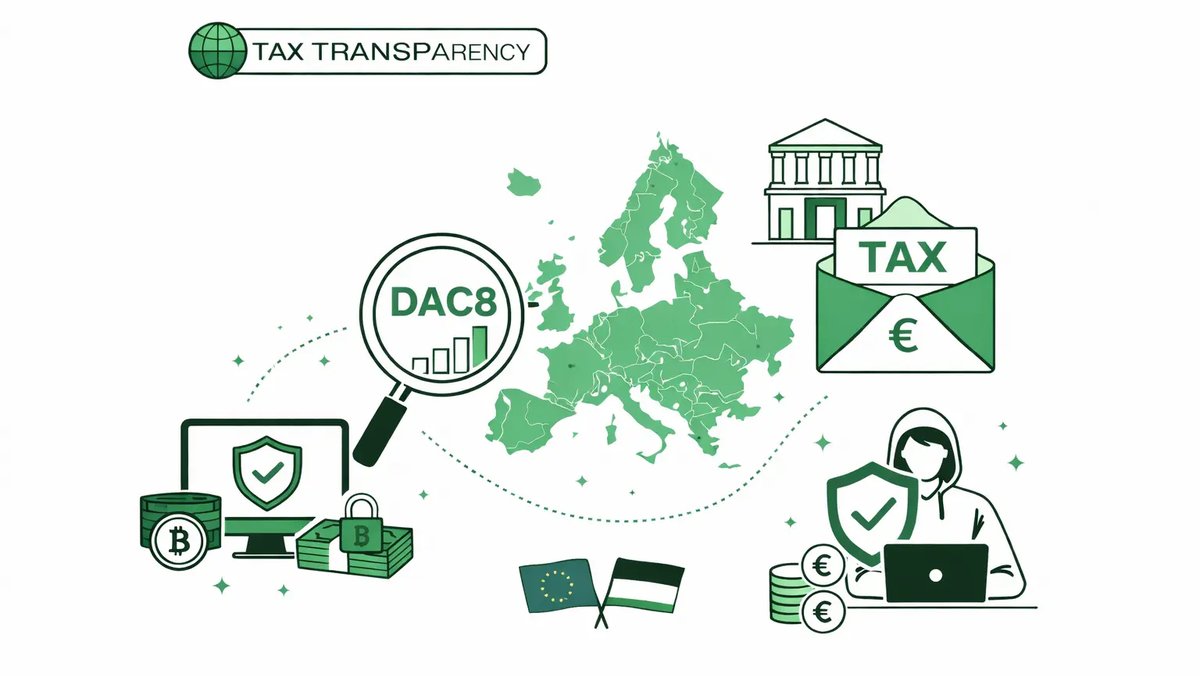
DAC8 And The Next Phase Of Crypto: From Wild West To Taxed Infrastructure
For more than a decade, digital assets have often been framed as existing on the edges of the financial system: difficult to classify, hard to monitor and awkward to fit inside traditional tax rules. That narrative is now changing in a very visible way. The European Union’s new digital-asset tax framework, known as DAC8, will take effect on 1 January 2026, pulling crypto firmly into the same information-reporting architecture that already covers bank accounts and investment products.
At first glance this looks like a regional legal update. In reality, it is a strong signal that crypto has graduated from being an experimental niche to becoming a reportable, traceable and taxable part of household and corporate balance sheets. And while regulators are tightening their grip, the last 24 hours in markets show a familiar tension: fear on the surface, but ongoing innovation and accumulation beneath.
Bitcoin is under pressure and sentiment indices lean towards anxiety, yet CZ is publicly encouraging traders to accumulate during periods of worry. Ethereum has laid out a two-step roadmap for 2026 with the Glamsterdam and Heze-Bogota hard forks. Tron is quietly processing over 1 billion USD in on-chain perpetuals volume per day. Uniswap governance has approved a major redeem-and-burn of 100 million UNI. At the same time, a serious security flaw on a browser extension has led to unauthorised withdrawals, reminding everyone that technology risk has not disappeared. In the macro backdrop, silver set a new all-time high at 75 USD, and the S&P 500 closed at a record 6,932, while long-time critic Peter Schiff once again warned of economic trouble ahead.
Viewed together, DAC8 and these market developments sketch a picture of a maturing asset class: one that is becoming more regulated, more integrated and more complex, even as it continues to be emotionally volatile.
1. DAC8: From Opaque Wallets To Systematic Reporting
DAC8 is the latest update to the EU’s Directive on Administrative Cooperation. Earlier versions focused on bank accounts, insurance products and traditional securities. DAC8 extends this framework to digital-asset service providers, requiring them to collect and share information about users’ holdings and transactions with tax authorities across the bloc.
Three features are particularly important:
• Wide scope. The rules do not just apply to native crypto exchanges based in the EU. Any platform or service with EU-resident users may fall under the reporting umbrella, including custodial wallets, certain lending and staking services, and other intermediaries that hold or move digital assets on behalf of clients.
• Standardised cross-border reporting. DAC8 is designed to make it much harder for residents to keep crypto activity in one jurisdiction invisible to authorities in another. The idea is that tax offices can reconcile information between countries and reduce mismatches between declarations and reality.
• Alignment with broader transparency trends. DAC8 does not exist in a vacuum; it sits alongside other initiatives such as the OECD’s Crypto-Asset Reporting Framework. Together, they point towards a world where anonymity towards tax authorities is no longer a realistic assumption for most users who interact with regulated platforms.
For retail users, this does not necessarily mean higher tax rates, but it does mean less room for ambiguity. For institutions, DAC8 is almost good news: greater clarity often makes it easier for compliance departments to approve exposure.
2. What DAC8 Signals About The Next Crypto Cycle
Regulation is often framed in oppositional terms: freedom versus control, innovation versus bureaucracy. A more practical way to interpret DAC8 is to see it as evidence that crypto has become too large to ignore. Tax authorities do not invest resources into building reporting pipelines for asset classes they consider trivial.
Several structural implications follow:
• “Offshore by design” becomes harder. Business models built entirely on the assumption that activity cannot be connected to real-world identities will face increasing pressure as more value migrates to venues that cooperate with tax frameworks.
• Compliant infrastructure gains a competitive edge. Exchanges, custodians and on-ramp providers that can demonstrate strong reporting and know-your-customer processes will be better positioned to serve both retail users and institutions that want to avoid legal surprises.
• Portfolio construction becomes more conventional. For many investors, DAC8 reduces the perception that crypto sits outside the financial system. Instead, Bitcoin, Ethereum and other large-cap assets start to resemble a new bucket within an established asset-allocation process, with similar tax treatment to other investments.
There is also a cultural shift. The early appeal of crypto included a strong element of opacity. DAC8 signals that the next phase will be less about hiding and more about optimising within clear rules. For long-term adoption, that trade-off is likely unavoidable.
3. Fear At The Surface: CZ, Schiff And The Sentiment Split
While lawyers and compliance teams digest DAC8, market sentiment tells a different story. Price action has been choppy, and many short-term participants are cautious. Against that backdrop, CZ’s public call for buyers to step in while fear dominates reflects an older market principle: periods of pessimism often offer better long-term entry points than moments of euphoria.
On the other side of the spectrum, long-time critic Peter Schiff is again warning of severe economic stress, encouraging investors to prepare for what he describes as a historic downturn. At the very same time, the S&P 500 is printing fresh all-time highs at 6,932, and silver has reached 75 USD per ounce.
This split is telling. Precious metals and equities can rally together when investors expect an extended phase of financial repression: solid nominal growth, elevated valuations and an undercurrent of concern about currency strength. Crypto sits awkwardly between these narratives. It is volatile like growth assets but marketed by some as a store of value like metals, which can confuse those who are new to the space.
For thoughtful participants, the key is not to pick a “hero” (optimistic founder versus cautious macro commentator), but to recognise that both sides are reacting to genuine uncertainty about debt, inflation and policy. DAC8’s arrival does not resolve those macro questions; it simply makes it safer for more institutions to participate in digital assets while they are being debated.
4. Ethereum’s 2026 Roadmap: Building Under Regulatory Clouds
While politicians focus on frameworks like DAC8, protocol developers continue to build. Ethereum’s newly shared roadmap for 2026 outlines two major upgrades:
- Glamsterdam (mid-2026). This hard fork is planned to focus on parallel processing and a higher gas limit. In simple terms, the goal is to make the network process more transactions at the same time, at lower average cost, while preserving security assumptions.
- Heze-Bogota (late-2026). This upgrade emphasises privacy enhancements and resilience against censorship, for example by making it harder for intermediaries to selectively exclude certain transactions from blocks.
Taken together, these upgrades send a clear message: Ethereum is trying to be both more scalable and more robust as an open infrastructure layer. Regulation such as DAC8 is focused on intermediaries that serve end users; in parallel, the base protocols are trying to ensure they remain neutral, programmable and globally accessible.
For investors, the roadmap matters because it shapes the types of applications that will be viable in the next cycle. More efficient blockspace and better privacy tools can support everything from consumer applications to institutional finance. It also underscores a theme that DAC8 indirectly reinforces: the line between “traditional” and “decentralised” finance is likely to blur as regulated entities build on public chains.
5. Tron Perpetuals: Liquidity Concentrates In Efficiency
Another notable development is the surge in on-chain perpetual futures activity on Tron. While many ecosystems have seen derivatives volumes soften during the market downturn, Tron has recorded over 1 billion USD in daily perps volume for two consecutive days, with seven-day volumes up 176% week-on-week.
This divergence highlights a structural pattern: liquidity tends to concentrate where transactions are cheap, fast and close to where stablecoins live. Tron’s role as a hub for stablecoin transfers gives it a built-in base of capital that can be repurposed into derivatives markets. In quieter macro conditions, this might be dismissed as a temporary spike. In the current environment, it shows that:
- On-chain derivatives are no longer a niche experiment; they are becoming a significant slice of trading infrastructure.
- Competition between chains is shifting from purely technical debates to who can offer the most practical combination of cost, speed and liquidity.
- Regulatory clarity (including tax rules like DAC8) may eventually determine how sustainable this activity is, as different jurisdictions evaluate on-chain leverage through their own risk lenses.
For risk-conscious participants, the key takeaway is not to chase volume for its own sake, but to recognise that derivatives liquidity is a leading indicator of where sophisticated participants are choosing to operate.
6. Protocol Balance Sheets: UNI, ARB, CC And The Rise Of Active Treasury Management
Beyond trading activity, governance decisions continue to reshape how major protocols handle their own “corporate” finances:
• Uniswap has approved a proposal to redeem and burn 100 million UNI while updating its tokenomics. This move both reduces circulating supply and aims to tie UNI more closely to the protocol’s actual usage and fee generation.
• Arbitrum developer Offchain Labs has been buying additional ARB, signalling long-term confidence in the network’s role within the layer-two landscape.
• Token CC has gained around 30% over the week after DTCC announced plans to tokenise U.S. Treasuries on Canton Network. That announcement reinforces a broader trend: tokenised government debt is becoming a central building block for on-chain finance.
These decisions share a common thread: protocols are behaving more like active asset managers. They are adjusting supply, buying back tokens, and linking their economics to real-world assets such as government bonds. That evolution dovetails almost perfectly with DAC8’s arrival. The more protocols resemble structured financial entities, the more regulators are likely to treat their tokens as reportable financial instruments.
7. Security Lessons: The Trust Extension Incident
Against this backdrop of institutionalisation, the market received another reminder that operational risk is still very real. A serious security issue in version 2.68 of a popular browser extension led to unauthorised withdrawals from hundreds of users, with losses estimated at more than 6 million USD.
From a brand-safety perspective, it is important to emphasise that incidents like this are not inevitable features of crypto; they are the result of software design, testing and user-protection practices. The key lessons are familiar but worth repeating:
- Wallets and browser extensions are critical security layers. Any update that affects transaction signing or key management needs careful scrutiny.
- Diversification of custody is a risk tool. Even for advanced users, spreading assets across different storage methods can reduce exposure to any single point of failure.
- Regulatory frameworks like DAC8 cannot eliminate technical risk. They can encourage better practices and disclosures, but users still need to evaluate the tools they rely on.
For developers, the incident is a reminder that the fastest way to build trust in a DAC8 world is not slogans about decentralisation, but robust engineering and transparent incident response.
8. Signals From Founders: ADA Rumours And Reputation Management
Another story from the last 24 hours concerns Cardano. Its founder, Charles Hoskinson, publicly rejected rumours that he has been selling ADA, insisting that he has not been offloading holdings.
Whether or not traders believe any given statement, the episode highlights how sensitive markets still are to founder behaviour. In a space where many tokens are closely associated with individuals or small teams, perception of alignment between founders and communities remains a major driver of sentiment.
In the context of DAC8, this raises an interesting question: as reporting becomes more standardised, will there be more demand for verifiable disclosures about founder holdings and vesting schedules? If regulators expect transparency from ordinary users, it would not be surprising to see investors ask for a higher bar from project leaders as well.
9. Putting It All Together: A More Accountable, Still Volatile Market
The stories of the day may look scattered — a European tax directive, a founding figure urging people to buy Bitcoin during a fearful phase, a new Ethereum roadmap, a Tron derivatives surge, protocol buybacks, a security incident, a founder rebutting rumours, silver and stocks at record highs. In reality, they are different facets of the same transition.
The transition can be summarised in three themes:
• From opacity to accountability. DAC8 is turning digital assets into reportable items on tax forms. Protocol treasuries are behaving more like corporate balance sheets. Founders are expected to be more transparent about their own positions.
• From experimentation to infrastructure. Ethereum’s upgrades, Tron’s perps volumes and DTCC’s tokenisation efforts all point to a future where blockchains are not side projects, but underlying rails for payments, markets and collateral.
• From single narratives to layered reality. Precious metals at record highs coexist with record equity indices. Crypto can be both an instrument for long-term diversification and a source of short-term stress. Macro pessimism and technological optimism can occupy the same chart.
For participants trying to navigate this environment, the most useful mindset may be neither uncritical enthusiasm nor blanket scepticism, but structured curiosity: understanding how regulation like DAC8 reshapes incentives, how protocol-level decisions affect token economics, and how macro conditions influence risk appetite across asset classes.
In that sense, the next phase of crypto is less about dramatic slogans and more about detail: reporting rules, upgrade schedules, treasury policies, liquidity venues and security practices. The market may still feel noisy day to day, but underneath, it is slowly becoming a more recognisable part of the global financial system — taxed, monitored, and, for those who take the time to understand it, increasingly usable.
Disclaimer: This article is for educational and analytical purposes only and does not constitute investment, legal or tax advice. Digital assets and other financial instruments carry risk and may not be suitable for every investor. Always conduct your own research and consider consulting a qualified professional before making financial decisions.