Kevin O’Leary, the CLARITY Act and the Flight to Quality in Crypto
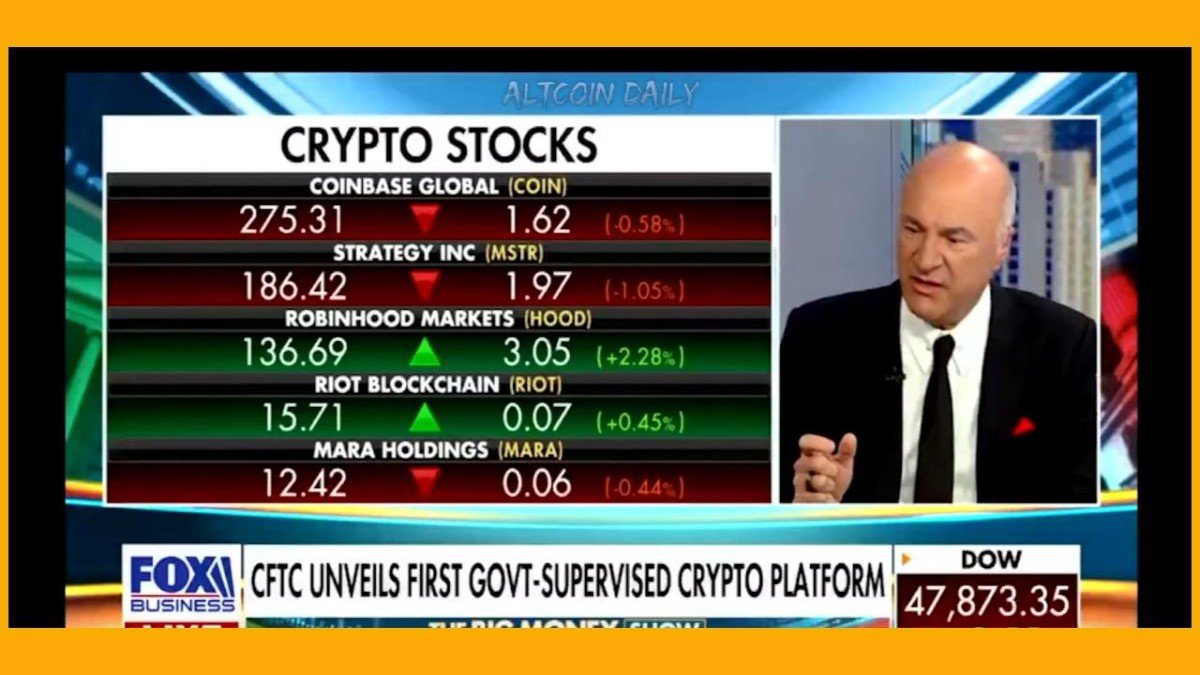
Kevin O’Leary has gone from one of Bitcoin’s loudest television skeptics to one of its most visible advocates for regulation. In 2025 he has repeatedly told audiences that his own portfolio now has a double-digit allocation to digital assets, but that the industry has “hit a wall” until U.S. lawmakers finish building a proper rulebook. In his framework, the Digital Asset Market Clarity (CLARITY) Act and a companion stablecoin bill are the keys that unlock a wave of institutional capital.
O’Leary’s latest message adds an important twist: even once the legal plumbing is in place, he believes most of that capital will concentrate in just two networks—Bitcoin and Ethereum. In his words, investors who simply hold BTC and ETH already capture the vast majority of the sector’s long-term upside, while thousands of smaller tokens fight for attention without attracting the deep, conservative capital that pension funds and insurance companies represent.
Is that view overly simplistic, or is it a realistic reading of where the market is heading? To answer that, we need to look at both sides of his argument: the regulatory shift he is excited about and the portfolio logic behind a two-asset core strategy.
What the CLARITY Act Actually Does
The Digital Asset Market Clarity Act of 2025—often shortened to the CLARITY Act—is a House bill designed to give the U.S. a more coherent framework for digital assets. Among other things, it would:
• Define when a token is treated as a digital commodity overseen primarily by the Commodity Futures Trading Commission (CFTC), and when it remains under Securities and Exchange Commission (SEC) jurisdiction.
• Create an expedited pathway for projects to register and trade as digital commodities once they meet disclosure and decentralization criteria.
• Lay out rules for digital commodity exchanges, custodians and brokers, bringing them closer to the regulatory standards that apply to traditional venues.
• Provide limited exemptions for token fundraising, so early-stage projects can raise capital under structured disclosures rather than navigating ambiguous enforcement risk.
Parallel proposals, such as the GENIUS Act for payment-stable tokens, focus on reserve quality, audit requirements and limits on who can issue dollar-linked assets. Together, these bills sketch the outline of a regulatory map that divides responsibility between the SEC and CFTC while giving institutions a clearer sense of what is permitted.
For O’Leary, this is not just a legal clean-up exercise. He frames it as infrastructure: without predictable classifications, registration frameworks and supervisory regimes, the largest pools of capital—pension funds, endowments, sovereign wealth funds—simply cannot participate. Their investment committees are bound by risk policies and fiduciary duties that demand clear rules of the road.
Why Institutions Care More About Rules than Narrative
Retail investors often focus on narratives: new technologies, communities, and potential use cases. Institutional investors, especially those managing retirement savings, start from a different place. Before they can even form a view on value, they need to know:
- Who regulates the asset and the platforms on which it trades.
- What disclosures issuers must provide, and how those disclosures are enforced.
- Which custodians meet regulatory and insurance standards.
- How the instrument is treated in capital-adequacy and risk models.
Many of these questions have been hard to answer in the U.S. Up to now, agencies have often relied on case-by-case enforcement instead of tailored rules. Different regulators have sent conflicting messages about whether particular tokens are more like commodities or securities. For a large pension fund, that ambiguity is a reason to wait on the sidelines, not a call to adventure.
The CLARITY Act does not magically solve every open question, and it may still change significantly before it becomes law. Even so, it signals a shift from improvisation to codified structure. For risk-averse institutions, that is the difference between “interesting story” and “potential allocation.”
The Long Tail of Tokens: Innovation and Dilution
O’Leary’s other controversial claim is that most of the crypto market beyond Bitcoin and Ethereum is essentially irrelevant from an investment standpoint. He highlights the sheer number of small tokens with limited liquidity or adoption and argues that very few of them can pass the due-diligence filters of serious institutions.
It is easy to caricature this view as hostility toward innovation, but there is a more nuanced way to read it. The digital asset landscape now includes tens of thousands of listed tokens across global venues. Many of them represent experiments: early-stage projects, community initiatives or niche financial instruments. A few will evolve into durable networks or successful applications. Many will not.
For a retail participant, allocating a small portion of capital to such experiments may feel similar to angel investing or backing a startup: high risk, potentially high reward. For a pension fund that has to defend every position to regulators and beneficiaries, the calculus is different. They are less concerned with maximising upside from niche projects and more focused on gaining exposure to the broad structural themes of digital assets with minimal headline risk.
This is where O’Leary’s emphasis on Bitcoin and Ethereum comes in. His argument is that, once regulation opens the gate, these two networks sit at the sweet spot of deep liquidity, institutional infrastructure and recognisable narratives.
Bitcoin and Ethereum’s Dominance in the Data
Several independent data sets support the idea that Bitcoin and Ethereum already capture the bulk of the sector’s economic weight:
• Across multiple industry reports in 2025, Bitcoin has consistently represented close to 60% of total crypto market value, with Ethereum adding another 8–10%. Together they account for more than two-thirds of aggregate market capitalisation, even before considering derivatives and structured products built on top of them.
• Ethereum processes some of the highest daily transaction volumes in the industry and underpins a large share of decentralised finance and tokenisation activity, while Bitcoin maintains the highest hash rate and most battle-tested monetary policy.
• Spot exchange-traded products now exist for both assets in major markets, and they dominate crypto ETF assets under management. The deepest regulated futures markets are also for BTC and ETH, supporting hedging and price discovery.
In statistical terms, many multi-asset crypto indices find that Bitcoin and Ethereum explain a large fraction of overall market variance. When prices move sharply, these two instruments often lead, with smaller tokens amplifying or lagging the move rather than creating their own independent trend.
That does not mean everything else is irrelevant. It does mean that, if an investor’s goal is simply to have exposure to the broad digital-asset theme, a portfolio that holds only BTC and ETH may already capture a large share of the sector’s systematic risk and potential upside.
Recent Market Behaviour: A Quiet Case Study
The last few months have offered a practical demonstration of this dynamic. After reaching record highs earlier in 2025, the crypto market has gone through a sharp correction. Headlines have focused on Bitcoin dropping from six-figure levels back toward the mid-$80,000s and on Ethereum retracing part of its rally. But beneath the surface, many smaller tokens have experienced even steeper drawdowns and thinner liquidity.
Broad altcoin indices have frequently underperformed a simple two-asset basket of BTC and ETH during the same period. In other words, an investor who owned only these two networks often fared better, on both return and volatility measures, than one who spread capital across dozens of smaller names. That pattern reinforces O’Leary’s point: during stress, capital tends to migrate toward the most established, liquid assets with the clearest regulatory path.
Why Institutions Gravitate to BTC and ETH
From the perspective of a large institution, Bitcoin and Ethereum tick boxes that few other networks currently can:
• Liquidity. Both assets trade with deep order books across regulated venues and derivatives markets. Large transactions are easier to execute without excessive price impact.
• Custody infrastructure. Multiple qualified custodians offer segregated accounts, insurance arrangements and integrations with traditional prime brokers, making operational risk easier to manage.
• Regulatory familiarity. Policymakers, courts and supervisors have spent years analysing Bitcoin and Ethereum, and emerging legislation often references them explicitly when defining digital commodities versus securities. That familiarity does not remove all uncertainty, but it reduces the risk of surprise reclassification.
• Analytical coverage. Research houses, rating agencies and index providers maintain dedicated coverage of BTC and ETH, allowing investment committees to rely on external analysis instead of having to build every model from scratch.
By contrast, a small token with limited history, modest liquidity and an evolving use case is harder to justify in a formal risk framework—especially when an institution is just beginning to build its digital-asset program. It is not that such assets can never be interesting; it is that they are unlikely to be the starting point.
Does a BTC + ETH Focus Ignore Innovation?
A fair criticism of the “only BTC and ETH matter” narrative is that it can sound dismissive of innovation happening elsewhere in the ecosystem. Layer-2 networks, application-specific chains and various protocol tokens experiment with new ways to coordinate computation, capital and communities. Some may evolve into important infrastructure in their own right.
However, there is a useful distinction between core monetary exposure and venture-style experimentation. For many large investors, Bitcoin and Ethereum will form the backbone of a digital-asset allocation, much as broad equity indices form the backbone of a stock portfolio. Beyond that, they may allocate a small "innovation bucket" to more speculative projects, venture funds or thematic indexes that capture emerging themes.
For individual investors, the conversation becomes one of risk budgeting. How much of a portfolio should be in relatively established assets with deep liquidity and track records, and how much in smaller, less proven networks? O’Leary’s intervention is best read as a reminder that it is possible to have meaningful exposure to the digital-asset story without needing to hold every token in the market.
Regulation as a Filter, Not Just a Gate
One under-appreciated effect of the CLARITY Act and similar initiatives is that they do more than open the door for new participants; they also act as filters. To qualify as a digital commodity or to trade on a registered venue, projects will need to meet disclosure, governance and compliance standards. Some existing tokens may not attempt that transition. Others may find the cost or scrutiny unattractive.
That does not mean those projects disappear, but it does mean they may remain in a more experimental or niche realm, outside the zone where pension funds and insurance companies operate. Meanwhile, assets that do pass through the regulatory filter—almost certainly including Bitcoin and Ethereum—gain an additional layer of legitimacy in the eyes of conservative allocators.
This is part of what O’Leary means when he says regulation will redirect capital toward a smaller set of assets. Rules do not just protect investors; they sort the market into tiers of readiness for institutional engagement.
How Individual Investors Can Use This Debate
For everyday market participants, the high-level debate between O’Leary and his critics can be translated into a few practical questions:
• What is my goal? If the aim is broad exposure to the long-term adoption of blockchain technology and digital value, a concentrated focus on BTC and ETH may be sufficient. If the goal is to seek outsized gains from early projects, a more diversified—but riskier—approach might make sense.
• How do I feel about regulatory risk? Assets with clearer legal treatment and deeper institutional infrastructure may be less exposed to sudden policy changes than those operating in grey areas.
• How much complexity can I manage? Following dozens of projects, each with its own technical and governance model, demands time and expertise. Some investors prefer the simplicity of a few high-conviction positions.
There is no one right answer. But understanding why major institutions are preparing to prioritise Bitcoin and Ethereum can help individual investors make more deliberate choices rather than simply chasing whatever is trending on a given day.
Conclusion: Clarity, Concentration and the Next Phase of Crypto
Kevin O’Leary’s comments distil two important truths about where digital assets stand in late 2025. First, without a durable regulatory framework like the CLARITY Act and related legislation, the largest and most conservative pools of capital will remain hesitant, regardless of how compelling the technology appears. Second, even with that framework in place, not every token will benefit equally. Capital that must answer to regulators, boards and retirees will almost certainly concentrate in assets that combine clear rules, deep markets and robust infrastructure.
Today, Bitcoin and Ethereum are the strongest candidates for that role. They have the most established track records, the broadest recognition, and the most mature ecosystem of custodians, exchanges and analytical coverage. Whether they ultimately capture 60%, 80% or 90% of the sector’s long-term value is unknowable. What seems likely is that they will remain at the centre of institutional strategies, while the long tail of tokens continues to function as an innovation laboratory on the periphery.
For investors, regulators and builders alike, the challenge is to harness this flight to quality without suffocating experimentation. A well-crafted regulatory framework can make room for both: a resilient core of widely held assets and a dynamic frontier where new ideas are tested. The conversation sparked by O’Leary’s remarks is ultimately about how to strike that balance as crypto moves from its improvisational early years into a more structured phase of integration with the global financial system.
Disclaimer: This article is for informational and educational purposes only. It does not constitute investment, financial, legal or tax advice and does not recommend any specific asset, product or strategy. Digital assets are volatile and may not be suitable for every investor. Anyone considering an allocation should carefully evaluate their objectives, financial situation and risk tolerance, and consult qualified professionals where appropriate.