Spot Bitcoin ETFs Open 2026 With $1.2B in Two Days: What the Flow Tape Is Really Saying
Bloomberg’s Eric Balchunas highlighted a punchy datapoint: U.S. spot Bitcoin ETFs entered 2026 with remarkable momentum, pulling in more than $1.2B of net inflows in the first two days. On the surface, that reads like a simple “more demand, higher price” story. But flow data is never just a scoreboard—it’s a fingerprint. It tells you who is buying, what constraints they face, and how “Bitcoin exposure” is being packaged for the largest pools of capital.
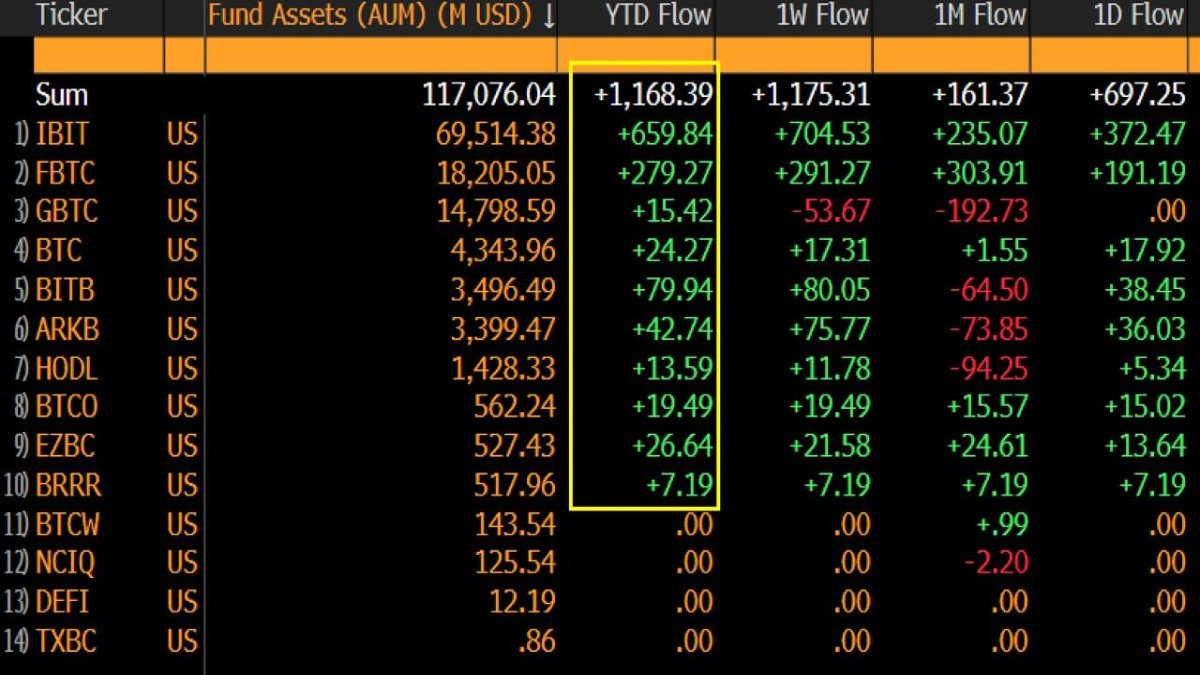
The table shared alongside the comment is particularly revealing because it separates headline inflows from the underlying composition: the largest products dominate the tape, the legacy products behave differently, and the flow cadence suggests a buyer that isn’t chasing memes—it’s executing a policy. That distinction matters, because policy-driven buyers change the market’s texture even when they don’t change the narrative.
Why the first two days matter more than the headline
Early-year flows are a special kind of information. January is when many investors reset risk budgets, implement new model allocations, and deploy capital that was deliberately held back for reporting or rebalancing reasons. That means the first week can show “real intent,” not just opportunistic trading. If the numbers are large, they often reflect an organizational decision—committees, mandates, and re-weights—rather than a spontaneous retail stampede.
That doesn’t make the signal automatically bullish. It makes it diagnostic. Strong early inflows can imply that Bitcoin is being treated less like a speculative satellite and more like a portfolio ingredient that must be acquired through compliant channels. In other words, the ETF wrapper is turning Bitcoin from an identity trade (“I’m a crypto person”) into a workflow trade (“This belongs in the allocation toolkit”).
Follow the concentration: the buyer is voting for liquidity, not novelty
The table’s most underrated message is concentration. The largest funds capture the lion’s share of net inflows—exactly what you would expect if the marginal buyer is institutional, fee-aware, and operationally conservative. Institutions don’t optimize for excitement; they optimize for execution quality, platform approval, and the ability to move size without moving the market. In practice, that usually means the biggest, most liquid vehicles win the first wave of adoption.
In the shared snapshot, the aggregate line shows roughly $117.1B in total AUM and about $1.17B in YTD net inflows early in the year. Within that, IBIT is shown with about $69.5B AUM and roughly $659.8M YTD inflows, while FBTC shows about $18.2B AUM and roughly $279.3M YTD inflows. That split is a clue: this isn’t “money buying Bitcoin ETFs” as a monolith—it’s money selecting specific pipes where compliance and liquidity feel strongest.
The deeper point: the market is rewarding distribution and reliability. When flows cluster in the dominant products, it suggests the buyer cares about (1) spreads and trading depth, (2) operational confidence around custody and reporting, and (3) internal approvals that let advisors act. This is how assets become mainstream: not by being loved, but by being easy to own.
How ETF inflows translate into spot demand (and why it’s not a 1:1 relationship)
It’s tempting to treat ETF inflows as direct “spot buys.” Reality is more nuanced. ETF shares are created and redeemed through authorized participants (APs) who source Bitcoin via a mix of venues—OTC liquidity, exchanges, internal inventory, and sometimes derivatives hedging. A day with large net inflows can lead to meaningful spot demand, but the pathway can be buffered by market makers who manage inventory and execution over time to reduce impact.
Still, net creation pressure matters because it changes the liquidity regime. If creations are persistent, market makers must replenish Bitcoin inventory repeatedly. That can tighten spot availability during risk-on stretches and compress downside liquidity during drawdowns—especially when other demand sources (like corporate treasury buying or offshore leverage) move in the same direction.
Here’s the practical translation layer to keep in mind:
• Inflow day: capital enters the ETF; APs may need to create shares; sourcing Bitcoin becomes the operational task.
• Execution window: sophisticated desks often spread purchases to reduce slippage, meaning spot impact can be distributed across sessions.
• Feedback loop: if price rises while inflows persist, it can attract additional allocation interest (momentum + policy), reinforcing the cycle—until volatility flips the risk models.
What this says about 2026’s Bitcoin market structure
A strong ETF start doesn’t just hint at demand; it hints at who sets the marginal price. When ETF channels dominate new buying, Bitcoin begins to behave more like a macro asset with scheduled flows than a purely crypto-native instrument. That shift has pros and cons. On the positive side, policy-driven buyers tend to be less reflexive than leveraged traders; they may rebalance instead of panic. On the negative side, institutional risk systems can become synchronized—when volatility spikes, multiple models can de-risk at the same time.
That’s why the most useful question for 2026 is not “How high can Bitcoin go?” but “What kind of market is Bitcoin becoming?” If ETFs keep absorbing steady inflows, Bitcoin’s volatility may gradually migrate from liquidation-driven chaos toward allocation-driven waves: fewer sudden cliffs, more rolling drawdowns that correspond to macro conditions, rates, and risk appetite. Not necessarily safer—just different.
Three risks that can sit behind ‘strong inflows’
Flow surges are exciting, but they can also mask fragility. When a market gets used to steady inflows, it builds expectations of constant bid support. That’s where complacency forms. The best way to stay rational is to name the failure modes clearly—without turning them into fearmongering. Educational analysis means respecting both upside narratives and downside mechanics.
Three risks worth watching if ETF momentum stays hot:
• Flow reversal risk: early-year allocations can pause after initial positioning. If price runs too far, too fast, committees may wait rather than chase.
• Macro shock correlation: in stress regimes, correlations rise. Bitcoin can trade like a high-beta risk asset even if the long-term thesis is “digital reserve.”
• Liquidity mismatch narratives: the ETF wrapper is liquid, but the underlying market depth has limits. In extreme scenarios, spreads widen and execution costs rise—especially if multiple vehicles experience outflows simultaneously.
Conclusion
The “$1.2B in two days” headline is impressive—but the more durable takeaway is what the flows imply about buyer identity. The tape looks like it’s being driven by liquidity-seeking, compliance-first capital using ETFs as the default bridge into Bitcoin exposure. That is a structural shift: it doesn’t guarantee a straight-line rally, but it does suggest Bitcoin is increasingly being treated as a portfolio component rather than a niche trade.
If 2026 is the year Bitcoin transitions further into mainstream allocation, the real story won’t be a single price print. It will be the persistence of net creations across weeks and months—and whether that demand survives the first serious volatility test of the year.
Frequently Asked Questions
Do strong ETF inflows guarantee Bitcoin price upside?
No. Inflows can be offset by other selling (profit-taking, miner flows, derivatives hedging, or macro de-risking). Flows are a demand signal, not a price promise.
Why do the biggest ETFs capture most of the inflows?
Because large allocators prioritize liquidity, platform approval, operational confidence, and execution quality. Those factors tend to concentrate flows in the largest products.
Is an ETF inflow the same as buying spot Bitcoin?
Not exactly. ETF creations often require sourcing Bitcoin, but the pathway can include inventory management and hedging, so the spot impact may be spread out over time.
What’s the best single metric to watch next?
Net flows over multiple weeks, not one or two days. Persistence matters more than a burst—especially if it continues through volatility.
Disclaimer: This article is for educational and informational purposes only and does not constitute investment advice or a recommendation to buy or sell any asset. Crypto assets are volatile and involve risk, including potential loss of principal.