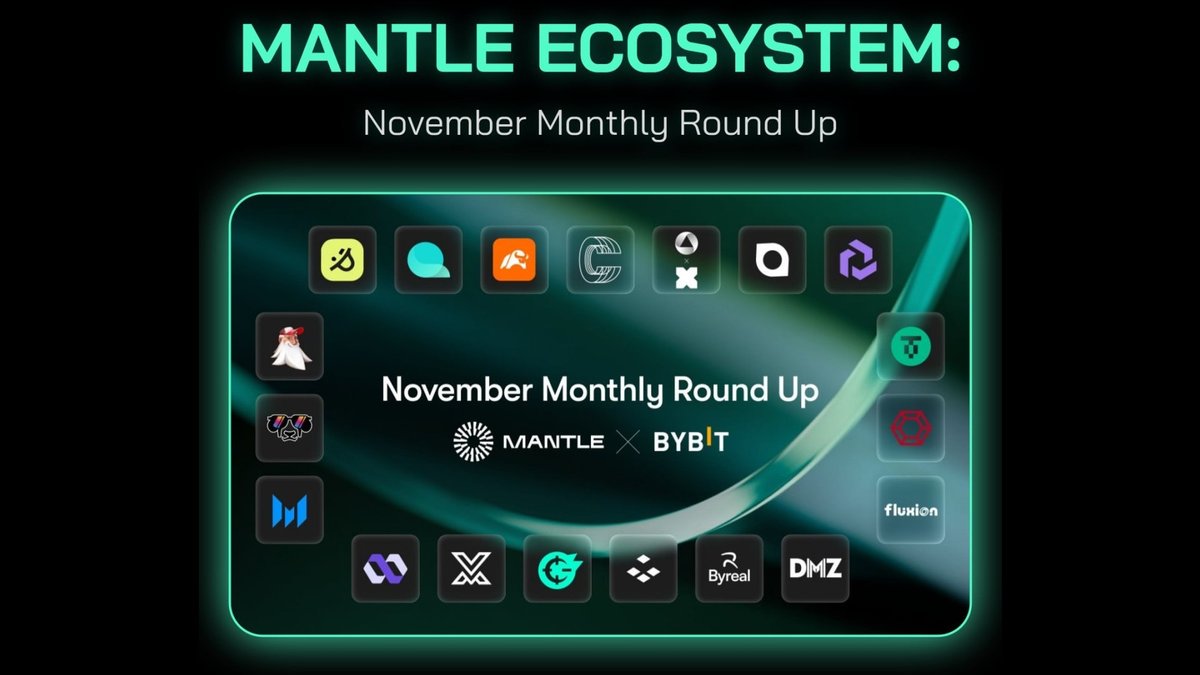
Mantle’s November Round-Up: RWA, Prediction Markets and New On-Ramps Set the Stage for 2026
For much of this cycle, Mantle has been an under-the-radar Layer-2: technically solid, backed by deep reserves, but rarely in the loudest narratives. November’s ecosystem update suggests that this might be changing. Instead of chasing a single headline vertical, Mantle is quietly laying bricks across several fronts at once—real-world assets (RWA), prediction markets, institutional on-ramps and consumer-facing experiences.
Viewed in isolation, each announcement is just another tweet or blog post. Taken together, they read like a roadmap for how a rollup can mature from “cheap block space” into a full-stack environment where capital, builders and end users all have a reason to stick around.
1. RWA as a Storytelling Wedge: The Mantle RWA ScholarSHIP
The headline initiative for November is arguably the Mantle RWA ScholarSHIP Content Bounty, launched in mid-month. The program invites creators, researchers and storytellers to produce original work around real-world assets on Mantle—anything from conceptual explainers to deep dives on specific tokenization use cases. The bounty allocates a total of $15,000 worth of MNT prizes across three tracks: research & analysis, video & storytelling, and culture & design.
Two points make this interesting beyond the prize pool itself.
• It treats RWA as a literacy problem, not just an engineering challenge. Instead of only funding smart-contract work, Mantle is explicitly rewarding explanations: how on-chain Treasuries work, why tokenized stocks might matter, what role stable-value products play in cross-border payments. That recognises that user adoption often lags not because the rails are missing, but because the story is still abstract.
• It builds a bridge between Mantle’s RWA stack and a broader creative community. Entries can be published on X, YouTube, TikTok and other platforms before being submitted for review. In practice, that turns the bounty into a distribution engine: good content both educates audiences and quietly onboards them into the Mantle brand.
The selection criteria emphasise originality, clarity and community impact, rather than pure hype. That may sound like marketing language, but it matters: networks that reward only short-term promotion tend to attract shallow engagement. By biasing toward thoughtful educational work, Mantle is trying to cultivate a base of advocates who can explain RWA concepts in plain language.
2. Builders at the Centre: Mantle’s Global Hackathon
Running alongside the content push is a global hackathon hosted with Bybit, featuring a six-figure prize pool for teams building on Mantle with a special emphasis on RWA, AI agents and new forms of on-chain liquidity. This is not unique—almost every major chain runs builder competitions—but the timing is telling.
Macro conditions have been volatile, and developer attention is fragmented across dozens of Layer-2 ecosystems. Launching a global hackathon now signals that Mantle wants to be seen as a place where serious builders can still raise grants, find liquidity partners and plug into institutional pipelines.
Equally important is the thematic focus. RWA is not just a buzzword here; it anchors concrete tracks such as tokenized equities, yield-bearing stable assets and compliant on-chain structured products. That aligns neatly with the partnerships Mantle has been announcing over the past few months.
3. Tokenized Stocks and the RWA Stack
One of Mantle’s quiet advantages is the way it has positioned itself at the intersection of crypto-native users and traditional finance. The November round-up highlights collaborations with Bybit, BackedFi and xStocksFi to bring tokenized shares of major companies onto Mantle.
In practice, these integrations allow users to gain price exposure to equities through on-chain instruments that are backed by off-chain custodial structures. While the exact implementations differ—some use fully backed on-chain tokens, others rely on synthetic replication—the broad effect is similar: Mantle becomes a venue where crypto collateral can sit alongside tokenized stocks, Treasuries or index-like products.
This matters for three reasons:
• Portfolio construction. Users who already hold MNT, stablecoins or other digital assets on Mantle can compose them with RWA exposures in a single environment instead of bridging out to another chain or returning to a traditional broker.
• Yield and risk management. DeFi protocols can build structured products—such as covered-call-style vaults or delta-neutral strategies—that blend tokenized stocks with on-chain liquidity. This opens the door for more nuanced risk profiles than “all-crypto” or “all-equities.”
• Institutional comfort. For professional investors, RWA rails help answer a persistent question: “Beyond native tokens, what else can I actually hold on this chain that fits my mandate?” The more familiar the underlying, the easier internal approvals become.
Of course, tokenized equities raise complex regulatory and operational questions. They depend on robust off-chain custodians, clear legal claims and transparent risk disclosures. Mantle is not alone here—multiple chains are competing to be the preferred venue for these assets—but its willingness to court partners in this domain shows where it expects real usage to come from over the next few years.
4. Liquidity Layers: MEVX, Anchorage Custody and the Bybit Alliance
Any RWA strategy lives or dies on liquidity. Mantle’s November updates therefore lean heavily into new execution venues and capital pathways.
MEVX, a native exchange on Mantle, has gone live with the goal of offering deep liquidity for spot and derivatives markets while tapping Mantle’s modular data-availability design to keep fees low. For newer networks, bootstrapping a flagship exchange is almost as important as the consensus layer itself: it gives market-makers and arbitrageurs a focal point, which in turn improves pricing for end users.
On the institutional side, Anchorage Digital Bank now supports MNT custody on Ethereum, giving professional clients a regulated venue to hold the token. That may sound like a niche detail, but it addresses a real friction point: many funds are operationally barred from self-custody or from using unregulated providers. Institutional-grade custody is often a prerequisite for larger tickets.
Meanwhile, Mantle’s long-running partnership with Bybit continues to deepen. November featured a joint campaign celebrating Bybit’s seventh anniversary with an advertised $2.5 million in rewards spread across trading incentives, quests and liquidity programs. For Mantle, this is effectively a demand-side subsidy: users who are already active on Bybit are nudged to bridge assets into the Mantle ecosystem and experiment with its native applications.
5. Prediction as a Primitive: PVPFUN and the Rise of AI-Driven Forecasting
Another intriguing piece of the puzzle is PVPFUN, an AI-powered prediction platform that launched on Mantle. Rather than focusing purely on speculative thrills, PVPFUN positions itself as a “social forecasting layer” where participants express views on real-world outcomes—elections, sports results, macroeconomic prints—and are rewarded for accuracy over time.
From an ecosystem perspective, prediction markets are valuable because they generate information as well as volume. When users stake their views on well-designed markets, the resulting prices compress a wide range of expectations into a single, continuously updated forecast. In a world where data is plentiful but signal is scarce, that is a powerful complement to charts and commentary.
PVPFUN taps Mantle’s low fees and fast finality to support frequent, small-ticket interactions, while AI components help with tasks such as surfacing notable markets, monitoring unusual activity and assisting users in understanding the implications of their positions. For Mantle, hosting such a platform strengthens its narrative as a home for data-intensive, latency-sensitive applications—not just static RWA instruments.
6. Expanding the Access Funnel: Moomoo and Beyond
Institutional custody and liquidity are only half the story; retail access matters too. One of the quieter November headlines was that Moomoo, a widely used traditional investing app, has started to support MNT trading. That effectively places Mantle alongside equities and exchange-traded funds in an interface designed for mainstream investors, not just crypto-native users.
When assets make this leap—from niche exchange listings to inclusion in multi-asset brokerage apps—it often reflects two things: sufficient market depth to support larger orders and a level of comfort from compliance teams. While this does not guarantee long-term adoption, it broadens the potential investor base considerably.
Taken together with Anchorage’s custody support, Mantle is building a distribution stack that touches both ends of the spectrum: regulated institutions on one side, retail investors using familiar brokerage tools on the other.
7. Why This Matters for Mantle’s 2026 Trajectory
It is tempting to view each of these initiatives as isolated bullet points, but they interlock in useful ways.
• RWA content and tokenized-stock integrations reinforce one another. As more tokenized instruments appear on Mantle, there is a growing need for educational material explaining how they work, how they are structured legally, and how they can be combined with existing DeFi primitives. The ScholarSHIP bounty helps fill that gap.
• Hackathons, MEVX and PVPFUN create a builder and user feedback loop. Developers who join the hackathon have live venues—exchanges, prediction platforms, RWA protocols—where they can plug in their innovations and immediately test demand.
• Institutional custody and retail listings expand the potential capital base that can participate in all of the above. Without those, even the best applications risk running into liquidity ceilings.
In other words, Mantle is not betting its future on a single “killer app.” Instead, it is assembling the components of a multi-sided marketplace: information (prediction markets), yield and exposure (RWA and tokenized stocks), execution (MEVX and partner venues), and education (ScholarSHIP and community content).
8. Risks and Open Questions
None of this is risk-free, and a sober analysis has to acknowledge the friction points.
8.1 Regulatory clarity around tokenized assets
Tokenized Treasuries and equities sit at the crossroads of securities law, banking regulation and digital-asset rules. Different jurisdictions may treat the same product very differently. If regulations tighten, protocols might have to restrict access, change structures or even unwind existing pools. Mantle’s strategy of working with regulated partners mitigates some of this risk but cannot remove it entirely.
8.2 Execution quality and user experience
Bringing in high-profile partners raises expectations. If bridges are clunky, interfaces confusing or support limited, users may try the ecosystem once and not return. For Mantle, 2026 will be a test of whether the infrastructure and developer tooling can keep pace with the marketing headlines.
8.3 Competitive pressure among Layer-2s
Mantle is part of a crowded field of Ethereum rollups, many of which are also courting RWA platforms, prediction markets and institutional custodians. Differentiation will hinge on subtle factors: fee stability during peak demand, quality of documentation, responsiveness of grant programs, and how quickly governance can adapt to new opportunities.
9. How Different Participants Can Engage
For readers trying to translate all of this into practical steps, it helps to think in terms of roles.
• Creators and researchers can explore the Mantle RWA ScholarSHIP and similar initiatives, using them as a sandbox to deepen their understanding of tokenized assets while building a portfolio of work.
• Developers may find the combination of global hackathon support, RWA rails and prediction-market primitives appealing. Mantle’s modular architecture and existing integrations with major liquidity venues give builders a reasonably mature base to iterate on.
• Institutional desks that already hold MNT through Anchorage or similar custodians can begin mapping out how Mantle-based products might fit into broader digital-asset strategies—whether as yield enhancers, diversification tools or hedging instruments.
• Retail users who access MNT through platforms like Moomoo or Bybit can start by treating Mantle as another ecosystem to learn about rather than as a place for aggressive speculation: try small, explore the variety of applications, and pay attention to how tokenized assets are structured.
Across all cohorts, one principle stands out: treat Mantle not just as a ticker, but as a network whose long-term value depends on the depth and resilience of its applications.
10. Conclusion: From Quiet Build to Potential Breakout
November’s Mantle ecosystem update is less about a single viral moment and more about momentum: content incentives that push RWA literacy forward, a builder competition that anchors developer attention, new exchanges and prediction platforms that generate activity, and serious work on institutional and retail access.
If 2024–2025 was the period when Layer-2s proved they could scale Ethereum, 2026 may be the year when they have to prove they can retain users in the face of intense competition and macro uncertainty. Mantle’s strategy—rooted in real-world assets, forecasting and cross-chain liquidity—positions it as one of the networks to watch in that next phase.
Whether this will translate into sustained adoption depends on execution, regulation and market sentiment. But from a structural point of view, Mantle is doing the slow, unglamorous work of building bridges between communities that rarely meet: content creators and quant funds, AI-driven prediction enthusiasts and tokenized-stock architects, DeFi natives and traditional brokerage users. That diversity may turn out to be its most important asset as the market heads into a new year.
Disclaimer: This article is for informational and educational purposes only. It does not constitute financial, investment, legal or tax advice, and it should not be treated as a recommendation to buy, sell or hold any digital asset. Digital asset markets are volatile and carry risks, and readers should conduct their own research and, where appropriate, consult qualified professionals before making any financial decisions.