From Perp DEXs to Prediction Markets: Is BNB Chain Quietly Setting Up the Next Big Cycle?
In 2025, one of the most visible success stories on BNB Chain was the rise of perpetual DEXs. Aster and a handful of peers turned BNB Chain into a busy venue for on-chain derivatives, attracting both liquidity and narrative attention. Many traders now associate BNB Chain with high-throughput, fee-efficient derivatives infrastructure.
As we move toward 2026, however, a new vertical is coming into focus: prediction markets—or more precisely, platforms that let users take tokenised positions on real-world events. Rather than trading only coins and indices, participants can express views on macro data, election outcomes, protocol metrics, sports and other measurable results through on-chain contracts.
What makes this shift notable is not just the product design, but the capital behind it. Kalshi, a regulated US event-market venue, has reportedly secured financing at an $11 billion valuation, while Polymarket has raised new capital at a valuation above $1 billion as its activity grows. Those numbers put leading prediction-market companies in the same valuation league as some layer-1s and far ahead of many DeFi protocols.
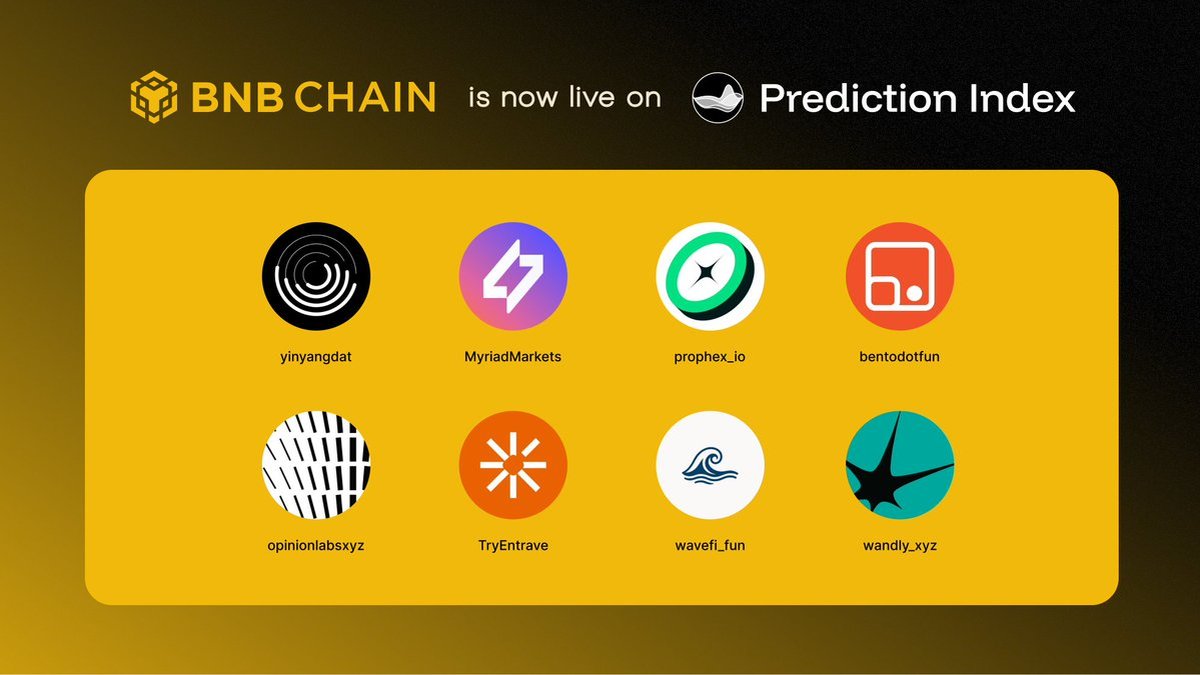
On the DeFi side, BNB Chain already has early prediction-market primitives such as Myriad and Opinion, which hold tens of millions of dollars in TVL even before any token generation event. Combine that with Binance’s wallet arm Trust Wallet rolling out a native Predictions tab, and it becomes hard to believe that the broader Binance ecosystem will ignore this vertical the way it initially did with perps years ago.
This article unpacks what is happening, why valuations look so rich, how BNB Chain fits into the bigger picture, and what a brand-safe approach to this trend might look like for both builders and users.
1. What Exactly Are Crypto Prediction Markets?
At a high level, a prediction market lets participants trade claims on future outcomes. Each market is defined by a clear, objective question with a verifiable resolution source—for example, whether a particular data release will come in above a threshold, or whether a given protocol metric will be achieved by a deadline.
On-chain, these markets are usually implemented as event contracts. A simple binary event might have two tokens, representing “Yes” and “No” outcomes, which settle to fixed values after the event is resolved. Before resolution, the prices of these tokens move based on supply and demand, reflecting the collective probability the market assigns to each outcome.
In practice, this structure is useful for several reasons:
- Price discovery on non-financial events. Markets can aggregate information about topics that do not have liquid futures or options on traditional exchanges.
- Risk transfer. Entities exposed to a particular outcome (for example, a protocol facing regulatory uncertainty) can partially hedge their risk via event markets.
- Data for forecasting. Observers can use event-market prices as one input into forecasting models, alongside surveys and quantitative indicators.
Crucially, not all prediction markets are the same. Kalshi operates under a CFTC framework in the United States and positions its contracts as regulated event instruments. Polymarket, by contrast, runs on public blockchains and has taken steps such as geofencing US users to align with enforcement actions. The DeFi platforms on BNB Chain tend to sit somewhere in between: they are permissionless protocols with open access, but their teams are increasingly aware that regulation will shape where and how users can interact.
2. Why Are Kalshi and Polymarket Valued Like Layer-1s?
For many crypto-native observers, the headline numbers around prediction markets were surprising. Seeing a regulated event-market venue like Kalshi valued at roughly $11 billion, or Polymarket raise funding at a valuation above $1 billion, invites obvious questions. Why should these businesses command similar multiples to base-layer blockchains or blue-chip DeFi protocols?
There are a few structural reasons.
First, the addressable market is not limited to web3 users. Event contracts can, in principle, serve anyone with an information-sensitive risk: corporates, asset managers, commodity producers, even media organisations. Kalshi’s strategy explicitly targets regulated participation from traditional finance and corporates, while Polymarket’s growth has been driven largely by internet-native users who are comfortable with self-custody and on-chain interfaces.
Second, prediction markets are naturally indexable. Once a platform reaches scale, it can create indices over its own markets: top-traded questions, sector-specific baskets, volatility measures and more. That makes them attractive as data providers and potential underlyings for structured products.
Third, event markets sit at the intersection of DeFi, data and consumer applications. They generate rich behavioural and quantitative data that can be reused by researchers, portfolio managers and even AI models. This “multiple use” nature of the same flow—trading fees, data licensing, index products—helps explain why venture investors treat them as potential category leaders rather than niche experiments.
On the DeFi side, aggregators like DefiLlama already track a prediction-market category with hundreds of millions of dollars in TVL, led by platforms such as Polymarket, Predict.fun, Opinion and others. Even if the raw TVL is smaller than for giant lending protocols, the fee density per unit of capital can be significantly higher because each unit of liquidity can underwrite many different event markets over time.
3. What BNB Chain Learned From the Perp DEX Wave
To understand why many observers expect BNB Chain to play a large role in prediction markets, it is useful to revisit the recent perpetual DEX boom.
Throughout 2025, protocols like Aster showed that BNB Chain’s combination of low fees, high throughput and tight integration with the Binance user funnel could turn it into a preferred venue for on-chain derivatives. Retail users appreciated the ease of bridging and the familiar environment, while liquidity providers benefited from strong volume and incentive programs.
Two lessons from that wave carry over directly to prediction markets:
• Distribution beats pure product. Many perp DEXs had comparable feature sets, but those aligned with large ecosystems and wallets gained disproportionate traction. In practice, this means that wallet-level integrations—such as those now appearing in Trust Wallet’s Predictions tab—can matter as much as the underlying smart contracts.
• Compliance and narrative must move together. As derivatives volume grew, regulators paid closer attention. Protocols that proactively engaged with policy discussions and risk management built more durable reputations than those that tried to stay under the radar.
If prediction markets end up following a similar trajectory, BNB Chain is again well-positioned: it has a large installed base, deep liquidity connections to centralised venues, and a history of turning emerging DeFi primitives into high-volume products.
4. Myriad, Opinion and the BNB Chain Playbook
Within this context, the emergence of Myriad and Opinion on BNB Chain is worth watching. According to data tracked by DefiLlama and related dashboards, these protocols have already accumulated tens of millions of dollars in TVL across their markets, despite not having launched native tokens yet.
Myriad, in particular, has gained visibility through its integration into Trust Wallet’s new Predictions section, which allows self-custody users to access event markets directly from a mainstream wallet interface. This kind of distribution partnership is exactly what helped perp DEXs explode in prior cycles: users discover complex on-chain products from within familiar apps rather than hunting for new websites.
Opinion, meanwhile, is building a more specialised interface with a focus on user experience and capital efficiency. Data from late 2025 shows that its TVL, although smaller than Polymarket’s, has grown quickly, illustrating the appetite for regionally accessible alternatives that live natively on BNB Chain.
For now, both protocols are still early. Their economics, governance design and long-term token distribution are not fully public, which is exactly why some sophisticated participants prefer to wait until after a token generation event to evaluate them more calmly instead of spending large amounts of time on speculative point campaigns. That “wait for TGE and re-assess” mindset is becoming more common after several cycles of aggressive airdrop farming that did not always translate into sustainable value.
5. Could Binance Itself Launch a Flagship Prediction Product?
Given this backdrop, a natural question arises: will Binance, or closely aligned entities within its ecosystem, eventually launch a flagship prediction-market product in the same way perp DEXs became a core focus in 2025?
There are several strategic reasons why an exchange group might explore this path:
• Diversified fee streams. Event markets generate fees that are partly orthogonal to pure crypto-asset volatility. Trading interest can remain strong around macro data, sports and policy events even when token prices are consolidating.
• Deeper user engagement. For many users, expressing a view on a specific outcome (for example, an interest-rate decision) can feel more intuitive than trading a token price. That can increase app engagement and cross-sell into other products.
• Strategic data. A large event-market venue effectively becomes an information hub. Aggregated flows and pricing can be valuable “market intelligence” across the rest of the product suite.
At the same time, there are constraints. Event markets sit at the intersection of financial regulation and rules on online speculative behaviour. Any major exchange or wallet that leans into this vertical needs to work closely with regulators across multiple jurisdictions to avoid crossing red lines. That is likely why we see a progressive approach: first enabling access via a self-custodial wallet in collaboration with existing protocols such as Myriad and, later, potentially exploring more integrated products once the regulatory perimeter is clearer.
For outside observers, the key is to treat talk of “the next Aster on BNB Chain” as a thought experiment rather than a guarantee. The opportunity is real, but execution and compliance will determine who actually captures it.
6. Risks, Regulation and Brand-Safe Framing
Because prediction markets sit so close to highly regulated activities, it is important to emphasise the risk and policy side, not just the growth story.
Regulatory classification remains unsettled in many regions. In the United States, for example, Kalshi operates under CFTC supervision as a designated contract market, which gives it a clear framework but also subjects it to detailed rules on which events can be listed. Other jurisdictions may classify similar products very differently. For decentralised protocols, this patchwork means that front-ends and access controls must be designed with care.
Market-integrity safeguards are essential. Because event markets often reference real-world data, oracles and resolution procedures are critical. Poorly designed systems can create conflicts of interest or leave room for manipulation of the final outcome. Projects that invest early in independent oracles, transparent resolution rules and appeal mechanisms are more likely to earn long-term trust.
Volatility is amplified by leverage and concentration. Even without using leverage directly, event contracts can behave in a binary way near expiry: prices move rapidly as probabilities converge to 0 or 1. For users, the most responsible approach is to treat these markets as high-risk instruments and size positions accordingly, rather than as casual side-activities.
From a brand-safety perspective, the healthiest framing is to treat on-chain event markets as analytical tools and risk-transfer mechanisms, not entertainment products. That means focusing on education: how probabilities work, how to interpret implied likelihoods, how to use these markets as one of several inputs into decision-making rather than a main activity. It also means being explicit that no outcome is guaranteed and that losses are possible even when a thesis seems well-researched.
7. How Builders and Users Can Approach the Trend
For builders on BNB Chain, the emergence of prediction markets raises several practical questions:
- Where can they add unique value? Some teams will focus on front-end experiences tailored to specific regions or themes. Others may specialise in risk engines, liquidity routing, or oracle infrastructure that can serve many protocols.
- How do they align with wallets and exchanges? As Trust Wallet’s integration with Myriad shows, distribution partnerships can be just as important as contract design.
- What is the path to compliance? Even if a protocol is permissionless, teams can still publish clear policies, transparency reports and guardrails to signal that they take regulation seriously.
For individual users, a few principles can help keep things grounded:
1. Focus on understanding the product before the token. It can be tempting to hunt for the “next ASTER of prediction markets,” but a more resilient strategy is to learn how the mechanism works—payouts, resolution, fees—before allocating serious capital.
2. Be selective about new launches. Some participants choose not to chase early points campaigns or airdrops and instead wait until a project has a live token, audited contracts and a track record of resolving markets fairly. That slower approach can still capture upside while reducing operational noise.
3. Use event markets as one lens among many. Prices on prediction platforms can be informative, but they are not infallible. Combining them with macro data, on-chain activity and independent research generally leads to better decisions than relying on a single indicator.
8. What 2026 Could Look Like if the Thesis Plays Out
If the current trajectory continues, 2026 could see prediction markets become a mainstream category within both DeFi and regulated finance:
- Traditional players like Kalshi continue to grow under clear regulatory regimes, potentially expanding the list of permissible event types and onboarding more institutional participants.
- On-chain platforms such as Polymarket scale further as infrastructure and wallet integrations improve, and more users become comfortable with self-custody and event-based contracts.
- BNB Chain evolves into one of the key bases for permissionless prediction markets, with Myriad, Opinion and yet-to-be-launched projects iterating quickly and benefitting from the distribution channels of the Binance ecosystem.
None of this is guaranteed. Macro conditions, regulatory developments and technological shifts can all accelerate or derail the trend. But the ingredients—high valuations, deep venture interest, growing TVL, wallet-level integrations and a clear product-market fit for certain user segments—are already visible.
For those who watched perp DEXs move from niche experiments to centre-stage products on BNB Chain, the prediction-market story feels familiar. The key difference this time is that event markets sit even closer to regulated territory, which means that sustainable success will depend not only on speed and incentives, but also on thoughtful engagement with policy and risk.
Conclusion
Prediction markets are no longer a side quest in the crypto landscape. With regulated venues like Kalshi and on-chain platforms such as Polymarket attracting large valuations and robust user bases, the vertical is starting to look like a core pillar of the broader digital-asset ecosystem.
BNB Chain, fresh off a cycle defined by perp DEX growth, appears well-positioned to host a new generation of event-driven protocols. Early entrants like Myriad and Opinion, along with Trust Wallet’s Predictions integration, suggest that the Binance-centric universe sees this opportunity clearly.
Whether 2026 delivers an “Aster of prediction markets” on BNB Chain remains to be seen. What is already clear is that the conversation has moved from if to how: how to design robust mechanisms, how to navigate regulation, and how to use these tools in a way that prioritises education, transparency and responsible participation over hype.
Disclaimer: This article is for informational and educational purposes only. It does not constitute financial, investment, legal or tax advice, and it should not be treated as a recommendation to buy, sell or hold any digital asset, token or financial instrument. Digital-asset markets and event-based contracts carry significant risk, including the potential loss of principal. Readers should conduct their own research and, where appropriate, consult qualified professionals before making decisions related to cryptocurrencies or other financial products.