
Bitmine’s 4 Million ETH Milestone: How a Super-Holder Is Reshaping the Ethereum Landscape
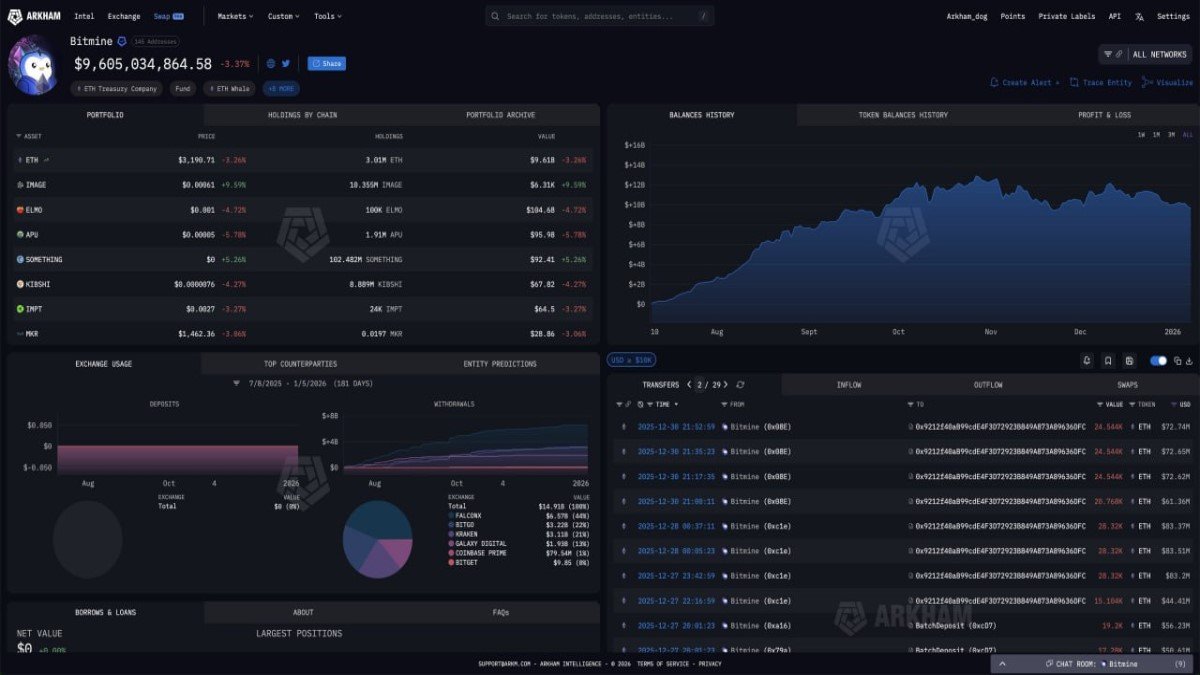
In the span of only five and a half months, Bitmine has gone from a new entrant in the Ethereum ecosystem to one of its most important stakeholders. The company has just added another 98,852 ETH, worth roughly 300 million dollars, bringing its total holdings above the 4 million ETH mark. At current prices, that is an estimated 13.2 billion dollars of Ether under one corporate roof, or about 3.37 percent of the entire circulating supply.
Numbers at this scale are not just a headline. They change how investors think about Ethereum, how risk is distributed across the network and even how future policy makers might approach the asset class. Bitmine is no longer simply a firm with a bullish view on ETH; it has effectively become a macro participant whose decisions can influence everything from staking dynamics to market liquidity.
How fast is fast? Putting 4 million ETH in context
Crypto has seen large balance sheet positions before, but the pace at which Bitmine has built its treasury stands out. Accumulating more than 4 million ETH in about five and a half months makes it one of the fastest institutional buying programs ever observed on public blockchains. Instead of a slow drip over multiple cycles, Bitmine chose a condensed accumulation window, accepting short term price noise in exchange for securing a strategic position quickly.
There are several reasons why a company might prefer speed over gradual exposure:
• Strategic clarity. If management has high conviction that Ethereum will remain a core settlement layer for digital finance, the risk of being underexposed can feel more dangerous than the risk of entering quickly.
• Signalling power. Crossing visible thresholds such as 1 percent or 3 percent of supply sends a clear message to markets, partners and regulators that the business is committed for the long run.
• Business model alignment. Bitmine is building products and yield strategies around its ETH base. Delaying accumulation would also delay the revenue streams linked to staking and onchain activity.
Seen through this lens, the 4 million ETH mark is less about speculation and more about forming a structural pillar for the company’s future operations.
From asset holding to economic infrastructure
What makes Bitmine different from a passive fund is that ETH is not just a line item on its balance sheet. It is the raw material for its business model. The company can stake Ether to participate in network security, use staked positions as collateral to raise capital, and channel that capital into a mix of DeFi strategies or structured products for clients. In other words, ETH functions simultaneously as treasury reserve, productive asset and marketing narrative.
When a single firm controls more than 3 percent of the supply, the impact flows into several layers of the ecosystem:
• Staking and network security. A large share of these coins will likely be staked, increasing the economic weight Bitmine has in validator sets. If managed responsibly and with diverse infrastructure, this can strengthen security. If overly centralised, it could concentrate operational risk.
• Onchain liquidity. Some portion of the treasury may be deployed into liquidity pools or lending markets. That can deepen liquidity and make it easier for other participants to enter and exit positions, but it also means market conditions become more sensitive to Bitmine’s treasury decisions.
• Benchmark for other institutions. Traditional firms often look for reference cases before making their own moves. A corporate investor willing to allocate double digit billions to Ether within months sends a strong signal that Ethereum is no longer viewed only as a speculative asset, but also as programmable collateral.
Supply concentration: opportunity and responsibility
Holding 3.37 percent of ETH changes Bitmine’s role in the ecosystem. On the positive side, it anchors a large pool of coins in hands that appear oriented toward long term strategies rather than short term trading. Long duration holders can dampen some of the more extreme swings that occur when supply is fragmented among many short term speculators.
However, supply concentration always comes with responsibilities and potential risks:
• Market impact of treasury moves. Any decision to materially increase or decrease exposure must be executed with care. Even if Bitmine uses over the counter channels and structured trades, the market will constantly attempt to infer its intentions, which can amplify volatility if communication is unclear.
• Governance influence. While Ethereum’s protocol governance does not function through onchain token votes in the same way as some application level DAOs, large holders still have soft power. Their public stance on upgrades, fee changes or roadmap priorities can tilt sentiment among validators, builders and other investors.
• Regulatory visibility. A corporate treasury of this size will inevitably sit on the radar of regulators and policy makers. How Bitmine manages compliance, risk controls and transparency may shape how similar strategies are viewed in future.
In other words, Bitmine is no longer just reacting to Ethereum’s trajectory. It is now one of the actors that can shape it, intentionally or not.
What it means for everyday ETH holders
For individual investors, the rise of a super-holder like Bitmine cuts both ways. On one hand, a deep pocketed, long term oriented buyer can act as a stabilising presence. Knowing that a large corporate treasury is committed to the asset can reinforce confidence during periods of market stress. On the other hand, reliance on a few large players introduces new questions: what happens if their strategy changes, or if the company faces external pressure unrelated to Ethereum itself.
Several practical considerations emerge for smaller holders:
• Understand who the big holders are. Public reporting and onchain data make it easier than in traditional markets to see concentration patterns. Treat that information as one of many inputs when evaluating risk.
• Differentiate between structural and cyclical flows. Bitmine’s accumulation is a structural decision tied to its business model, not just a short term trade. Structural flows can support an asset even when cyclical sentiment is negative, but they should not be mistaken for a guarantee of permanent price appreciation.
• Keep time horizons aligned. A corporate strategy may span a decade, while an individual might be thinking in months. The same data point can carry very different implications depending on one’s investment horizon and risk tolerance.
Ethereum’s narrative: from smart contract platform to institutional reserve asset
Ethereum has long been known as a programmable settlement layer for decentralised applications. Over time, another narrative has quietly grown alongside it: ETH as a yield bearing digital reserve asset. With staking yields, fee burns and a growing role in tokenized financial products, Ether is increasingly viewed as the native asset behind a broad onchain economy.
Bitmine’s rapid expansion reinforces that second narrative. A corporate treasury does not need every detail of every application; it needs confidence that the network will remain an important coordination layer for digital value. By locking in a position that now rivals or exceeds the holdings of many traditional ETFs, Bitmine is effectively betting that Ethereum will continue to sit at the centre of multi chain finance rather than be displaced.
This may encourage other institutions to think of ETH less as a purely speculative exposure and more as programmable collateral that can be integrated into structured products, lending facilities and onchain funds. If that process continues, the market may slowly move from asking whether Ethereum will survive to asking what role it plays in the broader architecture of digital markets.
Can such rapid accumulation destabilise the market?
Whenever one entity buys large quantities of an asset, there is a natural concern that the market could become distorted. In the short run, aggressive purchasing can push prices higher and reduce the float available to other participants. Over longer horizons, however, the effects depend on how the position is managed.
Several factors mitigate the risk of destabilisation in this case:
• Depth and maturity of ETH markets. Ethereum enjoys deep liquidity across spot, perpetual and options venues. Even large orders can often be executed without dramatic slippage when spread over time and routed through multiple channels.
• Diversified ownership base. Despite Bitmine’s significant share, the majority of ETH remains dispersed across exchanges, long term individual holders, staking pools, funds and application treasuries. The ecosystem is far from a single holder scenario.
• Productive use of assets. If most of Bitmine’s ETH is staked or placed in conservative yield strategies, it behaves more like long term infrastructure capital than speculative overhang.
That said, the market will pay close attention to any signs of leverage built on top of this treasury. Large positions financed with extensive borrowing can quickly turn from a source of stability into a source of stress. Transparency around risk management will therefore remain a crucial variable in how investors perceive Bitmine’s role.
What to watch next
Reaching 4 million ETH is likely not the end point of Bitmine’s plan; it is a milestone. Several developments will be worth monitoring over the coming quarters:
• Staking distribution. How much of the treasury is staked, and through which validators or partners. Diversity at the infrastructure level will signal an emphasis on resilience rather than pure yield maximisation.
• Product launches. New funds, structured products or yield strategies built on top of the ETH base will reveal how Bitmine intends to monetise its holdings without introducing excessive risk.
• Disclosures and governance stance. Regular reporting on risk, leverage and treasury policy can help align expectations with the rest of the ecosystem and reduce speculation during volatile periods.
Conclusion: a new era of corporate scale participation
Bitmine’s accumulation of more than 4 million ETH in just five and a half months is a clear marker of how far the digital asset landscape has evolved. What began as an experimental smart contract platform is now large and liquid enough for a single firm to allocate over 13 billion dollars and still view the position as part of a long term strategic plan.
For Ethereum, this development is both an endorsement and a responsibility. It confirms that major institutions see ETH as a core asset worthy of substantial balance sheet space, while also underscoring the need for ongoing attention to decentralisation, transparency and risk management.
For individual participants, the emergence of such super-holders is a reminder to look beyond daily price moves and examine who is accumulating, how quickly they are doing so and what incentives shape their decisions. The story of Bitmine and its 4 million ETH position is not just about one company’s conviction; it is part of the broader transition from retail dominated markets to an ecosystem where corporate treasuries, funds and onchain native institutions share the same digital settlement layer.
Disclaimer: This article is for educational and informational purposes only and should not be considered financial, investment, tax or legal advice. Digital assets are volatile and involve risk. Always conduct your own research or consult a qualified professional before making financial decisions.