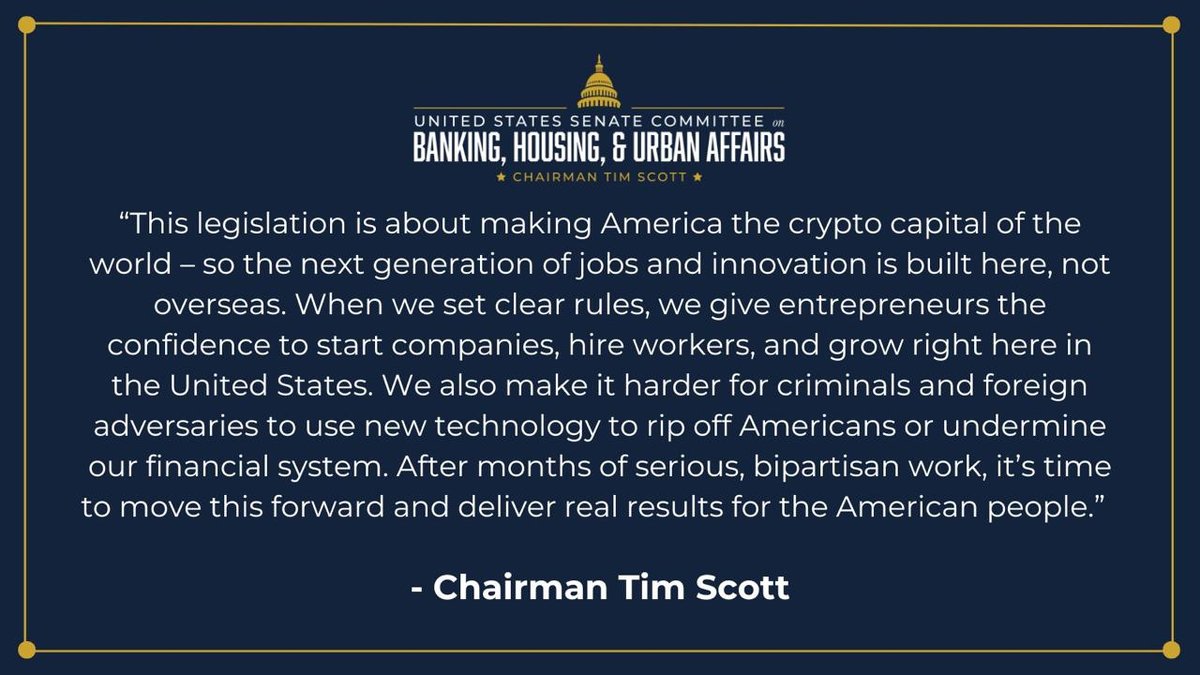
CLARITY Act: The Rulebook Crypto Wanted—And the Philosophy It Might Lose
Crypto has spent years trapped in a strange contradiction: it wants to be mainstream, but it also wants to stay permissionless. It wants banks, pensions, and public companies to participate, but it also wants builders to ship without asking anyone for permission. That tension has always been manageable in bull markets—when prices rise, people tolerate ambiguity. In sideways markets, ambiguity becomes a tax: on capital, on talent, and on the willingness to deploy serious infrastructure.
This is why the CLARITY Act matters. Not because “a bill is bullish,” but because it represents a pivot from enforcement-by-surprise to a more legible rulebook. A legible rulebook reduces existential risk for serious operators. Yet it also pressures crypto to choose what it is becoming: a new financial layer that integrates with legacy rails, or a parallel system that stays stubbornly independent. The hardest part is that both outcomes can happen at the same time—just not for every token, protocol, or community.
Clarity is not just paperwork—it is a pricing engine
Markets don’t only price growth; they price uncertainty. When a token’s future depends on how an agency interprets a decades-old legal test, you get a “regulatory volatility premium” that never shows up on a chart but lives inside every valuation model. In practice, that premium forces projects into one of two extremes: either stay small and nimble (and accept limited distribution), or spend heavily on compliance, lawyers, and lobbying (and accept slower shipping).
A clearer framework can compress that premium. Not overnight, and not uniformly, but enough to change how capital behaves. Institutional capital is famously slow, yet it is also sticky. It prefers predictable compliance costs, defined disclosure standards, and clear custody rules. If CLARITY meaningfully narrows the gray zone, it can widen the set of participants who are allowed to show up—banks, fiduciaries, corporates, and retirement-linked allocators who can’t “wing it” on legal risk.
Here is the underappreciated part: once uncertainty compresses, the market’s internal hierarchy becomes sharper. In a fog, everything looks similar; in daylight, business models and governance weaknesses are harder to hide. So a “clarity” regime is not purely a bullish catalyst. It is also an accountability regime. Some assets benefit from legitimacy; others lose the ambiguity that once protected their narrative.
The upside: a slower kind of capital, but a stronger floor
In crypto, “institutional adoption” is often imagined as a sudden wall of buying. In reality, it is usually a long migration of plumbing: compliant custody, standardized reporting, audit expectations, risk committees that need months, not minutes. This type of adoption tends to reduce tail risks and gradually improve market depth. Over time, deeper market depth can soften extreme drawdowns, because there are more natural buyers and more hedging tools.
That matters most for the core assets and core rails—Bitcoin-like monetary assets, settlement networks, and stablecoin systems that touch real payment flows. When rules become clearer, these core components are easier to integrate into mainstream finance, which can increase liquidity and reduce the probability of “everything goes to zero” panic moments. The long-term implication is subtle but powerful: crypto starts to look less like a casino and more like a new market infrastructure.
But that is only the optimistic arc. The bill’s deeper impact is not “price up.” It is “who gets to be legal by default.” And that question leads directly into the philosophical controversy.
The tradeoff: clarity can centralize power even when the chain is decentralized
Crypto was born as an argument: that value can move without intermediaries, and that rules can be encoded and enforced by open systems rather than gatekeepers. Regulation, by design, reintroduces gatekeepers—licensing regimes, compliance obligations, and the idea that a “responsible party” can be held accountable. This isn’t inherently bad. Society needs consumer protection and anti-fraud tools. But it changes the character of innovation.
In practice, a strict compliance frame favors entities that can pay the fixed costs: legal teams, audits, ongoing reporting, KYC/AML integrations, and the ability to survive regulatory delays. That tends to push power toward larger issuers, well-funded startups, and incumbents. Meanwhile, small open-source teams and community-led DAOs can struggle to map their reality onto traditional categories like “issuer,” “board,” or “management.” The chain can be decentralized while the business ecosystem around it becomes more concentrated.
So the philosophical question is not “regulation good or bad.” It is: which parts of crypto do we want to be regulated like finance, and which parts do we want to remain regulated like the internet? The CLARITY Act, depending on implementation details, could accelerate a split between “regulated crypto” and “permissionless crypto.” That split may become the defining market structure of the late 2020s.
DAO governance and profit-sharing: the compliance collision
DAOs are where crypto’s philosophy gets tested in the real world. A DAO is not just a token; it is a coordination engine. It can run a protocol, set fees, pay contributors, and sometimes distribute value back to participants. To a regulator trained on traditional securities law, a value-distributing governance system can look uncomfortably similar to an investment contract—especially when there are identifiable teams, marketing efforts, or a concentrated set of decision-makers.
This is why “revenue-sharing” is becoming the sharp edge of the debate. In a permissionless world, fee-sharing can be framed as protocol-level economics. In a traditional regulatory lens, fee-sharing can be framed as dividends, and dividends trigger an entire universe of registration and disclosure obligations. Even if a bill aims to create safer pathways, it may still push DAOs into hard choices: limit value distribution, restructure governance, or accept heavier compliance burdens.
The hidden risk is not that DAOs disappear. It is that they become legible only when they resemble companies. Once that happens, the long-term cultural gravity pulls them toward corporate norms: fewer anonymous contributors, fewer experimental governance models, and more “approved” integration partners. That could reduce some scams—but it can also reduce the weird, creative experimentation that made the space valuable in the first place.
Stablecoins: the real battleground is not technology, it is bank funding
Most public debates about stablecoins focus on reserves: 1:1 backing, transparency, redemption rights, and operational controls. Those are important. But the fiercest conflict is about something else: interest. If a stablecoin can effectively deliver yield to holders—directly or indirectly—it becomes a competitor to bank deposits. And bank deposits are not just a consumer product; they are the raw material banks use to fund lending and manage balance sheets.
From a bank’s perspective, a stablecoin that behaves like a high-quality, yield-bearing cash instrument can pull money out of deposits, compress net interest margins, and reduce the stability of their funding base. From crypto’s perspective, allowing yield reflects economic reality: reserves generate returns, and users argue they should benefit. The conflict is structural, not ideological. It is about who gets the upside of holding “digital dollars.”
This is why you often see policy pressure to restrict stablecoin interest. Even if an issuer doesn’t pay interest explicitly, third parties can create “shadow yield” via lending markets, reward programs, revenue-sharing, or token incentives. Policymakers who want to protect bank funding may try to close those pathways. Crypto advocates see that as incumbent protection. Banks see it as financial stability. Both can be true at the same time.
The ‘third-party yield’ problem: loophole, innovation, or systemic risk?
One reason stablecoin policy is complex is that the issuer is not the whole system. A stablecoin can be fully reserved and still become the base asset for leverage, carry trades, and maturity transformation when it gets integrated into lending and derivatives. If a law restricts issuers from paying interest, platforms can still wrap the stablecoin into products that deliver yield, funded by lending spreads, treasury management, or riskier strategies.
Regulators worry about two things here. First, consumer confusion: people may believe “stablecoin yield” is risk-free because the base asset is stable. Second, systemic spillovers: if a large fraction of stablecoins become intertwined with leveraged strategies, a stress event can hit liquidity faster than traditional regulators can react. Crypto builders worry about something else: if you over-regulate yield, you push innovation offshore or into less transparent structures.
The practical takeaway is that stablecoin policy is likely to evolve toward a layered model: fully reserved payment stablecoins on one layer, and explicitly risk-bearing yield products on another layer, with clearer disclosures. The CLARITY Act’s value—if it is designed well—would be to help the market separate these layers instead of forcing everything into one ambiguous bucket.
What CLARITY could mean for prices: fewer “rug pulls,” fewer moonshots
There is a reason many retail traders feel that token launches have become a graveyard: it’s not only because of bad projects, but because markets are getting better at pricing dilution, weak governance, and unsustainable incentives. A clarity regime accelerates that learning. Tokens that rely on narrative without cash flows or durable usage will struggle to justify premium valuations when compliance costs rise and disclosure becomes more standardized.
At the same time, legitimate, revenue-generating protocols may gain an advantage if rules reduce existential risk. Their valuations can still be volatile, but the “right tail” might become more realistic and the “left tail” less catastrophic. That can be healthy for an industry trying to become infrastructure. The catch is psychological: a maturing market feels less exciting. It rewards execution more than storytelling.
So if you are looking for a single headline takeaway: CLARITY could make crypto less like a lottery and more like a competitive technology sector. That is positive for long-term adoption, but it changes what “outperformance” looks like.
The strategic reality: crypto is splitting into three lanes
Regardless of how the final text evolves, the direction of travel is clear: governments want a framework, and large institutions want to operate inside it. That will likely produce three broad lanes in crypto. Lane one is “regulated rails”: stablecoins, custody, tokenized assets, and compliant exchanges. Lane two is “regulated-adjacent innovation”: protocols that design around compliance, with transparent teams and risk disclosures. Lane three is “permissionless frontier”: experiments that remain open-source, globally distributed, and harder to classify.
For markets, this split matters because it changes correlations. Lane one may start trading more like fintech infrastructure. Lane three may remain highly reflexive and speculative. Lane two will live in between, sometimes benefiting from legitimacy, sometimes punished by it. If you want to understand crypto in 2026 and beyond, stop trying to apply one framework to everything. Crypto is becoming a stack, not a single asset class.
How to read the bill without turning it into a meme
Policy headlines usually trigger tribal reactions: “This is bullish!” or “This kills decentralization!” A more useful approach is to treat the CLARITY Act like a market-structure specification. Ask: What definitions does it use? How does it treat custody? How does it define decentralization thresholds? Who is responsible when something breaks? Which disclosures are required, and how expensive are they? Those details will determine whether the act nurtures competition or entrenches incumbents.
Also, watch what happens around stablecoins. Payment stablecoins sit at the intersection of crypto and national monetary power. Rules around reserves and redemption are only the surface. The deeper fight is about whether stablecoins become a public utility-style payment layer, or a new shadow banking layer with yield products that rival deposits. That question will shape liquidity across the entire crypto market—because stablecoins are the market’s working capital.
Finally, keep one humility rule: regulation reduces one type of risk and can create another. A clearer regime may reduce fraud and arbitrary enforcement, but it can also concentrate activity into a smaller set of “approved” intermediaries. The future is not “regulated” or “unregulated.” It is a portfolio of tradeoffs.
Conclusion
The CLARITY Act captures crypto’s coming-of-age moment. The industry is no longer asking whether it will be regulated; it is negotiating how. That negotiation has two audiences. One is institutional capital, which wants predictability and legal safety. The other is the original crypto ethos, which wants open participation and minimal gatekeeping. The bill’s real impact will be determined by how it balances those audiences in the messy details.
If the act succeeds, it could lower the industry’s “regulatory volatility premium,” invite deeper liquidity, and help crypto become infrastructure rather than a perpetual experiment. But success has a cost: the parts of crypto that feel most alive—DAOs, permissionless composability, and value-sharing primitives—will be forced to translate themselves into legal categories that were never designed for them. In 2026, that translation may be the most important product challenge in crypto: not building a new chain, but building a new bridge between code and law.
Note: This analysis is educational and focuses on market structure and industry dynamics, not on encouraging any investment decisions. Regulatory proposals can change quickly, and outcomes depend on final legislative text, rulemaking, and enforcement priorities.