
Why “Clarity” Is the New Alpha: Tim Scott’s Push for a U.S. Crypto Rulebook and What It Really Changes
Crypto has never lacked imagination. What it has lacked—especially in the United States—is a predictable map for how imagination becomes infrastructure. That’s why Senator Tim Scott’s renewed push for a clearer market-structure framework (often discussed under the banner of a “CLARITY Act”) matters far beyond the headline. It’s not just “pro-crypto” or “anti-crypto.” It’s a bid to decide where the next generation of financial rails will be designed, audited, and ultimately trusted.
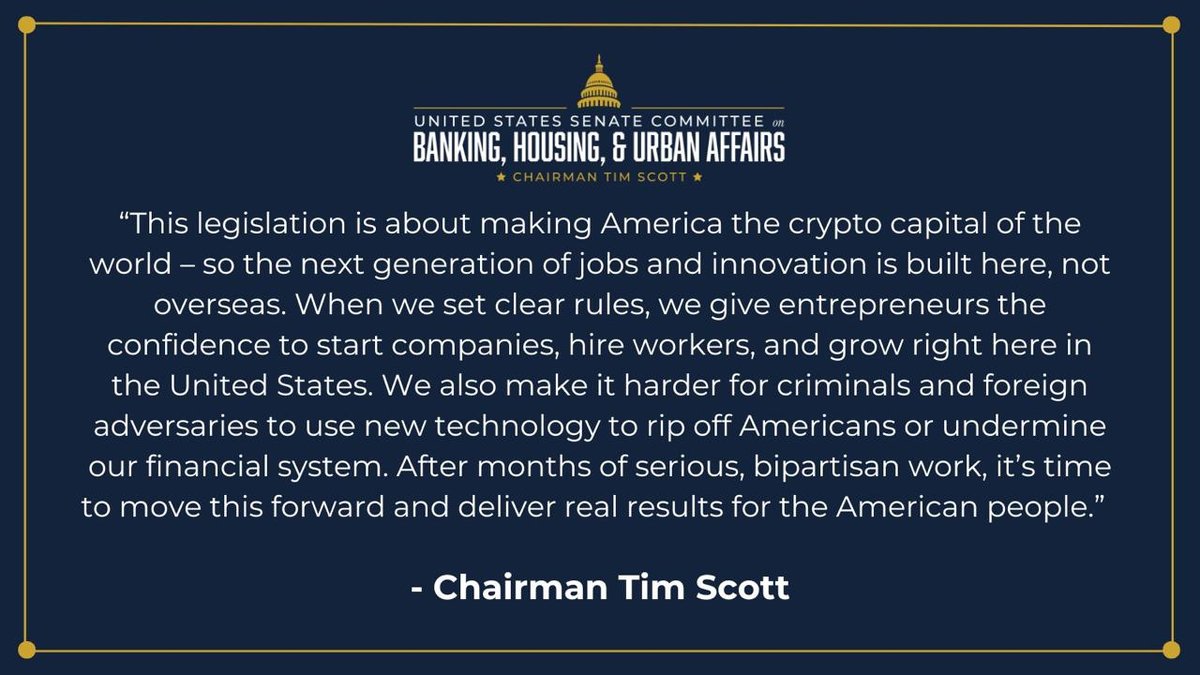
In a Senate Banking Committee graphic, Scott frames the goal in industrial-policy terms: keep jobs and innovation built “here, not overseas,” and pair that with stronger guardrails against criminals and foreign adversaries. That framing is revealing. The fight is no longer only about whether crypto is legitimate—it’s about who gets to set the default standards for legitimacy.
Clarity isn’t a slogan. It’s a liability assignment.
When policymakers say “clarity,” market participants often hear “price goes up.” That’s a temptation, but it’s not the core mechanism. Clarity primarily reallocates liability: who is responsible for disclosures, custody standards, conflict-of-interest controls, and consumer protections when digital assets change hands. In a world where the same token can be used as a payment instrument, collateral, governance weight, and speculative asset, ambiguity isn’t just annoying—it is a tax on participation.
That tax shows up in hidden ways: compliance budgets balloon, product roadmaps get stuck in legal review, and large institutions default to doing nothing because “maybe later” is cheaper than “maybe illegal.” The result is not a neutral pause; it is an unspoken advantage for jurisdictions that offer a more coherent rulebook—whether or not those rules are perfect.
• Think of “clarity” as reducing legal volatility, not price volatility.
• For institutions, reduced legal volatility is often a prerequisite for deploying real balance-sheet capacity—custody, prime brokerage, payments, and structured products.
• For builders, it defines which business models are viable without living under permanent enforcement risk.
Why the U.S. cares now: crypto has become plumbing, not a toy
The strongest argument for a market-structure bill in 2026 is that crypto’s highest-utility layer is no longer “number-go-up.” It is stablecoins, tokenized cash equivalents, and settlement primitives that move value 24/7. Even critics quietly admit this: you don’t need to love speculation to recognize that programmable settlement is a competitive advantage in a world of instant commerce.
That changes Washington’s incentives. Once an asset class starts touching payments, remittances, collateral chains, and bank-adjacent activities, regulators stop treating it as a niche and start treating it as a systemic interface. In that light, Scott’s “keep innovation at home” framing is less rhetorical than it looks. The U.S. is trying to avoid a repeat of the manufacturing offshoring story—except this time the factory is a ruleset, and the product is trust.
• If the U.S. writes clear rules, it can export standards the same way it exports capital markets norms.
• If it doesn’t, innovators route around uncertainty—often by incorporating elsewhere while still selling into U.S. demand.
What a CLARITY-style framework usually tries to settle
Market-structure proposals tend to address a few recurring bottlenecks: what counts as a security vs. a commodity, who regulates which venues, and how intermediaries prove they can safeguard customer assets. A notable House effort—the “Digital Asset Market Clarity Act”—was built around the idea that digital assets need tailored registration paths and clearer lines between the SEC’s investor-protection mandate and the CFTC’s market-integrity mandate.
The key point isn’t any single draft—it’s the operating system it implies. In practice, “clarity” is the difference between a market where each new product is a bespoke legal negotiation and a market where standard forms exist: registration routes, disclosure templates, custody requirements, and surveillance expectations that resemble other mature asset classes.
• Clearer SEC/CFTC boundaries can reduce “regulator roulette,” where the same activity is interpreted differently depending on which agency speaks first.
• Standardized disclosures can make token economics less of a mystery and more of a comparable risk profile.
• Venue rules can pressure exchanges (centralized or decentralized) to internalize conflicts—listing incentives, liquidation design, and market-maker relationships.
The underestimated winner: compliance throughput
There’s a quiet advantage enjoyed by the largest institutions: they already know how to turn regulation into scalable products. If you want to understand why “clarity” can unlock institutional participation, don’t think about ideology—think about throughput. Big firms can onboard clients, underwrite risk, run surveillance, and report to supervisors at industrial scale. But they cannot do that when the rules are fuzzy because fuzziness is not auditable.
This is why a CLARITY push has a paradoxical effect. It can be pro-innovation and pro-competition at the ecosystem level, while simultaneously raising the bar for casual or undercapitalized operators. That is not automatically good or bad. It simply means the market will increasingly reward teams that can pair product velocity with regulatory discipline.
• “Move fast” doesn’t die; it becomes “move fast with documentation.”
• The next moat may be less about clever token design and more about auditability, risk management, and resilient operations.
Will it help DeFi—or domesticate it?
DeFi is often described as “unstoppable,” but most users don’t interact with code directly. They interact through interfaces: wallets, front-ends, app stores, RPC providers, and fiat on-ramps. Regulation typically bites at interfaces first, because that’s where consumer relationships exist. A clarity framework could reduce existential fear for DeFi teams who want to serve U.S. users responsibly. But it could also channel DeFi into forms that resemble regulated brokerage—especially when leverage, consumer marketing, and one-click onboarding make risk easy to underestimate.
The more leverage enters the picture, the less “pure protocol” arguments tend to matter. If policymakers are serious about protecting users, they will target predictable failure modes: hidden risks, opaque fees, aggressive incentives, and asymmetric information. DeFi’s long-term advantage isn’t that it avoids rules—it’s that it can make rules verifiable on-chain, turning disclosure from a PDF into a dashboard.
• Good regulation should reduce the incentive for “dark patterns” (fees and incentives that are hard for users to understand).
• Good DeFi design should make risk transparent by default (collateral ratios, liquidation parameters, and governance controls).
The strategic risk: clarity can become capture
Any serious market-structure bill carries a risk of regulatory capture: incumbents nudging the rules to match their business models and raising compliance costs for newcomers. That’s not a conspiracy theory; it’s the normal gravity of complex regulation. If standards are written too narrowly, innovation doesn’t leave the U.S. because it hates rules—it leaves because the rules only fit today’s biggest players.
The second risk is “overfitting” to the last crisis. If lawmakers write a framework that solves for the most recent blowups while ignoring how fast crypto primitives evolve, you get brittle rules that age poorly. The goal should be principle-driven constraints—custody integrity, truthful disclosures, conflict-of-interest mitigation, and market manipulation controls—rather than micromanaging which smart-contract pattern is allowed.
• Watch for language that defines technology too specifically; that’s usually a red flag for future obsolescence.
• Watch for disclosure requirements that are realistic for startups, not just for mega-firms.
How to read the next 90 days like an infrastructure investor
If you want to understand whether “clarity” is becoming real, ignore the social-media temperature and watch for boring signals. Boring is where legitimacy hides: committee markups, agency coordination, pilot programs, and technical guidance. Those are the events that determine whether the U.S. builds a durable on-chain financial stack—or whether activity keeps migrating to the edges.
Here are practical checkpoints that matter more than slogans:
• Are there credible timelines for committee work and floor votes—or only interviews and soundbites?
• Do regulators publish interpretable guidance on custody, settlement finality, and market surveillance?
• Do major banks and custodians announce products that require real supervisory comfort (tokenized deposits, regulated stablecoin rails, broker-dealer connectivity)?
• Do consumer-protection rules improve disclosures without making experimentation impossible?
Conclusion
Tim Scott’s CLARITY push is best understood as a bet that the next era of crypto will be won not by louder narratives, but by quieter institutions: rulebooks, audits, custody standards, and settlement guarantees. That may sound unromantic, but it’s how every financial technology becomes financial infrastructure.
The most important shift is psychological. If the market starts to believe the U.S. is building a predictable regulatory lane—one that rewards transparency and punishes manipulation—then builders can plan, institutions can commit, and users can participate with fewer invisible risks. “Clarity” won’t eliminate volatility, but it can reduce the kind of uncertainty that scares away the capital and talent needed to build long-lived systems.
Frequently Asked Questions
What is the “CLARITY Act” in crypto conversations?
It’s a shorthand for U.S. market-structure legislation aimed at clarifying how digital assets are classified and regulated, and how trading venues and intermediaries should register and operate.
Does regulatory clarity automatically mean crypto prices rise?
Not automatically. Clarity mainly reduces legal uncertainty, which can enable broader participation over time. Market prices still depend on liquidity, macro conditions, and adoption.
Would a clarity framework help stablecoins and tokenized deposits?
Potentially. Payment-like instruments often benefit from explicit reserve, redemption, and supervision rules—especially when they connect to banks and large payment networks.
Is DeFi likely to be banned under a clarity approach?
A ban is not the default outcome. More commonly, regulation focuses on interfaces, consumer protections, and leverage risks. Protocol design that improves transparency and risk disclosure can coexist with regulation.
What’s the biggest open question?
Where the line is drawn between “software” and “financial intermediary.” That line will shape which parts of the stack can remain permissionless and which parts must adopt regulated wrappers.
Disclaimer: This article is for educational purposes only and does not constitute financial, investment, or legal advice. Digital assets are volatile and regulatory developments can change quickly. Always do your own research and consult qualified professionals where appropriate.