Big Bank CEOs, the CLARITY Act and Bitcoin at $90k: Why the Next Senate Hearing Matters
For more than a decade, the United States has debated how to regulate crypto without either smothering innovation or leaving investors unprotected. Most of that debate has happened in public letters, court cases and speeches. Now, with Bitcoin trading around the $90,000 region and exchange-traded products absorbing billions in flows, the conversation is moving into a more traditional venue: a high-profile Senate hearing with the chief executives of Bank of America, Citigroup and Wells Fargo.
On 11 December 2025, these CEOs will appear before key Senators to discuss the CLARITY Act—a comprehensive crypto market structure bill—as well as related rules for stablecoins, custody and trading. Committee votes are pencilled in for 17–18 December, with the possibility that a final bill reaches the full Senate in the first quarter of 2026.
Investors are watching closely, and not just because policy headlines can move prices in the short term. The outcome of this process will influence who is allowed to issue stablecoins, where digital asset trading can legally occur, and how easy it is for mainstream banks to compete with native crypto firms. In other words, it will help decide whether the next phase of the market is defined primarily by exchanges and fintech platforms—or by large regulated banks integrating crypto into their balance sheets.
1. The CLARITY Act in Context: From House Passage to Senate Scrutiny
To understand why this hearing matters, we need to step back and look at what the CLARITY Act is trying to achieve.
In July 2025, the U.S. House of Representatives passed the Digital Asset Market Structure Clarity Act, usually shortened to the CLARITY Act. The bill aims to resolve long-standing confusion over whether a given token is a security, a commodity or something in between. It assigns clearer responsibilities to the Securities and Exchange Commission (SEC) and the Commodity Futures Trading Commission (CFTC), and it sketches rules for trading venues, disclosures and custody.
Under the House version, most decentralized tokens that function as digital commodities would fall primarily under CFTC oversight, while assets that represent traditional securities—or are sold in ways that resemble securities offerings—would remain within the SEC’s domain. The goal is to replace regulation-by-enforcement with a more predictable framework, so that businesses can know which rules apply before launching products.
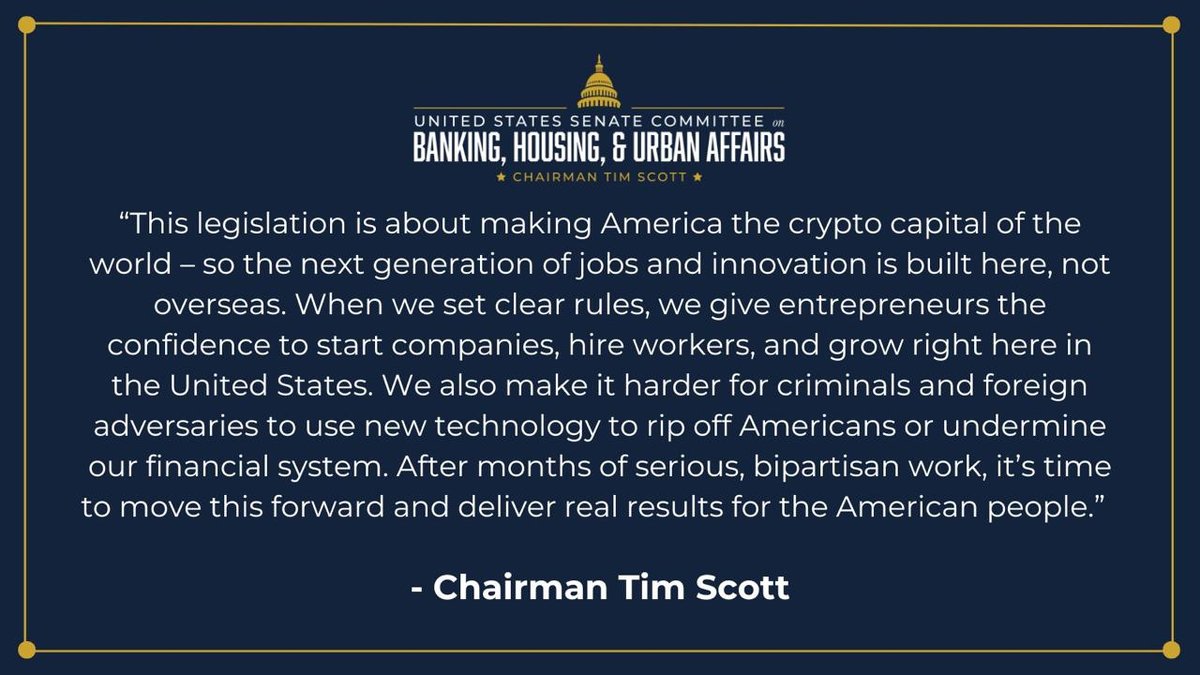
Since the House vote, the Senate has been working on its own market structure draft. While broadly aligned with the objective of clarity, the Senate Banking Committee’s version introduces nuances such as an “ancillary asset” category and additional protections for software developers. The upcoming hearing with major bank CEOs is part of this refinement process: lawmakers want to understand how new rules would affect traditional financial institutions, not just crypto-native firms.
2. What Exactly Are Senators Asking the Bank CEOs?
The hearing has several intertwined themes. At a high level, Senators want to know how the CLARITY Act and related stablecoin legislation would impact:
- The division of labour between SEC and CFTC for digital assets.
- Rules for trading and custody on regulated platforms.
- The treatment of stablecoins, particularly those that pay yield and might compete with bank deposits.
- Transparency and anti-money-laundering (AML) safeguards across both centralized and decentralized platforms.
From the banks’ perspective, this is not an abstract exercise. Their executives see an opportunity—and a threat.
2.1 Stablecoins as Direct Competitors to Bank Deposits
One of the most sensitive topics is interest-bearing stablecoins. If customers can hold a token fully backed by high-quality short-term assets and earn an attractive yield, that token begins to resemble a modern version of a savings account. For traditional banks, which rely heavily on low-cost deposits to fund loans and investments, this is a serious competitive challenge.
Recent legislative efforts in the House and separate stablecoin proposals envision a world where banks themselves can issue stablecoins, potentially under national charters, alongside non-bank issuers subject to federal standards. Many banking leaders support this direction: they want to participate in the stablecoin market, but they do not want unregulated or lightly regulated tokens to drain deposits while facing fewer obligations than insured depositories.
At the hearing, expect CEOs to walk a careful line. They are likely to argue that:
- Stablecoins should be subject to robust reserve and disclosure requirements, especially if they are widely used for payments or savings.
- Banks—with existing capital, liquidity and AML frameworks—are well positioned to issue and manage such products safely.
- Interest-bearing stablecoins need guardrails so they do not function as unchecked money-market funds operating entirely outside the traditional regulatory perimeter.
Behind the scenes, the core concern is that if stablecoins are allowed to pay competitive yields with minimal restrictions, they could siphon deposits away from banks, raising funding costs and reshaping the credit channel. The CLARITY Act and accompanying stablecoin rules will determine how that competition plays out.
2.2 Clarity on Trading and Custody: Who Can Offer What?
The second major topic is trading and custody. Under current law, banks that want to hold digital assets for clients or offer trading services navigate a patchwork of guidance, charters and state-level rules. The CLARITY Act seeks to streamline this by specifying how SEC-registered and CFTC-registered entities can engage in digital commodity activities, and by outlining custody standards.
Bank executives will likely push for a structure that lets them operate in this space without being disadvantaged relative to specialized crypto firms. They may argue for:
- Clear capital and liquidity requirements for holding digital assets in custody.
- Ability to offer spot trading and derivatives within existing broker-dealer or bank licenses, subject to additional risk controls.
- Recognition of established risk-management and compliance systems as a foundation for digital asset activities, so they are not forced into entirely separate regulatory silos.
For investors, the key question is whether banks will become primary on-ramps to Bitcoin and other major assets—or whether that role will remain concentrated in dedicated exchanges and fintech platforms.
2.3 AML, Transparency and the DeFi Question
The third theme is transparency and AML. Advocacy groups and some lawmakers have expressed concern that early versions of market structure and stablecoin bills could leave gaps in oversight, particularly for decentralized finance protocols and foreign platforms serving U.S. users.
Senators are expected to ask bank CEOs whether the proposed framework goes far enough in:
- Ensuring that stablecoin issuers and trading venues apply robust identity verification and transaction monitoring.
- Preventing illicit finance from moving through lightly supervised channels.
- Balancing innovation with national security and consumer protection concerns.
Banks, for their part, will emphasise that they already operate under strict AML standards and will present themselves as partners in enforcing those rules in the digital-asset domain.
3. Why Some Senators Are Hesitant
While the CLARITY Act passed the House with notable bipartisan support, the Senate landscape is more complicated. Several Democratic Senators have signalled worries that shifting too much authority away from the SEC or allowing broad exemptions for new asset classes could dilute investor protections or create openings for regulatory arbitrage.
In the context of the upcoming hearing, these concerns translate into questions such as:
- Could large banks gain new powers to engage in digital-asset activities without proportionate safeguards?
- Will stablecoin rules adequately protect lower-income households who may be drawn to higher-yield digital instruments?
- Are there conflict-of-interest issues when banks that stand to profit from the new regime help shape the legislation?
Some Senators may push for amendments that tighten oversight of interest-bearing stablecoins, require additional disclosures to retail users, or maintain a stronger role for the SEC in overseeing platforms that resemble investment products.
4. Bitcoin at $90k: Is the CLARITY Process Already Priced In?
All of this is happening while Bitcoin trades near the $90,000 mark—well above prior cycle highs and far removed from the levels seen during the 2022 downturn. That raises an obvious question: if the market has already rallied in anticipation of clearer rules and institutional participation, how much additional upside can policy deliver?
From an educational perspective, it is useful to think in terms of scenarios rather than precise price targets.
4.1 Scenario One: Smooth Passage and Gradual Implementation
In the most optimistic case, the Senate Banking Committee approves a version of the CLARITY Act later in December, differences with the House bill are resolved early in 2026, and the President signs a compromise package. Rulemaking and comment periods then unfold over several years, but the overall direction is steady: digital assets gain a well-defined place in U.S. financial law, banks and brokers integrate them as another asset class, and institutional participation deepens.
Under this scenario, Bitcoin’s role as a macro portfolio asset becomes more entrenched. Pension funds, insurance companies and sovereign investors, reassured by the regulatory framework, may feel more comfortable allocating a small portion of diversified portfolios to BTC via regulated vehicles. That does not guarantee monotonic price increases, but it does underpin the idea of Bitcoin as a long-term component of the financial system rather than a peripheral experiment.
4.2 Scenario Two: Slow Progress and Ongoing Tension
A more moderate scenario is that the bill advances, but only after substantial negotiation and delay. Additional hearings, amendments and political trade-offs could push final passage back or result in a framework that leaves significant questions unresolved—particularly around DeFi and cross-border platforms.
In this world, Bitcoin may continue to behave like a high-beta macro asset, sensitive to interest-rate expectations and global liquidity but lacking the fully settled regulatory foundation that would support very broad institutional adoption. The market could oscillate between optimism and frustration, repricing each time political headlines suggest that the bill is gaining or losing momentum.
4.3 Scenario Three: Gridlock or Reversal
The most cautious scenario is that disagreements between parties or chambers prevent a comprehensive framework from being enacted at all, at least in the near term. Alternatively, a watered-down bill might pass but leave core issues—such as stablecoin treatment or CFTC resources—largely unresolved.
In that case, markets would need to reassess how much of the current Bitcoin price reflected expectations of regulatory clarity. Some investors might conclude that the asset remains structurally constrained in key jurisdictions, limiting the pace at which new pools of capital can participate. Others might emphasize Bitcoin’s global nature and continue to focus on adoption trends outside the U.S.
None of these scenarios is preordained. The December hearing, committee votes and subsequent negotiations will be important signposts for which path the U.S. chooses.
5. Beyond Bitcoin: How the CLARITY Debate Shapes the Broader Crypto Stack
Although Bitcoin often dominates headlines, the CLARITY Act has implications across the entire digital-asset ecosystem.
• Stablecoins: Clear reserve, disclosure and licensing standards will influence which issuers can operate at scale, how they interact with the banking system and whether interest-bearing models are widely available.
• Layer-1 and Layer-2 networks: Definitions of “digital commodities” versus “securities” affect how these networks launch, how tokens can be distributed and which disclosures are required for developers and foundations.
• Exchanges and brokers: Registration pathways, customer-protection obligations and capital requirements will determine who can list which assets and under what conditions.
• DeFi protocols: While the current drafts do not fully resolve the treatment of decentralized platforms, AML expectations and liability rules outlined in companion legislation will influence how closely DeFi can interact with regulated financial institutions.
For builders, the most valuable outcome is not necessarily the most permissive rule set, but the one that is predictable. Knowing which regulator is in charge and which disclosures are required allows projects to plan multi-year roadmaps and reduces the risk of sudden changes in enforcement posture.
6. How Observers Can Read the Coming Weeks
Given the complexity of the process, how can an informed observer follow developments without getting lost in daily noise?
A practical framework is to track three layers:
1. Legislative milestones. Pay attention to whether the Banking Committee actually votes on schedule, how wide the margins are, and which amendments are adopted. These signals reveal the depth of bipartisan support—or lack of it—for key provisions.
2. Regulatory posture. Watch for joint statements from the SEC and CFTC on coordination and enforcement priorities. Even before final legislation, agencies can adjust their approach in anticipation of new mandates.
3. Market response. Instead of focusing only on the Bitcoin price, monitor ETF flows, implied volatility, and the performance of assets most sensitive to U.S. policy, such as dollar-backed stablecoins and U.S.-listed exchange equities.
Used together, these indicators provide a more nuanced picture than any single headline.
Conclusion
The upcoming Senate hearing with the chief executives of Bank of America, Citigroup and Wells Fargo is about more than a single day of testimony. It is a visible moment in a longer process by which the United States decides how digital assets fit into its financial architecture. The CLARITY Act and associated stablecoin rules will shape the competitive landscape between banks and crypto-native firms, determine the guardrails for interest-bearing tokens, and influence how easily long-term institutional capital can engage with Bitcoin and other digital assets.
With Bitcoin hovering around $90k, markets appear to be pricing in at least some expectation that clarity—and bank participation—will eventually arrive. Whether that expectation is met, exceeded or disappointed will depend on the choices made in the weeks and months ahead. For now, the most constructive stance is not to treat any single bill as destiny, but to understand the incentives of each actor: banks seeking a level playing field, regulators guarding stability and transparency, and lawmakers trying to balance innovation with responsibility.
Educational note: This article is intended to provide context and analysis around regulatory developments. It is not financial, legal or tax advice, and it should not be used as the sole basis for any investment decision. Digital assets remain volatile, and policy processes are uncertain. Anyone considering exposure to these markets should carry out independent research and, where appropriate, consult qualified professionals.