
When the Exit Queue Empties: What Ethereum’s New Staking Wave Signals for 2026
At the end of 2025, Ethereum is quietly entering a new phase. Price action has been noisy, narratives have rotated quickly, and attention has bounced between Bitcoin milestones and macro headlines. Yet underneath that surface, the staking layer is sending a remarkably consistent signal: more ETH is trying to get in than to get out.
Rough estimates tell the story clearly. Around 745,000 ETH are currently waiting to enter staking, while only about 360,000 ETH remain in the exit queue, and that exit line is shrinking. If this trend persists, the queue of validators wanting to leave could fall close to zero in just a few days.
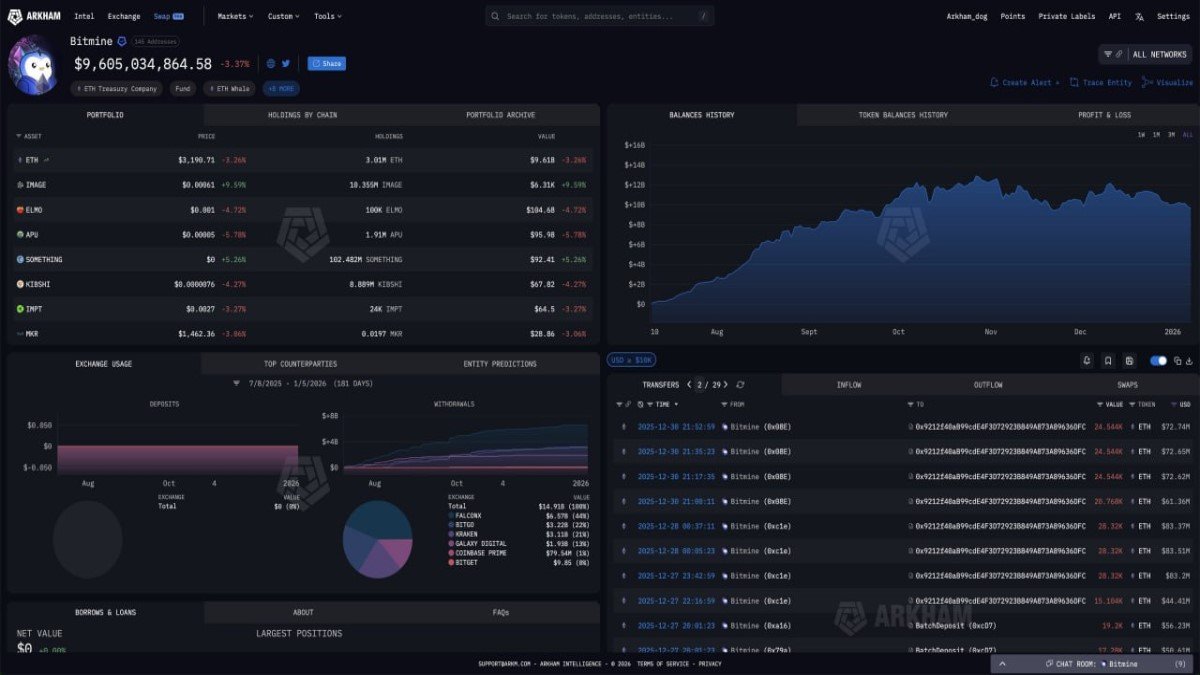
Historically, inflection points like this – where net staking turns positive after a period of net exits – have often appeared ahead of strong Ethereum rallies. This time, there is an additional twist: large institutions are not just buying ETH, they are staking it, choosing to lock in long-term exposure instead of treating ETH only as a trading asset.
This article unpacks what that shift really means: for supply and demand, for Ethereum’s role as a yield-bearing asset, and for investors trying to decide how seriously to take these on-chain signals.
1. The Mechanics Behind the Numbers: Deposit and Exit Queues
To understand why these queues matter, it helps to revisit how the Ethereum staking system works at a high level.
- Staked ETH is locked in validator positions that secure the network and earn yield through protocol rewards and priority fees.
- Entering staking is not instantaneous. When many validators want to join at once, they are placed in a deposit queue that processes registrations gradually to protect the network.
- Leaving staking also goes through an exit queue. Validators signal their intention to stop participating, then wait until the protocol safely removes them and unlocks their ETH.
For several months in 2025, the pattern was clear: more ETH was lining up to exit than to enter. That did not mean that Ethereum was collapsing, but it did tell us something about sentiment. After a long period of strong price performance and a crowded staking trade, some participants wanted liquidity back or chose to rotate into other opportunities.
Now that balance has flipped. The deposit queue (around 745,000 ETH) clearly exceeds the exit queue (about 360,000 ETH), and the exit side is eroding day by day. Quantitatively, this is the first time in roughly half a year that the net flow is firmly toward staking rather than away from it.
2. Why This Flip Matters More Than a Short-Term Price Move
It is tempting to read every on-chain metric as a short-term trading signal: deposit queue up, price must go up; exit queue up, price must go down. Reality is subtler. The staking queue flip is powerful not because it predicts tomorrow’s candle, but because it reveals a change in how participants are thinking about ETH as an asset.
Three points are worth emphasizing:
• Staking is a commitment decision. Validators are not locking up ETH for a few hours. Even with withdrawals enabled, moving in and out of staking carries opportunity cost and operational overhead. A rush into staking suggests that many holders have moved past trading the next small swing and are comfortable holding ETH through a longer horizon while earning yield.
• Exit queues tend to swell when fear is high. During periods of uncertainty, participants look for flexibility. They want their ETH liquid on exchanges or in self-custody, ready to react. A shrinking exit queue means that fewer holders feel an urgent need to keep "escape routes" open.
• Queue flips often precede narrative flips. In past cycles, the on-chain behavior of committed participants shifted before headlines and social sentiment did. Net staking inflows began to recover while the broader mood was still cautious, and only later did price and narrative catch up.
In that sense, the current data does not guarantee a rally, but it does suggest a regime change in how core holders are positioning themselves.
3. Institutional Stakers: From Holding ETH to Locking It
The other critical part of this story is who is driving the change. It is not only self-directed individual stakers cycling in and out. Over the second half of 2025, several large entities have been publicly and privately accumulating ETH and moving it into staking products.
When institutions choose to stake rather than simply hold ETH in custody, they are making several statements at once:
• They see ETH as long-term core infrastructure, not just a trade. Locking into staking means expecting the network to remain relevant and secure over many years, because rewards are paid in ETH and ultimately depend on sustained activity and fees.
• They are comfortable with protocol and staking risk. Even with mature clients and diverse validator operators, staking is not identical to holding a bearer asset in cold storage. There are operational, technical, and governance dimensions. Institutions choosing to stake are signaling that these risks are manageable relative to the expected benefits.
• They consider yield in ETH terms meaningful. A staking yield of a few percent may look modest in traditional finance, but when denominated in an asset that could potentially appreciate over the long run, it becomes a powerful combination of income plus optionality.
Importantly, many of these entities are not chasing the highest possible yield from exotic structures. They are often using relatively conservative setups: diversified validator providers, reputable liquid staking tokens, or in some cases internal infrastructure. That posture suggests a strategic allocation rather than a speculative chase.
4. Supply, Liquidity, and the "Soft Lock" Effect
When more ETH flows into staking than out, a natural question arises: how much does this actually change supply and liquidity dynamics?
4.1 Beyond simple "locked or unlocked" narratives
Some discussions simplify staking as removing ETH from circulation. That is not quite accurate. Staked ETH can be:
- Withdrawn over time through the exit process.
- Represented by liquid staking tokens that can still be traded, used as collateral, or integrated into DeFi.
However, there is still a meaningful effect. The more ETH is staked, the more of it is held by participants who have:
- A yield incentive to keep their position rather than sell impulsively.
- Operational friction that discourages rapid, emotional decisions.
- Portfolio frameworks that think in multi-quarter or multi-year time frames.
This creates what could be called a soft lock. ETH can technically move, but the combination of incentives and frictions makes quick selling less likely. Over time, that can tighten the effective free float available to respond to new demand.
4.2 Exit queue near zero: what it would mean
If the exit queue indeed trends toward zero as current data suggests, it implies that:
- Most validators who wanted out have already left.
- The remaining validators are either comfortable with their positions or actively adding more.
- Future withdrawals are more likely to be driven by portfolio management than by collective fear.
That does not remove the possibility of new exit waves in the future, but it marks the end of a period when selling pressure from unstaking was a persistent background factor. In previous instances, similar transitions have aligned with the early stages of new uptrends, when supply overhang was reduced while fresh demand started to build.
5. Historical Echoes: What Past Staking Inflection Points Have Taught Us
On its own, one data point is just a curiosity. What makes the current flip notable is that it rhymes with earlier phases in Ethereum’s post-merge history.
Looking back, previous periods where:
- Net staking shifted from outflows to inflows, and
- Exit queues contracted significantly
often appeared just before or during sustained price advances. The rough pattern has been:
- Overheating phase: price and staking participation both surge, yields compress, and speculative positioning builds up.
- Cooling phase: price corrects, some validators exit, and liquid staking tokens may trade at discounts as participants de-risk.
- Rebalancing phase: as uncertainty fades and yields stabilize, more ETH flows back into staking, driven by investors willing to lock in long-term exposure at new price levels.
The market is never identical from one cycle to the next, and past patterns are not guarantees. Yet the current configuration – shrinking exit queue, rising deposit queue, and increased institutional participation – fits that rebalancing phase surprisingly well.
6. Risks and Caveats: Why This Is Not a One-Way Signal
A responsible interpretation of the data must also acknowledge what it does not tell us.
6.1 Staking flows do not override macro conditions
Even if on-chain signals are constructive, Ethereum still lives inside a broader environment that includes interest rates, liquidity, regulations, and sentiment across global markets. Large external shocks can easily overshadow local improvements in staking behavior, at least in the short term.
6.2 Institutional flows can reverse
While many institutions are treating ETH as strategic infrastructure, they are not locked in forever. Changes in regulation, internal risk limits, or competing opportunities could lead some to rebalance away from staking in the future. The current shift tells us about today’s conviction, not permanent allegiance.
6.3 Elevated staking ratios can amplify both directions
The more ETH is staked, the more the system depends on the health of validator infrastructure, client diversity, and governance. Failures in these areas remain unlikely but not impossible. High staking participation magnifies the importance of continuous technical resilience and transparent protocol development.
In short, net staking inflows are a constructive signal, not a promise. They deserve weight in a broader mosaic of factors, not blind faith.
7. How Thoughtful Investors Might Use This Signal
For investors who are trying to navigate 2026 with care, the current staking dynamics can serve as a helpful input rather than a standalone trigger.
Some practical ways to integrate this information include:
• Reassessing time horizon. If a meaningful portion of market participants and institutions are comfortable locking ETH into staking, it may be a reminder to review whether your own horizon is too narrowly focused on very short-term moves.
• Reviewing allocation between liquid and staked ETH. Instead of all-or-nothing decisions, many portfolios can benefit from a mix: liquid ETH for flexibility and staked ETH for yield and long-term alignment with the network.
• Checking concentration risk. If you use liquid staking tokens or delegated services, it is worth examining how diversified those providers are and how they manage operational risk.
• Using on-chain data as a sentiment anchor. When headlines become noisy, trends in staking queues, exchange balances, and long-term holder behavior can provide a more grounded view of how committed capital is positioned.
None of this implies that everyone should rush to stake, or that a specific price target is guaranteed. Instead, the data suggests that the group willing to hold ETH through volatility is growing again, and they are choosing to express that conviction through staking rather than staying entirely on the sidelines.
8. Conclusion: A Quiet but Important Vote of Confidence
By the end of 2025, Ethereum’s story is not just about charts, but about who is willing to commit capital and for how long. The fact that the staking deposit queue now significantly exceeds the exit queue – roughly 745,000 ETH lining up to enter versus 360,000 ETH waiting to leave – is more than a technical curiosity.
It marks the end of a de-risking phase in which many validators preferred liquidity over yield, and the start of a new chapter in which both individuals and institutions are once again comfortable locking ETH into the protocol. Combined with visible large-scale purchases and staking activity from major entities, the picture that emerges is one of renewed structural demand.
Whether this shift ultimately precedes another powerful upswing for ETH, as it has in past episodes, will depend on many forces: macro conditions, technology upgrades, regulatory clarity, and the evolution of competing platforms. But regardless of the exact path, the message from the staking layer is clear:
Ethereum is not just being held; it is being entrusted with long-term capital again.
For anyone following the asset closely, that alone is worth paying attention to.
Disclaimer: This article is for educational and analytical purposes only and does not constitute financial, investment, or legal advice. Digital assets are highly volatile and may not be suitable for all investors. Always conduct your own research and consider consulting a qualified professional before making financial decisions.