
BitMine’s $112M Ethereum Purchase and the Truth About Price Targets
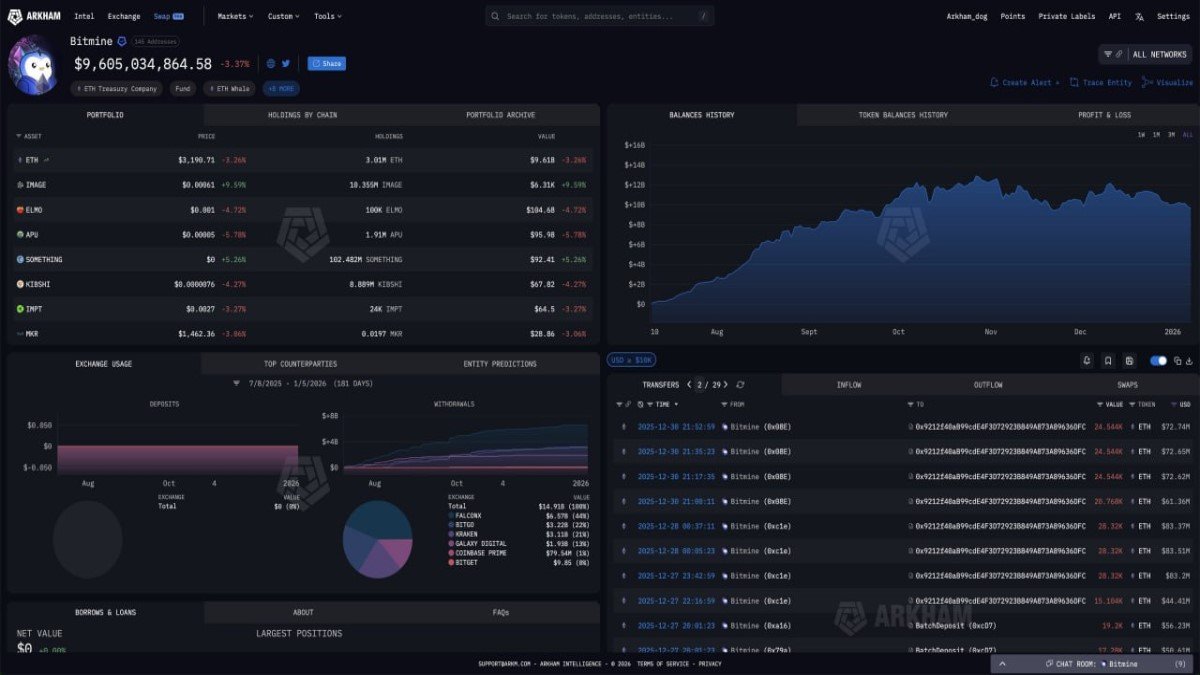
BitMine has quietly become one of the most influential actors in the Ethereum ecosystem. Its latest move — purchasing 33,504 ETH from prime broker FalconX for roughly 112 million USD — pushes the company’s holdings to about 3.86 million ETH. That is approximately 3.2% of the current circulating supply, a scale that would have been unthinkable only a few years ago.
On paper, BitMine is still sitting on an unrealised loss. Its estimated volume-weighted cost basis across 2025 is in the 3,500–3,800 USD range per ETH, while the market has spent much of the year trading below those levels. Yet the firm continues to add aggressively, and its leadership has been vocal about long-term conviction. Chairman Tom Lee has argued that Ethereum formed a durable bottom near 2,500 USD, and that ETH could reach 7,000 USD by early 2026 as part of what he calls an “Ethereum supercycle” analogous to Bitcoin’s behaviour around 2017.
At the same time, Lee has adjusted his public forecasts more than once. Earlier in the year, he was talking about 12,000 USD per ETH by the end of 2025; that target shifted to 9,000 USD by early 2026 as volatility and macro uncertainty persisted. Other high-profile figures add more numbers to the mix: Ric Edelman of Edelman Financial Engines, for example, has spoken about Bitcoin potentially reaching 180,000 USD by 2026, roughly in line with some long-term scenarios from major US banks such as JPMorgan.
The result is a familiar chorus: bold price targets, eye-catching percentages and timelines that sound precise but frequently change. Against that backdrop, BitMine’s decision to keep buying while “underwater” offers a useful case study. What does it really mean when a large institution accumulates ETH this aggressively? How should individual investors interpret forecasts from influential market participants? And why do long-term, data-driven strategies still matter more than any specific number attached to a particular year?
1. BitMine as an Ethereum “asset company”
The first point to understand is that BitMine is not simply a fund trying to trade short-term moves; it is constructing something closer to an asset operating company whose core balance-sheet item is Ethereum. In that sense, BitMine plays a role for ETH that resembles what some listed firms have done for Bitcoin. Instead of launching an ETF, management uses the corporate structure itself as a vehicle to hold and finance long-term positions in the asset.
Owning 3.86 million ETH gives BitMine several advantages:
• Balance-sheet optionality. The company can pledge ETH as collateral, participate in staking or structured-finance products, and potentially issue debt or hybrid instruments backed by its holdings.
• Narrative leverage. Because the position is large relative to supply, any additional purchases or treasury announcements tend to attract media attention, which reinforces BitMine’s brand and may help with future capital raising.
• Strategic influence. While Ethereum remains decentralised, major holders can still play a role in ecosystem initiatives, from supporting client diversity to funding infrastructure and research.
BitMine’s stated goal is to eventually own 5% of Ethereum’s circulating supply. At current levels, that would require acquiring roughly another 2.5 million ETH. This is a multi-year plan, not a short-term trade. The firm is effectively committing to being a structural buyer across cycles, even if that means enduring long periods of mark-to-market losses along the way.
2. What does a 3.2% stake actually mean for Ethereum?
When one company controls more than three percent of an asset’s supply, it is natural to wonder whether this concentration is healthy. There are two sides to the argument.
2.1. The bullish interpretation: reduced free float and signalling value
On the positive side, a large holder that consistently accumulates rather than trades short-term can reduce the effective free float of an asset. Every time BitMine buys ETH and holds it off-market, there are fewer coins available for sale at any given price. In a world where new issuance is limited and staking locks a significant percentage of the supply, this can contribute to upward pressure when demand increases.
There is also a signalling effect. Institutions often look to their peers when evaluating new asset classes. A company willing to allocate billions of dollars over several years, even while enduring volatility, sends a message that Ethereum can be treated as a strategic reserve asset rather than a speculative side bet. That signal may matter as much as the actual size of the position.
2.2. The cautious view: concentration and headline risk
On the other hand, concentration introduces its own risks. If a few large entities hold a meaningful share of supply, market participants must constantly assess the possibility that those actors could change strategy. Even if BitMine has no intention of selling aggressively, external pressures — regulatory changes, financing constraints, or shifts in management — could force partial de-risking at inconvenient times.
From an educational standpoint, the lesson is straightforward: large holders shape the liquidity landscape, but they do not eliminate risk. Individual investors should avoid assuming that any single company, however committed, can guarantee a specific price outcome for an asset as global and liquid as Ethereum.
3. The allure and limitations of price forecasts
Tom Lee’s evolving targets for ETH illustrate the nature of most market forecasts. At one stage, the headline was 12,000 USD by the end of 2025. As conditions changed, that shifted to 9,000 USD by early 2026, and now we hear about 7,000 USD as a plausible early-2026 level. None of this is unusual; analysts in every asset class adjust their views as new information emerges.
The problem is that headlines rarely convey this fluidity. Human psychology tends to latch onto the largest number mentioned and treat it as a destination. When reality deviates, disappointment follows, even if the underlying long-term thesis remains intact.
We have seen this before. In 2021, “Bitcoin to 100,000 USD” was a widely discussed scenario. When it did not happen on schedule, some investors concluded that the thesis was invalid and exited the market entirely — only to watch Bitcoin approach that level in a later phase of the cycle. The long-term trajectory can still be upward even when short-term timelines are wrong.
The key is to recognise what forecasts actually are: narrative tools and risk scenarios, not promises. Analysts are trying to translate a complex web of assumptions into a single, digestible figure. That figure is useful in discussions, but it is always a simplification. As conditions evolve, the assumptions change; so does the number.
4. Why big buyers can be wrong on timing and still be right on thesis
One reason price predictions persist is that, over long horizons, many of them end up looking approximately correct even if the timing is off. Bitcoin has experienced drawdowns of 70–80% multiple times in its history. Yet for those who held through multiple cycles, the long-run outcome remained positive. The path was far from smooth, but the direction was clear.
BitMine is betting that Ethereum will show a similar pattern. The company is comfortable seeing temporary losses on newly purchased ETH because its horizon is measured in years, not quarters. If the long-term thesis — that Ethereum will remain a core settlement and smart-contract platform, with growing usage and constrained supply — plays out, then whether the final target is 7,000 or 9,000, or whether it arrives in 2026 or 2028, matters less than being consistently exposed to the asset during its structural growth phase.
This is not a guarantee of success. Any asset thesis can fail. Competing platforms can gain share, regulatory frameworks can change, and technological shifts can alter the competitive landscape. What BitMine demonstrates, however, is that large buyers are willing to separate thesis from short-term forecasting. They care more about owning a scarce digital asset through multiple macro cycles than about calling each exact top or bottom.
5. The psychology of forecasts: why they feel persuasive
If everyone knows that forecasts are uncertain, why do they still attract so much attention? Several cognitive biases are at work.
• Confirmation bias. People naturally gravitate toward predictions that align with positions they already hold. If you own ETH, a respected analyst calling for 7,000 USD does not just sound plausible; it feels reassuring.
• Storytelling bias. A specific number and date create a simple narrative: “If X happens by Y, my decision was right.” That is easier to process than a probability distribution or a range of outcomes.
• Authority bias. Names like Tom Lee, Ric Edelman, Cathie Wood or large banks carry institutional weight. Even when their views diverge, the fact they are willing to attach numbers to public forecasts can sway opinion.
In addition, some price targets serve a strategic purpose. They can draw attention to a fund, support a new product launch or anchor expectations around a certain theme. That does not mean the forecasts are insincere, but it does mean that investors should be aware of the incentives behind them.
6. What actually matters for Ethereum’s long-term value
If headline targets are unreliable guides, what should observers focus on instead when evaluating Ethereum's long-term potential? Several structural factors stand out:
• Network security and decentralisation. The health of validator participation, client diversity and protocol upgrades that improve resilience.
• Usage and fee dynamics. The extent to which real economic activity — from stablecoin transfers to application-specific rollups — depends on Ethereum’s settlement layer.
• Layer-2 and rollup ecosystem. The growth of scaling solutions that increase throughput while still anchoring security to Ethereum.
• Tokenomics and issuance. The balance between staking rewards, fee burns and new issuance that determines whether ETH behaves more like a scarce asset or a high-inflation instrument.
• Regulatory clarity. The degree to which professional investors can hold ETH directly or through products such as ETFs without facing ambiguous treatment in major jurisdictions.
BitMine’s conviction is rooted in these fundamentals. The company believes that as Ethereum continues to serve as a key settlement layer for decentralised applications, tokenisation and possibly parts of the AI and data economy, demand for ETH as collateral and as a protocol asset will rise. Whether that translates into a specific price in a specific year is less important than whether the long-term direction is positive and resilient across different macro scenarios.
7. Educational takeaways for individual investors
For individual participants, the BitMine story and the surrounding forecasts offer several practical lessons.
7.1. Treat predictions as background noise
Price targets can be interesting, even entertaining, but they should not form the backbone of a personal investment plan. A forecast that matches your hopes for an asset does not make the outcome more likely; it simply makes it feel more comfortable. Instead of asking, “Will ETH be 7,000 USD by 2026?” a more useful question is, “What happens to my finances if ETH never reaches that level, or if it takes much longer than expected?”
7.2. Focus on time horizon and position sizing
BitMine can absorb large swings in Ethereum’s price because its exposure is sized for a multi-year horizon and funded through a diversified corporate structure. Individual investors rarely have that flexibility. For them, risk management starts with position size. No matter how compelling a thesis sounds, allocating more than one can emotionally or financially tolerate can turn normal volatility into a crisis.
7.3. Systematic accumulation beats market timing
The experience of past cycles suggests that trying to pick exact tops and bottoms is extremely difficult, even for professional desks. A disciplined approach such as dollar-cost averaging into assets one understands, over a long period, has historically fared better than attempts to jump in and out based on forecasts.
This is not about ignoring prices. It is about accepting that remaining in the market with a sustainable plan has often been more important than entering at the perfect moment. Investors who exited entirely when a high-profile forecast failed to materialise in 2021, for example, missed later phases of the cycle when Bitcoin eventually approached the same targets on a different timeline.
8. Conclusion: conviction, humility and the role of BitMine’s ETH bet
BitMine’s latest 112 million USD purchase from FalconX adds another chapter to the story of institutional Ethereum adoption. With 3.86 million ETH on its books and an ambition to reach roughly 5% of circulating supply, the company has made Ethereum a central pillar of its identity. Chairman Tom Lee’s public forecasts — from 12,000 to 9,000 to 7,000 USD — are part of that story, helping frame Ethereum as an asset capable of multi-fold appreciation in the years ahead.
Yet the deeper lesson lies not in any single number, but in the combination of conviction and humility. BitMine is willing to keep buying despite temporary losses because it believes in Ethereum’s structural role in a digitising financial system. At the same time, the shifting forecasts themselves are a reminder that no one can reliably specify exactly how high or how fast any asset will move, especially in markets as young and complex as crypto.
For long-term participants, the healthiest stance may be to borrow BitMine’s patience while avoiding overconfidence in specific predictions. That means grounding decisions in fundamentals, sizing positions prudently, and accepting that volatility and uncertainty are permanent features of the landscape, not bugs that can be eliminated by the right model or the right guru.
In that sense, all the price targets — whether for Ethereum, Bitcoin, equities or any other asset — are best viewed as stories that make a complex future feel simpler. They can be useful for thinking, but they should never replace a robust, long-term plan. The market will ultimately decide where ETH trades in 2026 or 2030. The part within each investor’s control is far more mundane: how much risk to take, how long to stay, and whether to build a strategy sturdy enough to survive both the bullish headlines and the inevitable disappointments along the way.