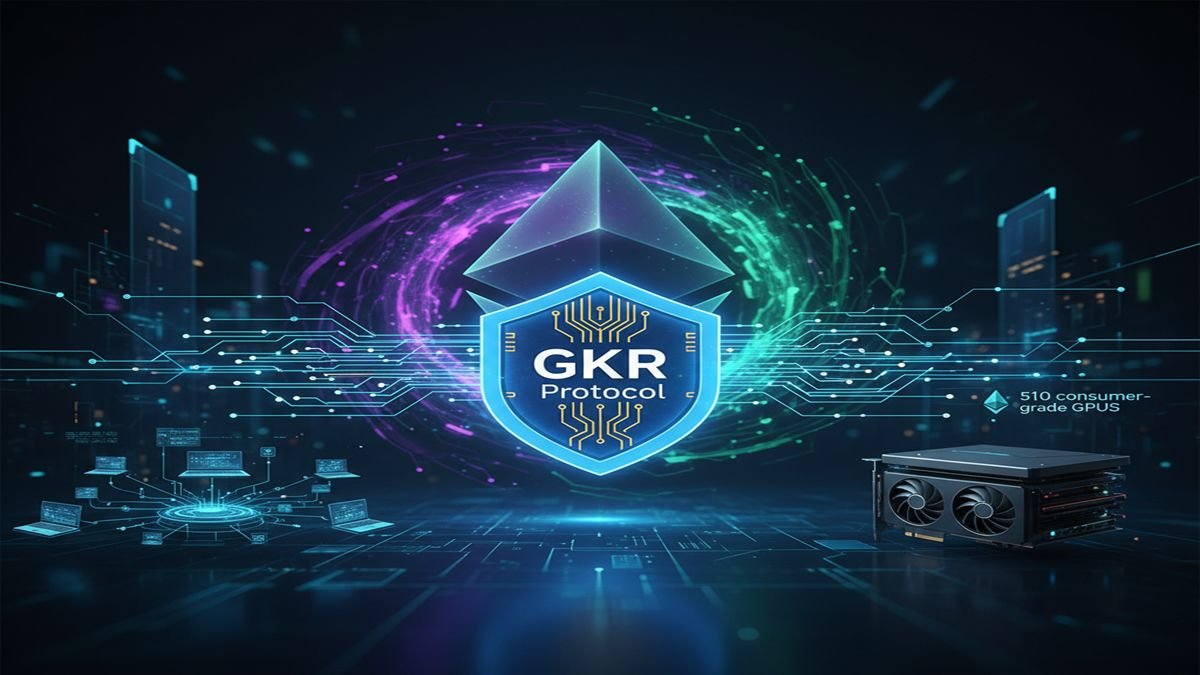
Vitalik Buterin highlighted GKR—the Goldwasser–Kalai–Rothblum protocol—at the heart of today’s ultra-fast ZK. The message was bigger than speed: architecture beats instant security incidents. This analysis explains how GKR works, where it wins, what infra upgrades are coming, and why long-lived systems—not quick fixes—own the future
“Instant solutions are irrelevant. The future belongs to those building systems that can stand the test of time.” That is the subtext of Vitalik Buterin’s reminder after sharing guidance on GKR—the Goldwasser–Kalai–Rothblum proof system that sits behind many of the fastest modern zero-knowledge (ZK) stacks. The internet celebrated benchmarks; Vitalik emphasized architecture. This article unpacks what GKR is, why it matters, the kinds of infrastructure upgrades arriving next, and a practical playbook for teams who want to build for resilience, not a one-off demo.
What Is GKR, in Plain English?
GKR is an interactive proof specialized for verifying computations expressed as layered arithmetic circuits. Instead of proving everything at once, the prover and verifier run a structured dialogue that repeatedly reduces a high-dimensional sum over a circuit to smaller and smaller sums via the sum-check protocol. The key trick is to encode each circuit layer as a multilinear extension—a polynomial that matches the layer’s table on Boolean inputs. The verifier randomly samples points; the prover answers with polynomials that must be self-consistent across layers. If they ever cheat, the randomness exposes it with high probability.
Why does this matter for speed? Because GKR turns a big, messy computation into a repeatable pattern—evaluate, reduce, fold—where most work is linear-time and highly parallelizable. Many modern provers use GPU kernels for the heavy vector math; some are moving to ASIC-friendly primitives. The verifier stays lightweight, doing only a handful of polynomial evaluations and hash checks. That asymmetry is the essence of scalable ZK.
GKR vs. “One Number to Rule Them All” Benchmarks
Proof time and proof size are seductive KPIs. But Vitalik’s point is that efficiency is architectural—how you arrange components matters as much as raw microseconds. GKR plays well in pipelines where:
- Computation is naturally layered (virtual machines, state transitions, batch verification of signatures, or data availability checks).
- You can rely on Merkle commitments to tables rather than expensive pairings for every step.
- You want recursion—wrapping many small proofs into a single proof without blowing up memory.
In contrast, some SNARKs with heavy preprocessing shine on single, fixed circuits but become awkward for evolving workloads. Others rely on pairing-based commitments that are tiny but bottleneck GPU throughput. The lesson: choose the proof architecture for the workload, not the other way around.
How GKR Interacts with Commitments (KZG, IPA, FRI, and Merkle)
GKR itself proves relations about multilinear extensions; it still needs a way to commit to polynomials or tables and open them at random points. There are multiple choices, each with trade-offs:
- Merkle commitments over tables: cheap, parallel, hash-friendly. Great for GPUs and SRAM-lean ASICs. Proofs grow with the log of table size but are predictable and network-friendly.
- FRI (as in STARKs): excellent for very large domains; pairs well with hash-based ecosystems and avoids trusted setups.
- KZG/IPA: tiny openings and elegant recursion, but MSMs (multi-scalar multiplications) can dominate prover time unless hardware-accelerated.
Vitalik’s emphasis on architecture translates to a practical rule: mix and match. Many leading stacks now hybridize GKR + Merkle/FRI for throughput-heavy layers and reserve pairing-friendly gadgets for small, proof-wrapping steps where size matters more than raw prover speed.
Where GKR Wins in Production
Three families of workloads map naturally to GKR:
- Rollup execution: Represent blocks as layered circuits (decode → state read/write → transition). GKR minimizes the work the verifier must do per block while provers scale out horizontally.
- Batch verification: Many signatures, many transactions, many lookups. GKR reduces the whole batch to a few random checks with small proofs.
- Recursive aggregation: Instead of one giant proof, generate many small proofs in parallel and fold them. GKR’s structure makes that fold cheap and memory-predictable.
Infrastructure Upgrades on the Way
The next wave is less about inventing new cryptography than about industrializing the pipeline:
• Arithmetization DSLs: High-level compilers that output GKR-friendly circuits with automatic table layout, batched sum-check steps, and machine-checked constraints.
• GPU/FPGA kernels: Specialized kernels for multilinear evaluations, butterfly-style reductions, and Merkle hashing (Poseidon/Rescue/Keccak variants) with coalesced memory access.
• Prover orchestration: Map-reduce style schedulers that split a block across workers, then recursively fold proofs. Think “prover as a service” with fault isolation and retry semantics.
• Deterministic I/O formats: Canonical encodings for witnesses, tables, and openings so different implementations can interoperate—critical for client diversity.
• Security monitoring: Proof verifiers with canary circuits and liveness alarms (proof delays, OI spikes, or hash-rate drift) to detect partial failures early.
Efficiency Is More Than Speed
Vitalik’s reminder is timely: fast is not the same as efficient. An efficient ZK system has four properties:
- Predictability — prover time and memory scale linearly with the thing you are proving; no surprise quadratic blow-ups.
- Composability — proofs compose (recursion, aggregation) without fragile ceremony.
- Auditability — circuits and commitments are reviewable by third parties; parameters and domains are documented.
- Portability — upgrades don’t force a full re-write of your application logic.
GKR helps with the first two by design. The rest are engineering decisions: interfaces, logging, telemetry, and conservative defaults.
Common Misconceptions
- “GKR is only for toy circuits.” False. It shines on large, layered workloads—exactly what chains and rollups produce daily.
- “Pairings beat hashes, always.” Depends. If your bottleneck is memory bandwidth, hash-centric commitments can win; if bandwidth is cheap but bytes on chain are scarce, tiny pairing openings win.
- “A faster prover is always better.” Not if it breaks recursion, explodes memory, or requires one brittle vendor. Architecture first, micro-ops later.
A Builder’s Playbook (If You’re Planning an Upgrade)
1. Profile before you port: measure where time goes—witness generation, hashing, MSMs, I/O. Don’t guess.
2. Choose your commitment mix: Merkle/FRI for big tables; KZG/IPA for small recursive wrappers. Keep the interfaces abstract.
3. Stabilize arithmetization: adopt a DSL that emits GKR-friendly layouts; standardize gates, lookups, and table schemas.
4. Plan for recursion early: design proof boundaries that can be aggregated nightly or per-epoch without re-engineering.
5. Make hardware a first-class concern: publish GPU/CPU parity tests, memory footprints, and recommended cards; expose knobs for batch size and parallelism.
6. Fail safely: when provers stall, the system should degrade gracefully (throttled batch sizes, alternate backends) rather than halt the chain.
Why “Instant Solutions” Don’t Matter
Crypto loves a shortcut. But ZK infrastructure amortizes over years. Decisions you make today—hash choice, field size, table shape—propagate into circuits, clients, and hardware. Short-term benchmarks fade; operational debt persists. Vitalik’s note is a nudge to favor designs that survive new hardware, new compilers, and new threat models. That is why GKR is powerful: it’s a pattern, not a stunt.
Signals to Watch in the Next 12–18 Months
- Open, audited GKR libraries with portable kernels and deterministic encodings.
- Recursion as a default in rollups—epoch proofs aggregating hourly block proofs with predictable finality windows.
- Hybrid stacks where hash-centric layers handle bulk compute and succinct wrappers keep proofs tiny for L1 verification.
- Hardware lanes: public benchmarks on consumer GPUs and early ASIC announcements focused on hashes + memory bandwidth, not only pairings.
Bottom Line
Vitalik’s message is not a hype ticking risk about a single trick. It is a design philosophy: build systems that age well. GKR fits that philosophy because it transforms large computations into predictable, parallel steps, leaving room for healthy competition among commitment schemes and hardware. Speed will keep improving—but architecture decides who survives the next decade. If you are choosing what to build today, choose the thing that remains legible, modular, and composable when the benchmarks change tomorrow.