Two Legendary Casascius Coins Wake Up After 13 Years: What This Really Tells Us
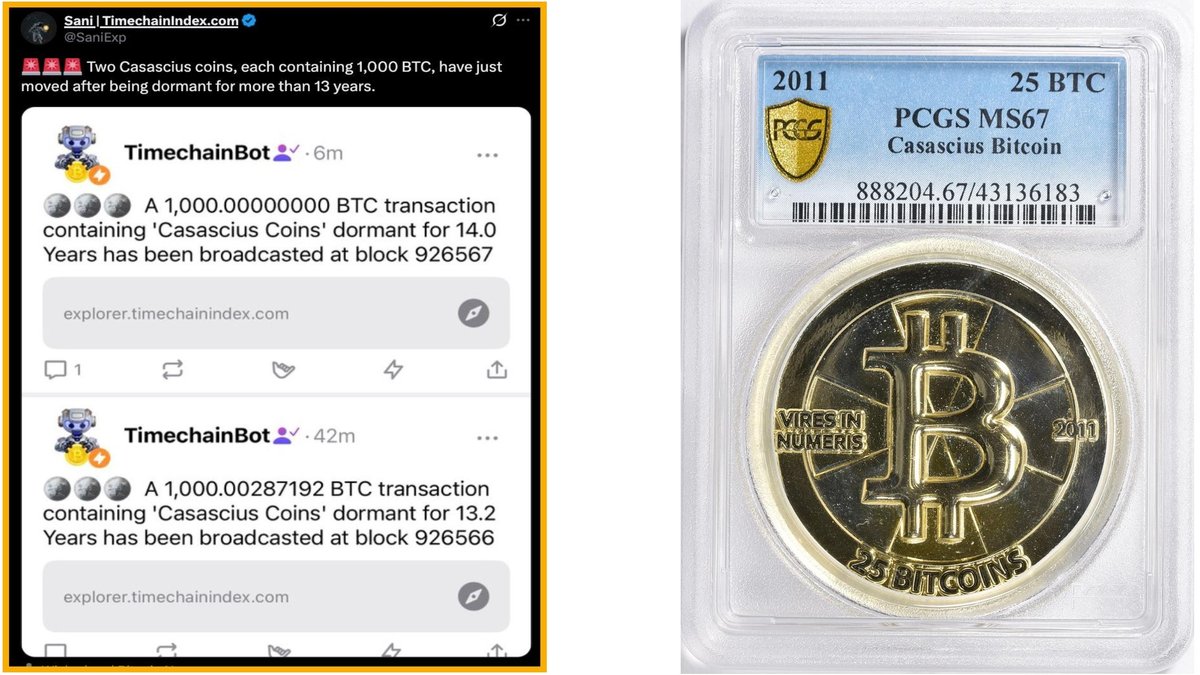
On a quiet December day, blockchain watchers noticed something remarkable: two ancient Bitcoin wallets, each tied to a physical Casascius coin holding 1,000 BTC, suddenly came to life after more than thirteen years of complete inactivity. On-chain data shows both transactions were broadcast in consecutive blocks, moving a combined 2,000 BTC that had not been touched since the early 2010s. At today’s prices, that stash is worth roughly $179–180 million.:contentReference[oaicite:0]{index=0}
For a community that closely watches the behaviour of long-dormant coins, this is a rare event. High-denomination Casascius pieces are the equivalent of Bitcoin artefacts: they sit at the crossroads of early-era experimentation, numismatic collecting and serious long-term wealth storage. When one of them moves, it raises questions that go well beyond the day’s price chart. Is an early adopter finally selling? Is someone refreshing their security set-up? What does it mean for Bitcoin’s increasingly mature ownership base?
This article unpacks the story behind these two coins and explains why their awakening says more about how long-term holders manage risk in 2025 than about any looming liquidation.
What Exactly Is a Casascius Bitcoin?
Casascius coins were among the earliest attempts to give Bitcoin a physical form. Created by Utah entrepreneur Mike Caldwell starting in 2011, they are metal coins or bars with a private key embedded under a tamper-evident hologram. Each piece is loaded with a fixed amount of BTC, ranging from tiny fractions of a coin up to enormous denominations like 100 BTC and 1,000 BTC.:contentReference[oaicite:1]{index=1}
To redeem the Bitcoin, the owner peels the hologram, revealing the key printed on a small paper insert. Once the key is swept into a software or hardware wallet, the coin is considered ‘peeled’ and the physical item becomes a purely collectible object, no longer backed by live BTC. Because the peel process is irreversible and visible, intact coins are prized both for their loaded value and for their status as untouched historical artefacts.
During the brief 2011–2013 minting window, Caldwell produced tens of thousands of coins and bars holding over 90,000 BTC in aggregate.:contentReference[oaicite:2]{index=2} They were sold at a time when a single BTC traded anywhere from a few dollars to low double digits. For early enthusiasts they were part novelty, part cold storage, and part statement: a way to make this new digital money feel tangible.
How Regulation Turned Casascius Into a Finite Relic
The story took a decisive turn in 2013. That year, the U.S. Financial Crimes Enforcement Network (FinCEN) published guidance treating certain virtual currency activities as money transmission.:contentReference[oaicite:3]{index=3} Later that year, Caldwell received a notice indicating that loading coins with Bitcoin and selling them might be considered an unregistered money-transmission business. Rather than fight an expensive regulatory battle, he chose to stop shipping coins that contained live BTC.
By November 2013, sales of loaded Casascius coins had been suspended.:contentReference[oaicite:4]{index=4} From that moment, the supply of genuine loaded Casascius pieces became permanently capped. No more would ever be minted under the original model. Over time this scarcity, combined with the historical aura of early Bitcoin culture, turned the coins into high-end collectibles. Specialist trackers now catalogue how many pieces remain loaded, how many have been peeled, and how much BTC is still locked inside.:contentReference[oaicite:5]{index=5}
Among all denominations, the 1,000-BTC units sit at the top of the pyramid. Archival data suggests that only a handful of such coins and bars were ever produced, making the two that just moved part of an extremely small club.
What Happened in December 2025?
According to reporting from CoinDesk, Yahoo Finance and other outlets, the two 1,000-BTC Casascius coins had been dormant since December 2011 and October 2012, respectively.:contentReference[oaicite:6]{index=6} At the time they were loaded, Bitcoin was trading below $12. That implies a notional price appreciation measured in millions of percent for anyone who held on.
In early December 2025, transactions corresponding to those coins were broadcast and confirmed in consecutive blocks. On-chain analysts identified the sending addresses as belonging to Casascius units based on known series and prior tracking efforts. The coins were moved to fresh addresses, but not immediately forwarded to major exchanges.
Importantly, nothing in the public data proves that the owner has sold, or even intends to sell. The blockchain only shows that the original Casascius addresses no longer hold the BTC and that the funds have been consolidated elsewhere. That is a crucial distinction, especially in an era when large long-term holders are increasingly sophisticated in how they manage risk.
Activation Does Not Automatically Mean Selling
Why would someone disturb an artefact that has quietly held 1,000 BTC for more than a decade? There are several plausible reasons, and immediate liquidation is only one of them.
1. Security upgrades as physical items age
Paper wallets and holographic stickers are not designed to last forever. Adhesives can dry out, paper can degrade, and environmental factors such as humidity or temperature swings can slowly damage the embedded key. For a coin that today represents tens of millions of dollars, the risk of physical deterioration becomes very real.
Recent stories from other Casascius owners give us a strong clue. In mid-2025, a collector who held a 100-BTC Casascius bar since 2012 finally moved the coins into a modern hardware wallet. He explained that the move was largely about safety; the bar had been stored in a vault for years, but he was no longer comfortable relying solely on a decade-old physical sticker to protect eight-figure wealth.:contentReference[oaicite:7]{index=7}
The same logic likely applies at the 1,000-BTC level. Moving the coins into a more contemporary custody arrangement — perhaps a hardware wallet or a multi-signature set-up with institutional support — can dramatically reduce single-point-of-failure risk without requiring any immediate sale.
2. Estate planning and generational handovers
Another possibility is that original early adopters are starting to formalise their estate planning. A physical coin hidden in a safe may be meaningful to someone deeply involved in Bitcoin’s early years, but it is a challenging inheritance structure. Successors may find it easier to manage clearly documented digital wallets, especially if combined with legal structures such as trusts.
Redeeming a Casascius coin can therefore be part of a broader effort to put long-held BTC into a form that is easier to administer across generations, while still keeping the exposure long term. That hypothesis fits with the broader demographic shift in Bitcoin: the people who experimented with it in 2011 are now more likely to be thinking about family balance sheets than about novelty coins.
3. Optimising between collectible value and monetary value
Unpeeled Casascius coins command a numismatic premium; collectors pay extra precisely because the hologram is intact. Yet at very high denominations, the relationship between collectible value and underlying BTC value becomes more complex. A 1,000-BTC coin combines priceless history with a level of concentrated risk that few investors would tolerate elsewhere in their portfolio.
An owner might choose to redeem part or all of the BTC while still preserving the physical item as a historic piece, even if its on-chain value becomes zero. In that sense, moving the coins could be seen as a rational way to separate artistic value from financial exposure.
How Big Is This Move in the Context of the Bitcoin Market?
At around $180 million, the awakened stash is enormous for an individual but modest in the context of Bitcoin’s global market. Daily spot volume across major exchanges regularly reaches billions of dollars, and long-term holder cohorts collectively own millions of BTC. From a liquidity perspective, the movement of 2,000 coins is noticeable but not transformational.
The symbolic impact, however, is larger. On-chain analysts pay close attention to dormant supply — coins that have not moved in many years. Metrics such as ‘coin days destroyed’ and ‘HODL waves’ track how much older supply is being spent. Large movements from early-era addresses can temporarily spike these indicators and often spark debate about long-term holder conviction.
Yet prior episodes suggest that such awakenings rarely mark turning points on their own. In 2023 and 2025, multiple dormant Casascius pieces in the 10–100 BTC range were redeemed without any clear link to market tops or bottoms.:contentReference[oaicite:8]{index=8} They are better interpreted as individual risk-management decisions than as macro signals.
The Declining Population of Loaded Casascius Coins
Every time a Casascius coin is peeled, the population of loaded pieces shrinks. That matters not only for collectors, but also for anyone interested in how much of Bitcoin’s supply may still be locked away in deep cold storage.
Tracking projects suggest that, out of roughly 27,000 original Casascius coins and bars loaded with more than 91,000 BTC, fewer than half the coins remain unredeemed.:contentReference[oaicite:9]{index=9} The percentage varies by denomination: many small 1 BTC coins have been spent, while a larger share of high-value pieces remain intact. The two 1,000-BTC coins that just moved come from the rarest segment of that distribution.
As more pieces are redeemed for security reasons or estate planning, the collectible market may attach an even higher premium to the ones that stay sealed. At the same time, every redemption slightly increases the share of Bitcoin that is actively managed in modern wallets, reinforcing the idea that the network’s monetary base is increasingly held by sophisticated, security-conscious owners rather than forgotten paper wallets in drawers.
Physical Bitcoin vs. Digital Custody: A Snapshot of an Evolving Culture
The revival of these two coins highlights a quiet cultural shift within the Bitcoin ecosystem. In the early 2010s, giving a friend a brass coin with the iconic ‘B’ logo and a QR code was a fun way to introduce them to the concept of digital money. Physical pieces helped make an abstract technology feel real. They were conversation starters at meetups, paperweights on desks, and experiments in blending art with cryptography.
Fast-forward to 2025, and custody practice looks very different. Hardware wallets, multi-signature schemes and institutional custodians with insurance and audited processes have become the norm for meaningful balances. Regulatory clarity has improved, and there are now detailed industry standards for how to secure digital assets for the long haul.
In that context, a 1,000-BTC Casascius coin is both magical and awkward. It captures the romance of Bitcoin’s early days, but it concentrates an enormous sum into a single piece of paper under a hologram that was never designed to survive multiple decades. Moving the coins on-chain is a way to bring that early wealth into alignment with today’s best practices, even if the physical artefact remains a conversation piece for collectors.
What This Episode Teaches Long-Term Holders
For everyday Bitcoin users, most of whom will never own a Casascius coin, the story still carries useful lessons:
• Security methods should evolve over time. A storage approach that made sense when an asset was worth a few hundred dollars may be irresponsible once it represents life-changing wealth. Periodic reviews of custody arrangements are part of responsible long-term holding.
• Movement is not the same as exit. When analysing on-chain data, it is important to distinguish between coins moved for security, consolidation or internal reorganization, and coins sent to venues that clearly indicate an intention to trade.
• Collectible value and financial value are not identical. Physical artefacts can carry historical or emotional weight that goes beyond their monetary worth. Owners need to decide how to balance those dimensions rather than assume one will always dominate.
• Transparency cuts both ways. The Bitcoin ledger allows anyone to observe major movements, which can inform research and market analysis. At the same time, it can fuel speculation when context is missing. A disciplined approach uses the data as one input among many, not as a standalone signal.
Bottom Line
The awakening of two 1,000-BTC Casascius coins after thirteen years is a rare and fascinating event, but not necessarily a dramatic turning point for the Bitcoin market. It illustrates how early-era wealth is gradually migrating from experimental physical formats into more robust digital custody, and how long-term holders are adapting to a world where their once-novel coins now represent generational capital.
For the broader ecosystem, the episode is a reminder of Bitcoin’s unusual history. An asset that began as a niche experiment now has physical relics that function like modern-day treasure chests. As those chests are carefully opened and their contents reorganized, the network’s story moves into a new chapter — one where nostalgia and professionalism coexist, and where even the most storied coins eventually become just another output on a global, neutral ledger.
Disclaimer: This article is for informational and educational purposes only. It does not constitute investment, legal or tax advice, and it does not recommend any specific strategy or asset. Digital assets can be volatile and may not be suitable for every reader. Anyone considering exposure should evaluate their own objectives, financial situation and risk tolerance and, if necessary, seek guidance from qualified professionals.