Coinbase, Collateral, And Capital Flows: A 24-Hour Snapshot Of Crypto’s Next Phase
Over the last 24 hours, headlines across macro, policy and crypto have moved in the same direction: away from speculative side-show, toward integration of digital assets into the core plumbing of global markets. Coinbase is preparing to list Jupiter (JUP) and Plume (PLUME), large institutional treasuries are adding Bitcoin and Ethereum in size, regulators are experimenting with tokenized collateral, and venture money continues to fund new infrastructure from privacy layers to real-world-asset blockchains.
This is not just another busy news day. It is an x-ray of where the next cycle is likely to be decided: on regulated venues, inside collateral frameworks, and in the stablecoin and layer-2 rails that connect traditional balance sheets to on-chain liquidity. Below, we unpack the main signals and what they may mean for market participants who approach crypto as a long-term macro and technology theme rather than a short-term trading arena.
1. Coinbase Adds Jupiter And Plume: Listings As Market Structure Signals
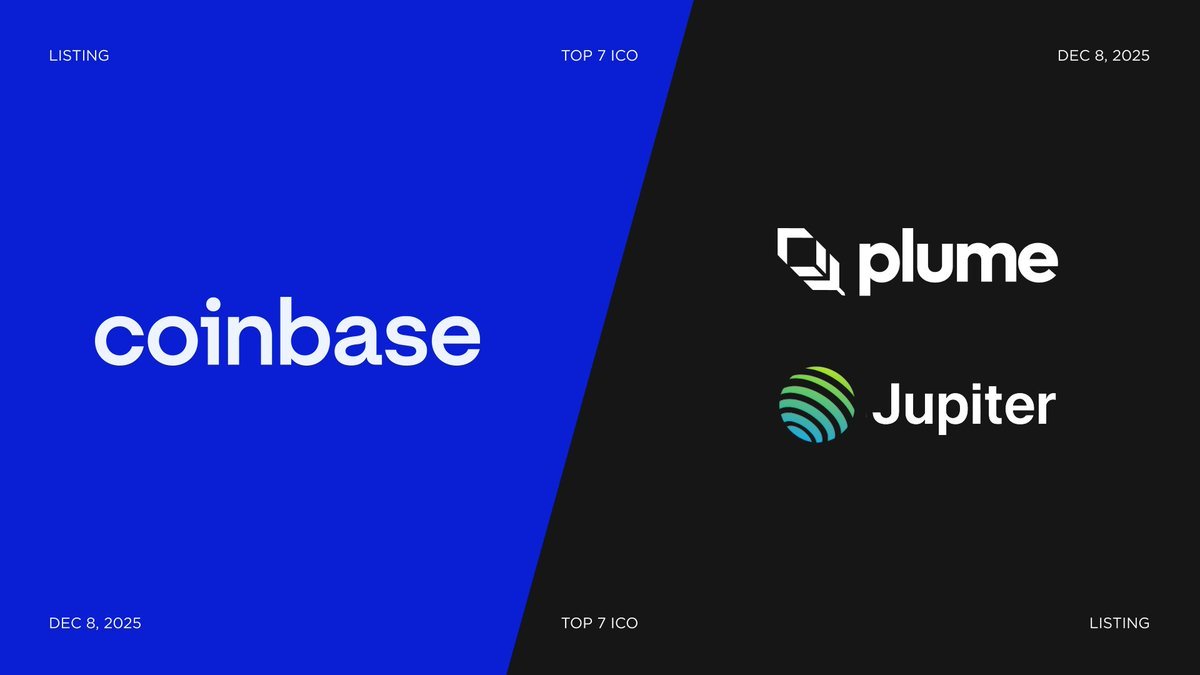
Coinbase has confirmed that it plans to list Jupiter (JUP) and Plume (PLUME) within the next 24–48 hours. Both tokens were recently added to the exchange’s official listing roadmap alongside several other projects, a step that does not guarantee timing but does indicate that they have cleared an initial filter on technical and compliance grounds.
Jupiter is the main routing and liquidity aggregation layer in the Solana ecosystem, connecting traders to the deepest routes across a wide universe of Solana tokens. Plume, by contrast, is building an EVM-compatible, real-world-asset-focused network aiming to tokenize assets such as credit or fixed income and plug them into DeFi-style tooling. Putting these two on the same roadmap is telling: Coinbase is effectively saying that both high-throughput trading infrastructure and regulated-leaning real-world-asset rails are core to the next phase of adoption.
For everyday users, a Coinbase listing tends to be interpreted purely as a potential price catalyst. The more important angle is structural. When an asset becomes available on a large, regulated exchange, it enters the toolkit of a much broader audience: U.S. retail, registered advisers, and, over time, institutions running multi-asset portfolios with strict custody and compliance constraints. That does not make any individual token a guaranteed winner, but it does mean the project is being evaluated as a piece of market infrastructure rather than a short-lived narrative.
2. Big Balance Sheets Vote: Strategy And BitMine Double Down On BTC And ETH
On the institutional side, two balance sheets dominated the last 24 hours. First, Michael Saylor revealed that his firm Strategy has just purchased another 10,624 Bitcoin, worth around 962 million USD, at an average price near 90,615 USD per coin. That takes the company’s total holdings to roughly 660,624 BTC, with a market value north of 60 billion USD at current levels. Second, Tom Lee’s BitMine disclosed that it acquired 138,452 ETH during the week, investing about 435 million USD, and now holds more than 3.86 million ETH on its books.
These moves matter less as individual trades and more as evidence of how certain institutions are framing Bitcoin and Ethereum. Strategy’s repeated purchases position BTC as a long-duration treasury asset, closer to a macro reserve or strategic store of value than a tactical position. BitMine’s accumulation of Ether is a bet on Ethereum’s role as a settlement and yield layer, especially after the Fusaka upgrade and in anticipation of more accommodating monetary policy.
There is a useful piece of perspective buried in the data point that eight years ago Bitcoin’s all-time high was 15,000 USD. The asset is now trading multiple times above that level, but the narrative has shifted even more than the price. Back then, BTC was mostly discussed in the context of speculative mania. Today, sovereign wealth funds, banks, and asset managers are reportedly sitting across the table from Saylor to discuss allocation frameworks, and ETFs have reshaped how exposure is implemented. The flows from Strategy and BitMine are a visible tip of a larger reallocation process that will play out over years, not days.
3. Policy And Collateral: From Capitol Hill Conversations To Tokenized Margin
Regulation also took a step forward. In Washington, chief executives of major U.S. banks are scheduled to meet Senators to discuss legislation on crypto market structure. These conversations are not about retail memes; they are about how to define assets, which agency supervises which product, and how to integrate digital instruments into existing rules for custody, capital and disclosure. The fact that large bank leaders are spending time on this topic signals that they now see digital assets as part of the mainstream conversation on financial infrastructure.
In parallel, the U.S. Commodity Futures Trading Commission (CFTC) is moving ahead with a pilot framework for tokenized collateral, including assets such as Bitcoin, Ether and regulated stablecoins like USDC, to be used in derivatives markets. The initiative is designed to test how on-chain representations of cash-like instruments and other assets can sit inside clearing and margin systems without weakening risk controls. If this experiment succeeds, it could open the door for more efficient collateral management and 24/7 settlement, while still sitting within a regulated perimeter.
Outside the United States, Argentina signalled that from 2026 its banking sector will be allowed to offer crypto services directly. This is especially notable for emerging markets, where local currency volatility, capital controls and access to international assets are recurring themes. A regulated channel for digital assets through banks could, in theory, reduce the reliance on informal or offshore platforms and enable more transparent, supervised participation. The key question for the next two years is how these frameworks will be implemented in practice, and whether banks treat digital assets as a core product line or as a niche add-on.
4. Macro Backdrop: Growth Resilience, Trade Imbalances And The AI-Hardware Axis
Macro data and commentary provided the background noise for risk assets. U.S. Treasury Secretary Bessent indicated that the United States is on track to finish the year with roughly 3 percent GDP growth, a pace that is neither recessionary nor overheating. Solid growth alongside gradually easing inflation gives central banks more room to adjust policy without triggering panic, which tends to be supportive for long-duration assets such as technology equities and, indirectly, large-cap digital assets.
At the same time, JPMorgan chief executive Jamie Dimon reiterated his view that Europe faces structural competitiveness challenges, arguing that the region has, over time, discouraged business investment and innovation. Elon Musk noted that social platform X is seeing record downloads in Europe, while political leaders are pressing ahead with new rules and large fines on major technology platforms. For crypto, the signal is that Europe will likely continue to lead on rule-making and consumer protection, even if parts of the market see it as less friendly to risk-taking.
On the other side of the world, China’s annual trade surplus has reached a record level of around 1 trillion USD, despite years of tariff pressure. The U.S. decision to allow exports of Nvidia’s H200 chips to China, alongside discussions about revenue sharing on those sales, underscores how deeply intertwined artificial intelligence, semiconductors and geopolitics have become. For crypto, these developments are not just background noise: networks such as Bittensor (TAO), which is approaching its first halving, live at the intersection of AI and on-chain incentives. The more capital that flows into AI hardware and research, the more important it becomes to understand how decentralized systems and token-based coordination might plug into that stack.
5. On-Chain Infrastructure: From Rehypothecation Debates To Tokenized Equities
Within crypto-native infrastructure, several stories illustrate how the market is maturing. The co-founder of Fluid acknowledged that certain Jupiter Lend vaults on Solana use rehypothecation to increase capital efficiency. In simple terms, this means collateral posted in one part of the system can be reused elsewhere, subject to rules and risk controls. While this can improve yields and utilization, it also raises important questions about how isolated risk really is if market conditions turn. The ongoing discussion around Jupiter’s design is a reminder that due diligence in DeFi is less about chasing headline returns and more about understanding collateral chains and worst-case scenarios.
ZKsync, another prominent scaling project, announced that it will phase out support for ZKsync Lite by 2026 to focus resources on ZK Stack and the broader ZKsync ecosystem. This reflects a broader pattern across layer-2 networks: teams are consolidating around architectures that are easier to standardize, integrate and audit. For developers and users, the key takeaway is that infrastructure roadmaps are not static. Chains and rollups evolve, and part of risk management is keeping track of which environments will be actively maintained over a multi-year horizon.
In parallel, tokenization continues to migrate traditional instruments on-chain. Robinhood is expanding its tokenization program to cover nearly 500 U.S. equities and ETFs on Arbitrum, adding around 80 new assets in this latest batch. At the same time, it is deepening its international footprint, including a push into Indonesia through acquisitions such as Buana Capital and PT Pedagang Aset Kripto. Combined with the earlier news that French banking group BPCE is rolling out in-app crypto trading featuring assets like SOL, the picture is of brokerage and banking platforms gradually treating blockchain not as an exotic experiment, but as just another settlement and distribution rail.
6. Stablecoins, ETFs And The Quiet Build-Out Of Collateral Rails
Another through-line in the last 24 hours is the steady institutionalization of collateral and yield products around digital assets. On the ETF side, Grayscale has filed for a Sui ETF that would give traditional investors regulated exposure to the SUI ecosystem via a listed vehicle. BlackRock went a step further by filing for an iShares staked Ethereum ETF, designed to package ETH exposure together with on-chain staking rewards. These products, if approved, would extend the toolkit for allocators who want blockchain exposure but are constrained to listed, supervised instruments.
In the venture and protocol space, Aztec Network’s public token sale, which has attracted commitments in the tens of thousands of ETH, signals strong interest in privacy-preserving layer-2 infrastructure. At the same time, Magma Finance on Sui is pushing forward an adaptive liquidity model, while Pye Finance on Solana has raised fresh capital to build tools that make stake-based yields more transparent and programmable. Bithumb’s listing of ALLO with fee-free trading, and Mantra’s OM migration saga with centralized exchanges, highlight practical coordination challenges between projects, venues and users. The lesson is that infrastructure risk is not limited to code; communication and timelines matter just as much.
Stablecoins remain the connective tissue in all of this. Crown has raised new capital to expand BRLV, a Brazilian real-denominated stablecoin backed by government bonds, aiming to give institutions compliant access to Brazil’s high-yield fixed-income market. In parallel, Circle has deepened its strategic relationship with Bybit, including revenue-sharing mechanisms designed to incentivize deeper USDC usage across the exchange. These developments show how stablecoins are evolving from simple digital cash analogues into structured products that sit directly inside yield-bearing and collateral workflows.
7. Policy Signaling And Data: What The Next Few Weeks Could Look Like
Beyond structural moves, a series of political and data points hint at how policy might evolve. White House economic adviser Kevin Hassett suggested that President Trump will soon announce significant positive economic measures, while the U.S. Labor Department confirmed that October and November producer price data will be released together in January 2026. These steps aim to shape expectations around growth, inflation and monetary policy, all of which feed into real yields and risk-asset appetite.
President Trump also commented on relations with China and Europe, expressing optimism about trade with Beijing after a call with President Xi, and concern that Europe is moving in an unhelpful direction after imposing a large fine on platform X. The Bank of Japan, for its part, reiterated that the Japanese economy has weathered tariff pressure better than many feared. For investors, the practical takeaway is not to trade every headline, but to recognize that crypto now lives inside the same information set as global equities and bonds. When trade policy, tariffs or competition policy shift, they can influence both the cost of capital and the regulatory mood music around digital assets.
Media personalities also weighed in. Jim Cramer’s remark to own Nvidia rather than actively trade it reflects a broader view that certain technology platforms are better treated as long-term structural holdings than as short-term trading vehicles. Whether one agrees or not, the analogy carries over to digital assets: some participants are trying to identify which networks could become core infrastructure and frame them in multi-year terms, while others focus on short-term volatility. The important thing is to be clear about which game one is playing.
8. Putting It All Together: An Educational Framework For Days Like This
How should a thoughtful observer process a day where, at first glance, the news feels scattered? One way is to sort headlines into three buckets: who is buying and why, which rails are being built, and how the rules are changing.
• Who is buying and why: Strategy and BitMine are not trying to time one-week candles. They are expressing a view that BTC and ETH are becoming core macro and infrastructure assets, and they are building that exposure gradually, even if their average entry is temporarily underwater.
• Which rails are being built: Coinbase’s roadmap additions, Robinhood’s tokenization on Arbitrum, Plume’s RWA focus, Magma and Aztec on Sui and Ethereum, and stablecoins like BRLV are all about wiring real-world assets, liquidity and privacy into programmable systems.
• How the rules are changing: Bank CEOs on Capitol Hill, the CFTC’s tokenized collateral initiative, Argentina’s future banking rules for crypto, and ongoing ETF filings show that the regulatory perimeter is being redrawn to include digital assets in a more explicit way.
From this angle, the last 24 hours look less like noise and more like confirmation of a slow shift. Digital assets are being evaluated as collateral, as yield-bearing instruments inside regulated wrappers, and as infrastructure for tokenized stocks, bonds and local-currency cash flows. Macro growth, trade balances and AI hardware policy form the backdrop instead of a separate movie.
None of this guarantees a straight line for prices. In fact, as regulatory pilots move forward, as halving events like Bittensor’s approach, and as new listings such as JUP and PLUME go live, volatility is likely to remain high. But the direction of travel is clearer than it has been in years: away from isolated speculation, toward deep integration with the financial system’s balance sheets, payment rails and collateral engines.
For readers, the most useful response is not to chase every new token or headline, but to build an understanding of how these pieces fit into the longer arc: which assets are becoming credible collateral, which networks are likely to be maintained and upgraded over a decade, and which policy experiments are quietly rewriting the rules under which all of this will operate.
Bottom Line
In a single day, we have seen Coinbase prepare new listings, large institutions expand BTC and ETH holdings, regulators advance tokenized collateral, stablecoin issuers deepen partnerships, and ETF providers push further into non-Bitcoin products. Taken together, these are not separate stories. They are chapters in the same narrative: the gradual migration of financial infrastructure onto programmable, always-on networks.
As always, this article is for educational and analytical purposes only and should not be viewed as financial, legal or tax advice. Markets can move quickly in both directions, and any allocation decision should be based on independent research, personal risk tolerance and, where appropriate, professional guidance.