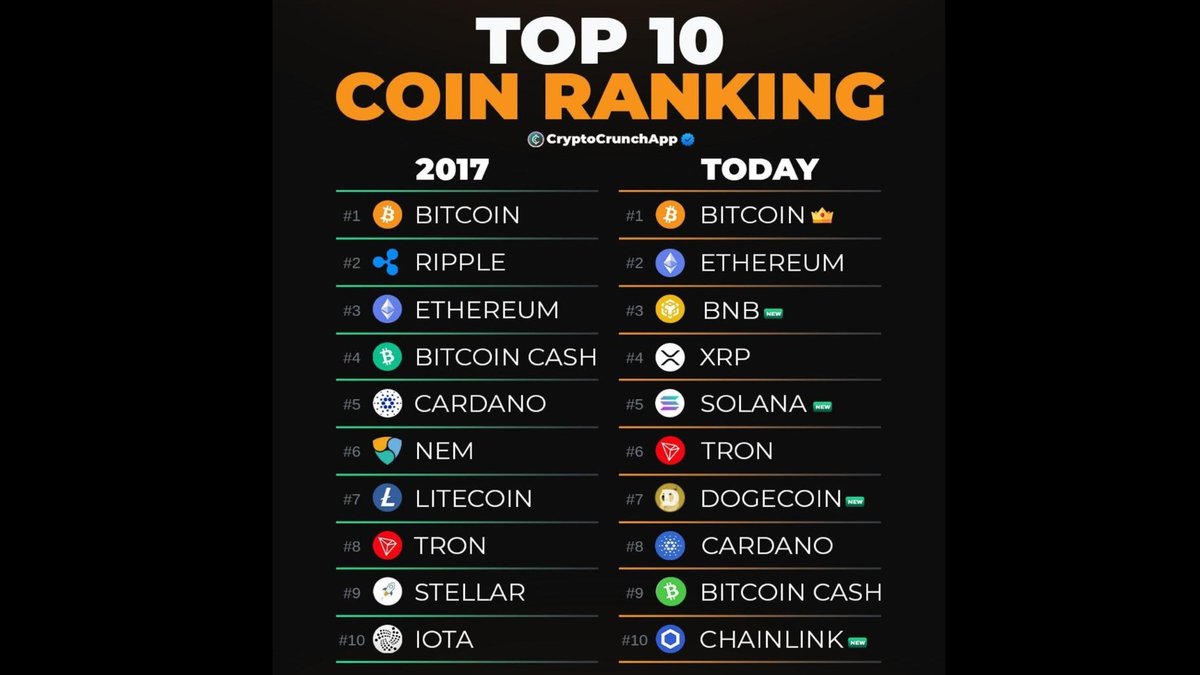
Bitcoin Still #1 While 40% of the 2017 Top 10 Has Disappeared
A single image comparing the top 10 digital assets in 2017 and the top 10 today captures an entire cycle of change. At the very top of both lists sits Bitcoin, still the largest and most recognisable asset in the space. Below it, the picture is far less stable. Roughly 40% of the coins that were in the top 10 in 2017 have since been replaced by new names.
The ranking used here intentionally excludes stablecoins and focuses on non-pegged assets. It also treats today's XRP as the same asset that many investors previously called Ripple. With those clarifications, the comparison looks like this:
- 2017 top 10 (excluding stablecoins): Bitcoin, XRP (labeled Ripple at the time), Ethereum, Bitcoin Cash, Cardano, NEM, Litecoin, TRON, Stellar, IOTA.
- Today's top 10: Bitcoin, Ethereum, BNB, XRP, Solana, TRON, Dogecoin, Cardano, Bitcoin Cash, Chainlink.
Six names remain in both lists: Bitcoin, Ethereum, XRP, Cardano, TRON and Bitcoin Cash. The other four places have rotated out of NEM, Litecoin, Stellar and IOTA into BNB, Solana, Dogecoin and Chainlink. That rotation isn't just trivia for collectors of old market cap charts; it contains several important lessons about how this market actually works.
The Only Constant at the Top: Why Bitcoin Has Stayed #1
Before exploring the turnover, it is worth pausing on the one asset that has not yielded its position at all. Bitcoin is still number one in terms of overall market value. There are a few structural reasons for that persistence:
• First-mover network effects. Bitcoin had a head start of several years before alternative networks launched. That early lead translated into broad awareness, deep liquidity and a global base of long-term holders. Once a network reaches that scale, it becomes difficult for newer contenders to displace it as the primary benchmark.
• Clear, simple narrative. Bitcoin's core story has remained consistent: a digitally scarce asset with a predictable supply schedule. It does not try to be everything at once. That clarity makes it easier for both individuals and institutions to understand its role in a portfolio compared with more complex platforms.
• Relative regulatory clarity. While digital assets as a whole still operate in an evolving legal environment, many regulators now broadly treat Bitcoin as a distinct category similar to a commodity. That relative clarity has supported the development of spot exchange-traded funds and other regulated products, further reinforcing its position.
• Conservative technical roadmap. Bitcoin has changed slowly. Feature additions are cautious and heavily reviewed. That pace can be frustrating for those who want experimentation, but it also reduces the risk of unexpected protocol changes undermining confidence.
The net effect is that Bitcoin behaves more like the 'base layer' of the digital asset universe. Other networks may temporarily grow faster or attract more attention, but in terms of total value and mindshare, Bitcoin has remained the anchor.
Altcoin Turnover: Who Survived and Who Vanished?
Once we move beyond the top slot, the story quickly becomes one of rotation. To understand what the 40% turnover really means, it helps to group the assets into three sets: the survivors, the departures and the newcomers.
The Survivors: Ethereum, XRP, Cardano, TRON and Bitcoin Cash
Five non-Bitcoin assets have managed to stay in the top 10 across an entire cycle:
• Ethereum has grown from an experimental smart-contract platform into the default settlement layer for a wide range of applications, from decentralised finance to digital art and tokenised assets. Despite competition and periods of high fees, its developer ecosystem, tooling and infrastructure remain extremely deep.
• XRP, known as Ripple in many 2017 rankings, has maintained relevance through its focus on cross-border payments and the institutional relationships built early on. Even amid legal questions over the years, it preserved a large and active user base.
• Cardano has taken a research-driven approach with slower but methodical development. Its community emphasises formal methods and careful upgrades, and the asset has kept a meaningful share of investor attention despite intense competition among smart-contract platforms.
• TRON evolved into an important settlement layer for stablecoins and high-throughput transfers, particularly in certain regions where low-cost transactions are essential. That utility has helped it retain a position near the top in overall value.
• Bitcoin Cash remains significantly smaller than Bitcoin, but it has preserved enough liquidity and community support to stay within the top cohort, even if it no longer dominates payment narratives the way it once tried to.
What do these survivors share? Each has either:
- A durable use case (smart contracts, cross-border transfer, stablecoin settlement),
- a committed long-term community, or
- strategic integrations with exchanges, wallets and payment providers that keep demand for the asset alive.
The Departures: NEM, Litecoin, Stellar and IOTA
On the other side of the ledger are the assets that were major players in 2017 but no longer appear in the top 10 list (again, ignoring stablecoins): NEM, Litecoin, Stellar and IOTA.
Each story is different, but there are some common themes:
• Shifts in narrative. Many early projects positioned themselves as faster or cheaper payment coins. Over time, the narrative shifted toward smart-contract platforms, tokenisation and on-chain applications. Projects that did not strongly adapt to this new focus tended to lose relative ground.
• Intense competition. As hundreds of new networks launched, attention and liquidity naturally fragmented. Even technically sound projects could be overshadowed by platforms that better captured the imagination of developers or users.
• Limited differentiation. Some early assets competed primarily on incremental improvements over Bitcoin or other large networks. Once transaction fees on major chains stabilised and scaling solutions emerged, it became harder for 'faster payment coin' narratives to stand out.
Importantly, departure from the top 10 does not mean these networks disappeared entirely. Many still have dedicated communities and active development. The point is simply that market leadership is far from permanent outside of Bitcoin's top position.
The Newcomers: BNB, Solana, Dogecoin and Chainlink
The fresh names in the current top 10 illustrate how much the industry's centre of gravity has moved since 2017:
• BNB began as an exchange utility token and evolved into the base asset for a large smart-contract ecosystem. Its growth is tied to a combination of trading activity, low-cost transactions and the reach of a major global exchange brand.
• Solana represents a new generation of high-throughput networks focusing on speed and low fees. It became a hub for applications where latency and user experience matter, from trading interfaces to consumer-oriented projects.
• Dogecoin demonstrates the power of culture and internet communities. Originally created as a light-hearted project, it has benefited from years of online enthusiasm, tipping culture and endorsement from well-known public figures.
• Chainlink fills a different niche altogether: it is an infrastructure protocol that connects blockchains with external data. As more complex financial and gaming applications moved on-chain, the need for reliable data feeds grew, supporting demand for its token.
These four assets have little in common with the payment-centric projects that filled much of the 2017 list. Instead, they highlight a rotation toward platforms, infrastructure and cultural assets rather than pure currency substitutes.
Why the Top 10 Is So Unstable
Looking at the two lists together, a pattern emerges: Bitcoin is an exception, not the rule. Below it, rankings are shaped by a combination of technology, culture, regulation and liquidity. A few structural drivers explain why roughly 40% of the old leaders have rotated out.
1. Technology and Use Cases Evolve Quickly
In 2017, much of the discussion revolved around basic transfers and initial token offerings. Today, the conversation includes decentralised finance, tokenised real-world assets, stablecoin settlement, on-chain gaming, and integration with artificial intelligence and data services.
Networks that did not broaden their capabilities or build strong developer ecosystems risked losing relevance. At the same time, newer platforms designed from the ground up for high throughput or specialised use cases were able to leapfrog earlier designs.
2. Liquidity Follows Engagement
Market value does not purely reflect technology; it also follows where users, developers and applications choose to build. Ecosystems that attracted active communities, continuous launches and visible brands tended to capture a larger share of exchange volume and institutional interest.
This feedback loop means that once a platform reaches a certain threshold of engagement, its position in the rankings can strengthen quickly. That dynamic helps explain the rise of networks like Solana and the staying power of Ethereum.
3. Regulation and Market Structure Shift the Map
Over the past eight years, regulatory discussions have become more detailed. Some networks have benefited from clearer guidance, while others faced more questions. At the same time, the growth of regulated investment vehicles – from exchange-traded funds to structured products – has concentrated capital in a smaller number of large, liquid assets.
For altcoins, this creates a barbell effect: a handful of large names gain deeper institutional access, while many smaller assets rely primarily on retail interest and niche communities.
4. The Quiet Influence of Stablecoins
The ranking in the image deliberately excludes stablecoins, yet in terms of transaction volume and settlement, stablecoins now play a central role. They serve as the connective tissue between exchanges, payment platforms and real-world businesses. Because they aim to maintain a stable value, they are not usually judged by market capitalisation growth in the same way as other assets.
However, their presence in the ecosystem indirectly affects which non-pegged assets gain prominence. Networks that become major stablecoin hubs (such as Ethereum or TRON) often benefit from higher utilisation, fees and visibility, supporting the value of their native assets.
Implications for Long-Term Investors
The most practical lesson from the 2017 vs. today comparison is simple: the top 10 is not a permanent 'blue chip' list. Being in the top tier at one point in time does not guarantee a place in the next cycle.
For long-term participants, that has several implications:
• Avoid assuming that size equals safety. Large market value can provide liquidity and attention, but it does not immunise a project from technological disruption, regulatory changes or shifts in user behaviour.
• Focus on underlying drivers, not just rankings. Questions about developer activity, real-world usage, network effects and governance structures often matter more than a single snapshot of market capitalisation.
• Diversification within reason. Concentrating entirely in smaller assets can be risky, but relying only on one or two large names also has drawbacks. A thoughtful allocation recognises that some projects may flourish while others fade.
• Time horizon matters. Over months, price movements can be dominated by sentiment. Over years, the persistence of a project in the top tier tends to reflect deeper fundamentals: sustained demand, robust infrastructure and effective risk management.
Bitcoin's continuing dominance suggests that a small number of assets may remain central references across cycles. At the same time, the 40% turnover rate among the rest of the top 10 is a reminder that innovation and rotation are structural features of this market, not anomalies.
Looking Ahead: Will Today's Leaders Still Be on Top in 2033?
If we project another eight years into the future, it is unlikely that the current list will remain intact. Several forces could reshape it:
• Further integration with traditional finance. As more assets become tokenised and as regulated products expand, networks that successfully connect to existing financial infrastructure may climb the rankings.
• Growth of application-specific ecosystems. New platforms optimised for gaming, social applications or data markets could carve out meaningful niches and join the top tier.
• Advances in scalability and privacy. Protocols that combine high performance with robust security and appropriate levels of transparency may draw both users and institutions.
• New forms of digital ownership. The rise of non-fungible tokens, real-world asset platforms and on-chain identity systems suggests that the next generation of leading assets may look very different from the payment-oriented projects of 2017.
Against that backdrop, Bitcoin's role as a neutral, predictable asset may continue to stand out. Whether or not it is still number one in total value, its influence on market cycles and investor psychology is likely to remain significant.
Conclusion: Stability at the Top, Rotation Everywhere Else
The simple visual of the 2017 vs. today top-10 rankings tells a nuanced story:
• Bitcoin has remained the dominant asset, benefiting from network effects, clarity of purpose and expanding avenues for regulated access.
• Altcoin rankings are highly dynamic. Four of the 2017 top 10 have been replaced, underscoring that leadership outside Bitcoin is contested and subject to rapid change.
• The market's focus has shifted from payment coins to programmable platforms, infrastructure protocols and cultural assets, reflected in the rise of names like BNB, Solana, Dogecoin and Chainlink.
• Stablecoins, though excluded from the list, quietly shape the landscape by directing usage and liquidity toward certain networks.
For anyone navigating this space, the main takeaway is not to chase rankings for their own sake. Instead, it is to understand why certain assets endure, how new narratives emerge, and where genuine usage is building over time. The leaders of the next cycle may already exist today, or they may still be in development. Either way, the history between 2017 and today is a reminder that the digital asset market constantly rewrites its own leaderboard — with Bitcoin, so far, remaining the one fixed point in an otherwise shifting landscape.
Disclaimer: This article is for educational and informational purposes only. It is not financial, investment, tax or legal advice. Digital assets can be volatile and may not be suitable for every investor. Always conduct your own research and consider consulting a qualified professional before making financial decisions.