Context: A Familiar Shock on the Tape
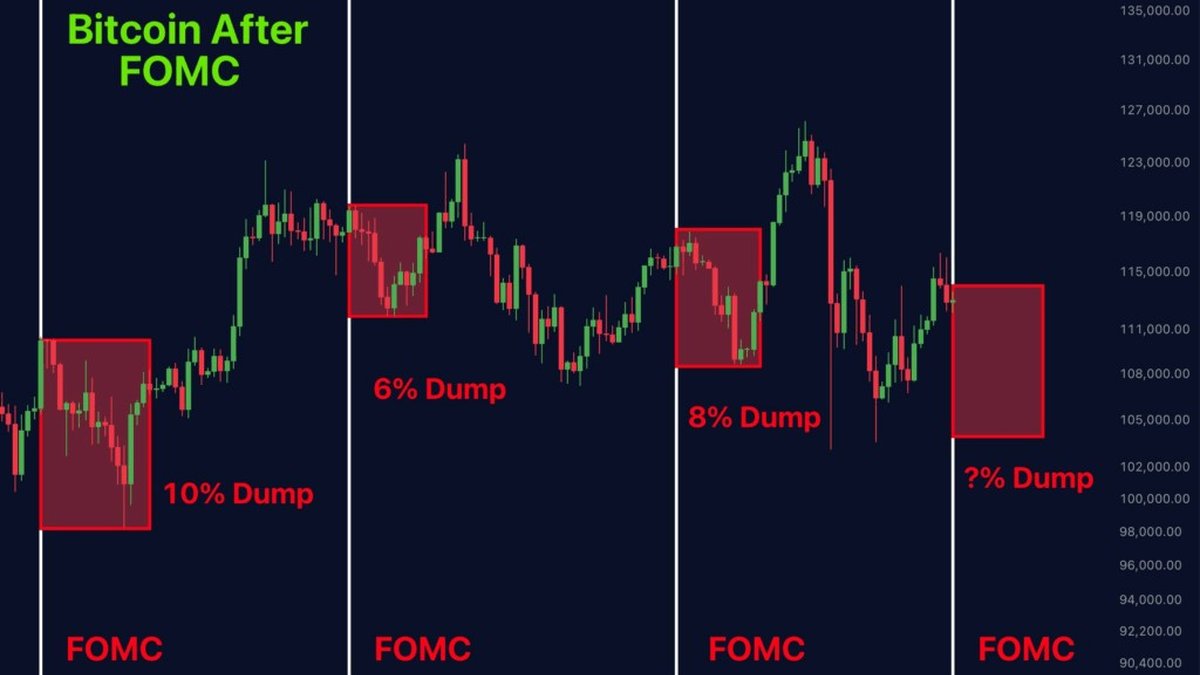
Bitcoin sold off from a recent local high, with price retreating roughly nine percent from the neighborhood of 104,000. The timing — immediately after the Federal Reserve’s policy decision and press conference — feels familiar. Veterans of prior cycles have a name for it: the 'FOMC dip-then-rip.' The folklore says BTC tends to wobble lower 5–8% in the hours or day following the meeting, only to reverse and punch to fresh highs within days or weeks.
Is that a real edge, or are we drawing lines on clouds? The honest answer is that the pattern is conditional. It tends to appear when (1) the prevailing medium-term trend is already up, (2) positioning into the event is hedged with rich options, (3) funding and basis are elevated but not extreme, and (4) fiat intake through ETFs and stablecoin issuance remains positive. When those ingredients align, a post-meeting air-pocket becomes fuel rather than warning. When one or more ingredients are missing, the same air-pocket can widen into a new regime.
The Microstructure Under the Myth
There are repeatable mechanical reasons for a 'dip-then-rip' around macro events. In the run-up to the decision, traders buy protection, dealers sell options, and implied volatility rises. Many funds anchor to scenario trees: if the Fed is dovish, beta rallies; if hawkish, beta sinks. But, crucially, a large share of these options are short-dated, purchased to survive the announcement window. Once the decision is released and uncertainty collapses, implied vol nearly always compresses (a 'vol crush'). That crush forces dealers who are short options to adjust hedges: if they were short calls and long puts sold to hedgers, the post-event vol reset can pivot their gamma exposure, sometimes pushing them to
Layered on top is perpetual swap leverage. In rising regimes, funding rates tilt positive; longs pay shorts, indicating crowding. A hawkish-sounding sentence in the press conference, or simply an absence of new dovish information, often triggers the first wave of deleveraging: long perps are force-trimmed, basis narrows, and price knifes through thin liquidity. Once funding normalizes and liquidation engines finish their work, a second, slower process takes over: cash buyers — ETFs, market-on-close rebalancers, and measured spot demand — absorb supply at lower levels. If those buyers exist in size, the bounce turns into a trek back to the highs.
Why Bitcoin Reacts Differently Than Equities
Equities live in a cash-flow world; Bitcoin lives in a monetary premium world. When the Fed nudges the path of real rates lower, the present value uplift in equities is mechanical (lower discount rate on future earnings). In Bitcoin, the channel is expectations for future liquidity and the opportunity cost of holding a non-yielding, scarce asset. The impulse is mediated by fiat rails: ETFs buying or redeeming units, stablecoin issuers expanding or contracting float, banks and brokers enabling or throttling fiat ramps. Hence, Bitcoin’s post-FOMC response is a two-step: first, a leverage flush (microstructure), then a liquidity verdict (macro flows). If the verdict is friendly, price grinds higher; if not, it bleeds.
Evidence Without Data Mining
History does show multiple episodes where BTC dipped in the 24–72 hours post-decision and then went on to make new cycle highs within the next fortnight. But using that observation as a blind trading rule invites overfitting. Markets remember why they moved, not just when. The most robust approach is to decompose post-FOMC price action into three measurable pillars:
- Volatility Term Structure: Does front-end implied volatility collapse relative to back-end within 24 hours? If yes, the event risk was hedged and is being monetized — a set-up for mean reversion higher if the trend is up.
- Leverage Reset: Did funding rates compress toward flat and did CME/major venue basis return to mild contango? If yes, mechanical selling is largely complete.
- Fiat Intake: Are spot ETFs printing net creations and is aggregate stablecoin supply expanding on a rolling 7–14 day basis? If yes, there is fresh cash to chase dips.
When all three flash green, the probability of new highs increases. When one or more flash red — particularly the fiat intake pillar — the pattern often degrades into choppy range-trading or lower highs.
What Happened Last Night — Through That Lens
The overnight move checked the first two boxes that usually appear in the script: implied vol spiked into the event and then eased; funding flipped sharply lower as perps unwound. The unanswerable question on day one is the third box: will ETFs and stablecoin issuers step in? Because these flows arrive with a lag (creations settle after market-hours cutoffs; on-chain issuance ramps as fiat processes clear), the first 24 hours after a Fed day frequently look worse than the final verdict. That is why traders who rely only on the first knee-jerk miss the inflection happening in settlement pipes.
Three Engines Behind the 'Dip-Then-Rip'
1) Options Positioning and Dealer Gamma
Into macro events, implied volatility rises, skew can steepen, and dealers often end up short gamma at key strikes. If price gaps lower through those strikes, dealers sell to hedge — amplifying the slide. But as time decays and vol crushes after the announcement, the same dealers find themselves less short (or even long) gamma, turning into dip buyers. This dynamic does not require a change in fundamentals; it is the mechanical choreography of hedging.
2) Leverage Exhaustion and Basis Mean Reversion
Perpetual swaps dominate crypto liquidity. When longs crowd in, funding becomes rich, and small downticks trigger forced trimming. The first wave is brutal but finite. Once funding compresses and basis on regulated venues like CME shifts back toward small, healthy premia, it signals that levered noise is out and cash players can define price again.
3) Fiat Rails Turning Back On
ETF creations, stablecoin minting, and exchange on-ramps are the arteries that bring new money in. Around policy meetings, many allocators pause flows until the dust settles. The day after, investment committees reconvene, compliance checklists clear, and creations print. This lag explains why 'day two' and 'day three' after FOMC often look nothing like 'hour two.'
When the Pattern Fails
There are clear conditions under which the 'dip-then-rip' fails. Understanding them protects you from blind faith in a meme:
• Hawkish Surprise in Real Terms: If the decision pushes expected real rates higher (via dot plots, balance sheet guidance, or fiscal-monetary interaction), the opportunity cost of holding BTC rises. In that regime, the microstructure bounce fades into macro headwinds.
• Fiat Intake Turns Negative: Net ETF redemptions over a 5–10 day window, combined with contracting stablecoin supply, remove immediate buying power. Rips stall, and range highs get sold.
• Distribution from Long-Term Holders: If 6–12 month and older cohorts use the post-FOMC rally to distribute, on-chain realized losses stay elevated and the market struggles to build higher bases.
• Exogenous Shocks: Exchange stress, regulatory actions, or security breaches can override pristine microstructure and reset risk premia wider for weeks.
Building a Professional Playbook
Instead of treating 'dip-then-rip' as prophecy, treat it as a hypothesis to be tested in real time. Here is a step-by-step playbook we use when covering macro event weeks for institutional readers.
T-48 to T-0 Hours
- Track front-end vs back-end implied vol; note skew direction. Elevated front vol indicates hedging demand that can unwind.
- Map large option open interest strikes across major venues. Identify 'air pockets' where a break could trigger dealer selling, and 'magnets' where pinning could occur.
- Measure perp funding and open interest. High funding + rising OI into the event increases the probability of a sharp post-decision flush.
T-0 to T+24 Hours
- After the statement and press conference, watch the vol crush. If 7-day implied collapses relative to 30- and 60-day, dealers are de-risking — a precondition for stabilization.
- Monitor liquidation prints and funding resets across top exchanges. Once funding leans slightly negative to flat, the forced-selling engine is near exhaustion.
- Do not chase the first bounce; ETF and stablecoin flow confirmations are still in the pipe.
T+24 to T+96 Hours
- Check daily ETF creation/redemption data and on-chain stablecoin supply. Two consecutive sessions of net creations and positive net issuance is your green light.
- Reassess breadth: are BTC-led advances pulling ETH and high-liquidity L2 assets higher, or is the move narrow and fading?
- Evaluate options term structure for normalization: a gentle contango and easing skew signal calmer conditions.
Does a New High Follow This Time?
The current backdrop has a plausible path to new highs if three switches flip green: ETF creations resume, aggregate stablecoin float expands, and funding/basis stabilize without re-leveraging too quickly. The overnight nine percent drawdown is, paradoxically, part of the bull case if it cleanses leverage without triggering structural outflows. Conversely, if net creations stall for a week and stablecoin float contracts, any rally into resistance will likely be sold, and the meme will fail this episode.
Why Narratives Matter Only After Flows
Headlines will attribute the next leg to a catchy soundbite from the Chair or to a social media meme about 'making crypto the future.' But the tape obeys flows, not slogans. If money enters through regulated ETFs and on-chain dollars, prices rise; if not, they don’t. Our role as a research desk is to separate the poetry from the plumbing and give you the measurable checkpoints that determine which story wins.
Risk Budgeting for Different Participants
For long-only allocators: A staged re-entry plan beats binary calls. Add a sleeve when ETF creations turn positive on a 5-day sum; add another when stablecoin supply rises week-over-week; complete the tranche when front-end implied vol mean-reverts and funding is near flat. This converts an anecdotal pattern into a rules-based process.
For traders: Look for vol-selling opportunities after the crush, not before. Calendar put spreads financed by call overwrites can capture the typical post-FOMC vol decay while leaving upside optionality if the 'rip' materializes. Fade over-extensions into resistance if ETF/Stablecoin signals remain negative.
For builders and treasuries: If you require fiat to fund operations, use the post-FOMC days to term out exchanges between stablecoins and cash while spreads are tight. If you manage protocol treasuries, pre-define a buffer of 6–9 months of operating run-rate in dollars or T-bill tokens so that you are not a forced seller into any downside that violates the pattern.
The Psychology: Why the Pattern Feels So Convincing
Humans anchor to salient, recent experiences. The last few policy cycles have indeed been friendly to risk assets; crypto participants learned to 'buy the event' after the first shakeout. Over time, shared heuristics become self-fulfilling: when enough traders expect a dip-then-rip, they pre-position to buy the dip, thereby creating it. But self-fulfilling patterns die the moment the macro backdrop changes. That is why we step away from folklore and back into measurement every time.
Bottom Line
The 'post-FOMC dip-then-rip' is not superstition; it is the visible shadow of three engines: options hedging unwinds, leverage resets, and delayed fiat inflows. The engine room is now running: vol has started to bleed, funding eased, and the liquidation machine has cooled. Whether this episode ends with a new all-time high depends on the third engine — fiat intake via ETFs and stablecoins — and on whether long-term holders refrain from distributing into the bounce. If those dials move in the right direction, history can rhyme again. If they don’t, respect the difference between a story you want to be true and a tape that refuses to comply.