X402: When AI Agents Learn to Pay Their Own Bills
One of the quiet assumptions of the modern internet is that humans sit in front of screens, type card numbers or connect bank accounts, and press the “Pay” button. Artificial intelligence is starting to break that model. As AI agents shift from passive chatbots to autonomous workers that fetch data, call APIs and coordinate services, they need a way to pay for the resources they consume — bandwidth, compute, data and tools — without waiting for a person to manually approve every invoice.
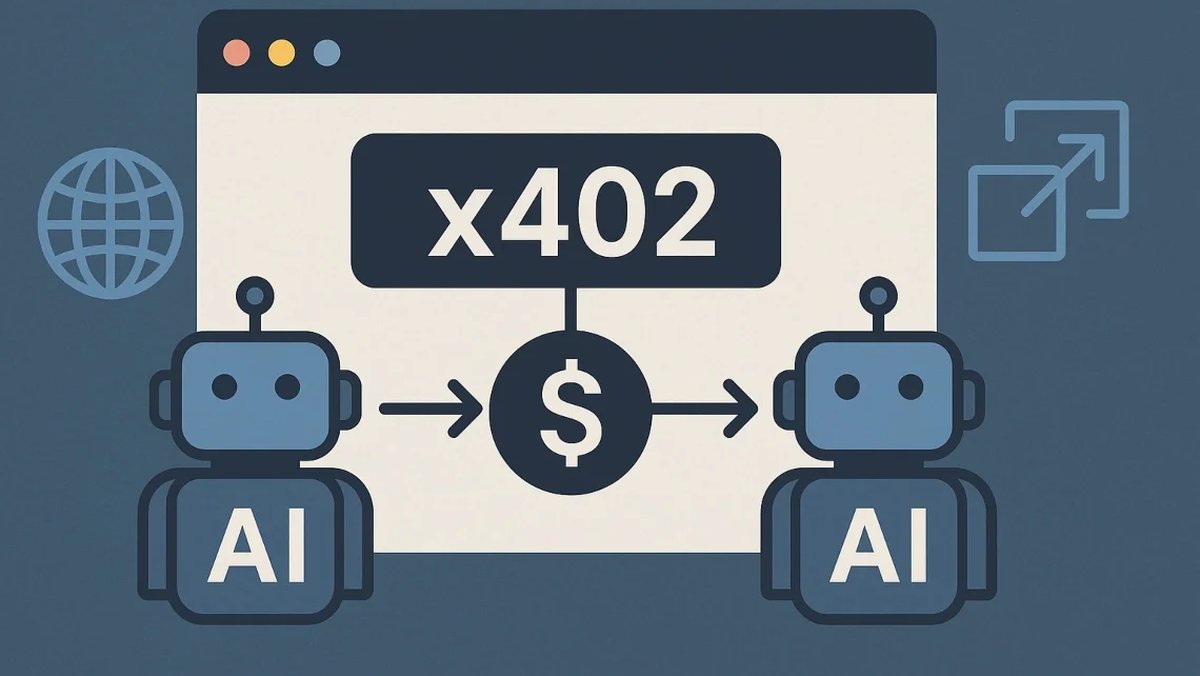
X402 is an emerging attempt to solve that problem. It takes a dusty corner of the web — the HTTP 402 “Payment Required” status code — and turns it into a machine-native cash register. Instead of treating 402 as an error, x402 treats it as a structured, on-chain checkout flow that lets an AI agent pay in stablecoins and immediately try again, all without accounts, API keys or registration forms.
Backed by companies like Coinbase and Cloudflare, and with Solana moving quickly to position itself as a primary settlement layer, x402 is more than a short-lived narrative. It is a concrete example of how Web2 infrastructure and Web3 payments can lock together around a very practical use case: letting machines talk to each other and settle up in real time.
1. From HTTP Error Code to Economic Primitive
HTTP 402 has been part of the web specification for decades, labeled “Payment Required” but left largely unused. In most applications it never shows up at all, and when it does, it behaves like an error: “you’re not allowed to access this resource.”
The x402 standard flips the meaning:
- 402 is no longer a dead end; it is an invitation to pay.
- The response includes clear machine-readable instructions: how much to pay, in which asset, on which network, and to which address.
- Once the payment is confirmed on-chain, the agent retries the request with a proof of payment attached.
In other words, x402 wraps a traditional HTTP response around a blockchain payment flow. It turns the familiar request–response loop of the web into a request–price–pay–serve
The key idea is simple but powerful: instead of pre-registering, receiving static API keys and negotiating billing cycles, an agent can interact with any x402-aware service on a pay-as-you-go basis. If it has sufficient stablecoins, it can buy access; if not, the request naturally fails without extra overhead.
2. How X402 Works in Practice
At a high level, the x402 flow looks like this:
1. The agent calls an API or website. It sends a normal HTTP request to access data, run a model, or use a tool.
2. The server responds with HTTP 402. Instead of just denying access, it attaches a machine-readable payment request: the price, the accepted stablecoins, supported networks and the destination address.
3. The agent pays on-chain. Using its own wallet infrastructure, the agent sends the required stablecoin amount on a supported network such as Solana or another chain integrated with the x402 standard.
4. The agent retries with proof of payment. It calls the same endpoint again, this time including a reference to the transaction. The server verifies the payment on-chain and, if valid, returns the actual data or service response.
Notice what is missing from this flow:
- No username or password.
- No API key creation or secret management through a centralized dashboard.
- No lengthy onboarding or per-client contracts for low-value calls.
The relationship is purely economic and purely transactional: pay, then receive. For AI agents that may call hundreds of APIs across the internet, this simplicity is a feature, not a bug.
3. Why AI Agents Need a Native Payment Standard
To understand why x402 is more than a clever use of an old status code, it helps to think about the gap between where AI is today and where many people expect it to go.
Right now, most AI assistants are front-ends. They answer questions, format documents and occasionally call a handful of pre-integrated tools. But the next wave of AI development is about agents that act: booking services, negotiating rates, querying specialized data providers, and coordinating with other agents.
Those agents will need to:
- Purchase data from APIs and data marketplaces.
- Pay for compute when they call external models or cloud functions.
- Buy bandwidth and storage from infrastructure providers.
- Settle micro-invoices between agents in complex workflows.
Traditional payment methods are poorly suited to this world. Credit cards are tied to humans, not agents. Bank transfers are slow and hard to automate across borders. Even modern billing systems assume a human decision-maker at the center, approving subscriptions or invoices.
By contrast, x402 assumes that the unit of interaction is the agent, not the human. It turns money into just another protocol-level resource, alongside compute and storage. If an agent has stablecoins in a wallet, it can move through the internet as an autonomous economic participant.
4. The Role of Stablecoins and Solana
X402 does not specify a single blockchain or asset, but in practice the early ecosystem is converging around stablecoins on chains that offer:
- Low transaction fees.
- High throughput.
- Fast finality.
Solana has emerged as a natural fit in the early x402 experiments for exactly these reasons. When an AI agent is paying a few cents or a few dollars for data or model access, fees need to be small relative to the transaction size. Payment confirmation also needs to be fast enough that the extra round trip does not ruin the user experience.
According to ecosystem figures, the number of x402-style transactions on Solana has already grown from roughly 500,000 to around 1.7 million in a relatively short period of time. That is still tiny compared to mainstream consumer payments, but it signals real developer interest in treating on-chain stablecoins as a native payment rail for software.
Stablecoins are central to this story because they hide volatility from day-to-day operations. When an AI agent pays 0.50 USDC for an API call, the provider can think in normal currency terms while still receiving funds on-chain. This is very different from early crypto experiments where everything was priced in volatile assets, making budgeting and accounting difficult.
5. Coinbase, Cloudflare and the Push to Standardize
Two names around x402 stand out: Coinbase and Cloudflare. Both are deeply rooted in the existing internet stack, and both have a reason to care about machine-native payments.
- Cloudflare operates at the infrastructure layer, sitting in front of millions of websites and APIs as a performance and security gateway. Integrating x402 into its tooling makes it easier for any site owner to expose pay-per-request endpoints without building their own payment logic from scratch.
- Coinbase brings wallet infrastructure, stablecoin expertise and regulatory experience. By funding x402 development and integrating it into developer SDKs, it can make sure that agents have a reliable way to hold and move the stablecoins they need.
Together, they are trying to make “an agent paying a tool” as standard as a browser sending an HTTP GET request. That means:
- Common message formats for 402 responses.
- Shared expectations about how to verify payments.
- Libraries that abstract away chain-specific details so developers can focus on their core products.
Standardization matters because without it, each AI tool and each agent provider might invent their own mini-protocol. That fragmentation would push us back toward the world of bespoke integrations and one-off billing arrangements that x402 is trying to replace.
6. Economic Implications: Agents as Independent Participants
If x402 or similar standards gain traction, the long-term implications stretch far beyond a single status code. They point toward a world where economic activity is increasingly machine-to-machine.
Consider a simple scenario: an AI research agent tasked with building a market report for a client. To complete its work, it might:
- Query several premium data providers via x402-enabled APIs.
- Pay other specialized AI agents for summarization or translation.
- Rent short bursts of computing power for intensive calculations.
At each step, the agent would be making small, frequent, programmatic payments — something traditional systems handle poorly. With x402 and stablecoin rails, those payments become as easy as sending additional HTTP requests.
That shift also enables new business models:
- Micro-APIs: Instead of selling large subscriptions, data providers can charge per request without friction.
- Composable services: Agents can chain together many small paid services from different providers, knowing that each component can be monetized fairly.
- Usage-based tooling: Developers can expose narrow, specialized functions to the open web and let agents discover and pay for them as needed.
In this sense, x402 is not just about payments. It is part of a broader evolution where software becomes a primary customer of other software, with stablecoins acting as the common language of value between them.
7. Open Questions and Practical Challenges
None of this is automatic or risk-free. For all its elegance, x402 raises several important questions that developers, regulators and users will need to address.
7.1 Key management for agents
If an AI agent can move money on-chain, someone has to control the keys. That raises issues such as:
- How to enforce spending limits and policies for agents.
- How to separate user funds from the agent’s operating balance.
- How to recover from mistakes or bugs without putting large sums at risk.
Multi-signature schemes, smart contract wallets and policy engines will likely play a role in giving humans oversight while still letting agents act autonomously within defined parameters.
7.2 Pricing, budgeting and abuse
On the provider side, offering x402 endpoints introduces new design choices:
- Setting prices low enough to be attractive, but high enough to cover costs.
- Preventing misuse or denial-of-service behaviour by misconfigured or malicious agents.
- Designing clear usage dashboards and alerts so customers can understand their spend.
Because x402 is deliberately lightweight, much of this responsibility sits at the application layer. Mature tooling will be needed to make the economics predictable and sustainable.
7.3 Regulation and consumer protection
As x402-based payments grow, regulators will naturally ask how to ensure that:
- End users understand when an agent is spending on their behalf.
- Providers handle customer data and funds responsibly.
- Stablecoin usage stays within existing legal and compliance frameworks.
The positive news is that x402 itself does not bypass regulation; it simply defines how to express a payment request and response. The entities holding stablecoins, providing tools or building wallets will still need to follow applicable rules. In that sense, x402 is a plumbing standard rather than a new financial regime.
8. What This Means for Crypto and Web3 Builders
For the digital-asset ecosystem, x402 is an example of crypto moving from abstract narratives to clear, everyday utility. Several educational points stand out:
• Stablecoins move to center stage. In a world where agents pay each other, stablecoins become the default medium of exchange. They are easier for businesses to budget with, easier for regulators to understand, and more intuitive for pricing than volatile assets.
• Throughput and latency matter. Chains that can support high volumes of low-fee transactions — such as Solana in the early x402 experiments — are naturally positioned as settlement layers for machine activity.
• Developer experience is key. The winning implementations will not just be the fastest technically, but the easiest to plug into existing stacks through SDKs, libraries and cloud integrations.
• AI and crypto are converging around infrastructure, not hype. X402 is not a meme or a token; it is a standard that gives AI agents a way to participate in an on-chain economy.
For builders, the opportunity is not only to support the core x402 spec, but to create monitoring tools, wallets, accounting systems and risk controls tailored to an agent-first world.
9. A Quiet but Important Step Toward Machine Economies
It is tempting to dismiss standards like x402 as niche details that only protocol engineers care about. But many of the internet’s biggest shifts began with similarly modest building blocks: status codes, URI schemes, scripting languages. What makes x402 interesting is that it sits exactly at the intersection of two powerful trends:
- AI agents that act on behalf of users and organizations.
- On-chain money that can move globally, 24/7, in programmable ways.
By turning HTTP 402 from a forgotten error into a structured checkout flow for machines, x402 offers a simple answer to a hard question: how should non-human actors pay for the resources they consume? The answer it proposes — “with stablecoins, over open networks, using a shared standard” — is likely to resonate far beyond the current cycle.
Whether x402 itself becomes the dominant format or simply inspires successors, the direction of travel is clear. Over time, more of the world’s economic activity will not just involve humans tapping screens, but agents quietly settling microtransactions in the background. For participants in crypto and traditional finance alike, understanding that shift early is less about chasing a trend and more about recognizing where the internet’s next layer of infrastructure is being laid.
Disclaimer: This article is for educational and informational purposes only and does not constitute investment, legal or tax advice. Digital assets and experimental technologies such as x402 involve risk and may not be suitable for all participants. Always conduct your own research and consult qualified professionals before making financial or technical decisions.