Tether Starts 2026 With 96,000+ BTC: What a Stablecoin Giant’s Bitcoin Treasury Really Signals
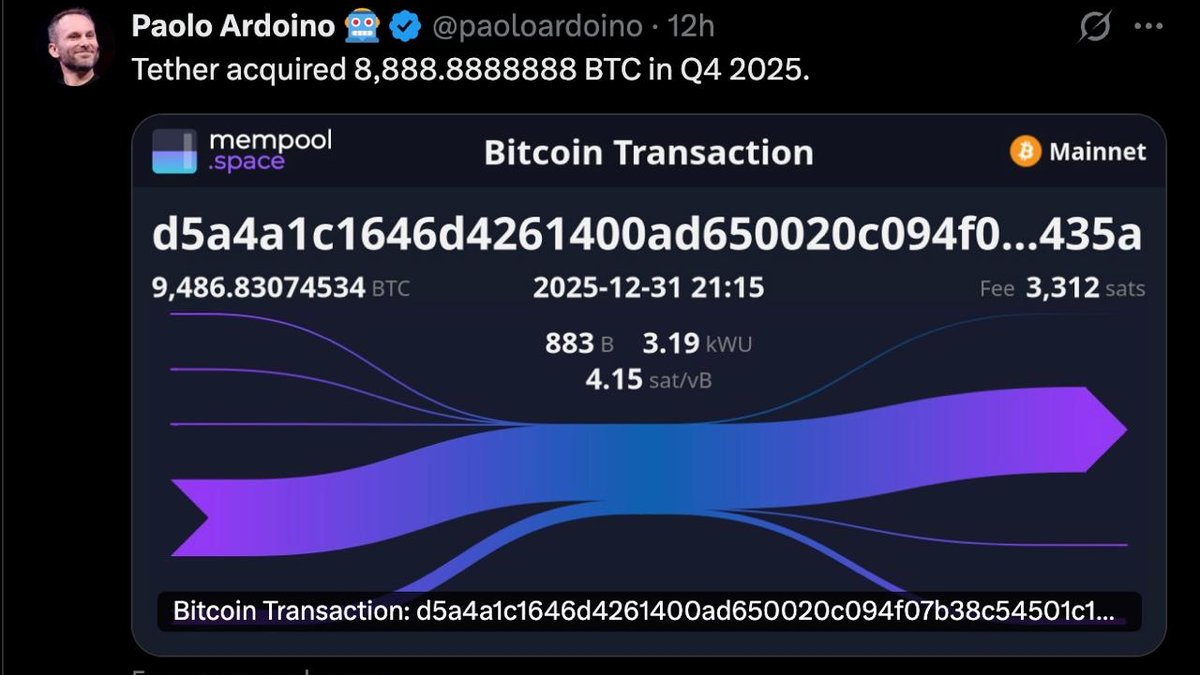
Tether reportedly entered 2026 holding more than 96,000 BTC, boosted by a late-December purchase valued around $779 million. The headline almost writes itself: “Institutions keep accumulating.” It’s the kind of update that gets repeated as a morale boost—or used as ammunition in an argument about whether Bitcoin is “inevitable.”
But if you read it that way, you miss the most important shift happening in plain sight. This is not only about Bitcoin demand. It’s about the evolution of stablecoin issuers into something that looks increasingly like a financial institution with a balance sheet, a profit engine, and a strategic reserve policy. When a stablecoin issuer becomes one of the largest BTC holders, the topic is no longer just price. It becomes market structure: concentration, liquidity buffers, transparency practices, and how a private company’s treasury choices can influence perceptions of systemic risk.
1) Why This Is Different From ETFs, MicroStrategy, or a Whale Wallet
When a spot ETF holds Bitcoin, the story is clear: the ETF holds BTC because investors bought shares and the product must custody assets accordingly. When a corporate treasury like MicroStrategy holds BTC, the story is also legible: the company has explicitly chosen Bitcoin as a strategic asset, and the market prices that decision into the equity.
Tether’s situation is structurally different. A stablecoin issuer sits near the core of crypto settlement. USDT is used for trading, remittances, and liquidity routing across exchanges and chains. That means Tether’s balance sheet isn’t only “a company’s assets.” It is also an anchor of confidence for a product used as money-like liquidity within crypto.
So the question becomes: what does it mean when the issuer of a money-like instrument accumulates a volatile, long-duration asset?
The adult answer is not “bullish” or “bearish.” The adult answer is: it depends on the reserve architecture and the liquidity layer. If the liquid reserve layer is robust, a strategic BTC allocation can be a long-horizon diversification. If the liquid layer is thin or opaque, the same allocation can raise questions about stress behavior in extreme scenarios. The exact same Bitcoin position can be viewed as prudent or risky depending on what surrounds it.
2) The Stablecoin Issuer Is Becoming a Treasury Institution
Stablecoins used to be described as “just a token backed by reserves.” That description is increasingly incomplete. At scale, stablecoin issuance becomes a cashflow business: reserves are held in interest-bearing instruments, operational profits accumulate, and treasury management decisions become strategic rather than incidental.
This is the lens that makes Tether’s accumulation meaningful. If the company consistently channels a portion of profits into Bitcoin, it’s behaving like a treasury manager with a diversification mandate. The implications are broader than a single purchase:
• It creates a recurring institutional bid that isn’t driven by retail hype alone, but by an internal capital allocation policy.
• It increases concentration of BTC in a small set of large entities, which changes market psychology around custody, disclosure, and systemic influence.
• It forces a transparency conversation because “trust in USDT” increasingly intersects with “how the treasury behaves.”
In other words, this isn’t only “Tether bought Bitcoin.” It’s “a major settlement rail is building a strategic reserve.” That’s a very different category of story.
3) What the Market Is Actually Reading Into This
When people share a headline like “Top 5 holders,” they’re rarely talking about balance-sheet nuance. They’re expressing a belief: large players wouldn’t hold BTC if BTC were unserious. That belief is emotionally compelling—but it can oversimplify what’s really happening.
The market reads three distinct signals from this kind of news:
Signal A: Bitcoin as a treasury-grade asset. If a stablecoin issuer treats BTC as a long-term reserve component, it strengthens the narrative that BTC can sit on institutional balance sheets without requiring daily speculation.
Signal B: Reserves are profitable enough to diversify. A purchase of this size implies that the business is generating surplus capital beyond immediate operating needs—at least under current conditions.
Signal C: The issuer expects to remain central. You don’t accumulate strategic reserves if you expect to exit the market. Large holdings suggest confidence in long-term relevance.
But there’s also a mirror image signal that mature observers will track: stress behavior. How would the system behave if redemptions surge? Would BTC holdings remain untouched as “strategic reserves,” or could they become a source of liquidity? You don’t need to assume worst-case outcomes to ask the question. You ask it because systems are defined by how they behave under stress.
4) Liquidity Is the Real Story, Not the Purchase Size
Stablecoin confidence ultimately depends on redemption mechanics and liquidity buffers. Most users don’t read reserve reports; they simply assume a stablecoin will behave like a dollar. That assumption holds until it doesn’t, and when it doesn’t, markets reprice trust brutally fast.
This is why the most important variable is not how much BTC Tether holds. It’s how the reserve stack is layered—what portion is in highly liquid, low-risk instruments versus longer-duration or more volatile holdings. In traditional finance, banks hold a mix of liquid assets and longer-duration assets, and regulation exists largely to ensure they can meet withdrawals. Crypto is still building the equivalent trust framework.
For educational readers, here’s the concept that matters: a reserve strategy is healthy when it is explicit about priorities. A mature reserve stack typically has:
• Immediate liquidity to handle routine redemptions.
• High-quality, liquid instruments to handle stress periods.
• Long-horizon strategic holdings that are not expected to be used for day-to-day liquidity.
BTC fits best in the third bucket. That’s not a criticism; it’s simply how volatile assets behave. The trust question is whether buckets one and two are strong enough that bucket three doesn’t create anxiety.
5) Concentration Risk: When ‘Institutional Adoption’ Has a Second Edge
“Institutions hold BTC” is often celebrated. Yet concentration comes with trade-offs. If a meaningful share of BTC supply sits in a handful of large entities—ETFs, corporates, custodians, and now stablecoin issuers—then market narratives become more sensitive to those entities’ disclosures and actions.
This is not automatically negative. Large holders can reduce free-float supply and may contribute to long-term stability if they’re genuinely long-horizon. But concentration also means:
• News shocks amplify. A rumor about a large holder can move markets even if it’s false, because the perceived impact is large.
• Transparency becomes systemic. If one entity’s reporting is unclear, uncertainty can spill into broader market trust.
• Operational risks matter more. Custody and governance failures at a large holder have outsized reputational impact, even if the Bitcoin network itself is unaffected.
In mature markets, concentration is managed through disclosure standards and governance. Crypto is moving in that direction, but it’s not fully there yet. That’s why big-holding headlines should be read with curiosity, not just excitement.
6) What to Watch in 2026: Better Questions Than “Are You Holding?”
The viral framing—“Big institutions are holding BTC, what about you?”—is emotionally effective but analytically thin. It turns a complex system story into a social signal. A better approach is to convert the headline into better questions that improve understanding without pushing anyone toward a specific financial decision.
Here are the questions that actually matter in 2026:
• Disclosure cadence: How consistently does the issuer communicate reserve composition and changes? Regularity reduces rumor power.
• Reserve segmentation: Is it clear which assets are “liquidity buffers” versus “strategic holdings”?
• Redemption performance: In periods of market stress, do redemptions process smoothly? History often teaches more than statements.
• Regulatory environment: As global reporting and stablecoin frameworks evolve, how does the issuer adapt its operations?
• Market behavior around large transfers: When on-chain movements occur, does the issuer provide context to reduce misinterpretation?
Notice the theme: these questions are about system reliability, not price prediction. That’s the maturity upgrade crypto needs—less cheering, more understanding.
Conclusion
Tether starting 2026 with 96,000+ BTC is a meaningful headline—but not because it “proves” anything about Bitcoin’s future price. It’s meaningful because it reflects a structural evolution: a stablecoin issuer is behaving like a treasury institution, building a strategic reserve that reinforces its long-term identity.
The right way to read the story is not through tribal excitement or fear. It’s through the lens of balance-sheet design and system trust. In 2026, crypto’s most important battles won’t always be fought on charts. They’ll be fought in disclosure practices, liquidity architecture, governance expectations, and the market’s ability to distinguish a strategic reserve decision from a liquidity event.
If crypto is becoming a dominant financial framework, this is what that looks like: boring questions about reserves becoming more important than loud opinions about price.
Frequently Asked Questions
Does Tether holding a large amount of BTC make Bitcoin safer?
Not directly. Bitcoin’s network security doesn’t depend on who holds coins. However, large institutional holdings can influence market perception, liquidity dynamics, and the intensity of reactions to disclosures or rumors.
Is this the same as a Bitcoin ETF accumulating BTC?
No. ETFs generally hold BTC because investors buy ETF shares, and the product must custody assets. A stablecoin issuer’s BTC accumulation is typically a treasury allocation decision, which depends on profit, reserve policy, and risk preferences.
Should users worry about USDT reserves if Tether holds BTC?
The relevant question is reserve composition and liquidity layers. BTC can be a strategic holding, but stablecoin confidence relies on sufficient liquid assets to meet redemptions. Evaluating disclosure and stress performance is more helpful than reacting to a single holding statistic.
What’s the biggest risk in headlines like “Top 5 BTC holder”?
Oversimplification. It can encourage readers to treat holding as a social contest rather than a risk-managed decision. The more useful approach is to focus on transparency, liquidity architecture, and operational resilience.
Disclaimer: This article is for educational purposes only and does not constitute financial, investment, legal, or tax advice. Digital assets and stablecoins involve risks, including volatility, liquidity, custody, and regulatory risks. Always do your own research and consider consulting qualified professionals for guidance relevant to your situation.