JPMorgan’s 170K Bitcoin Scenario: What Has to Go Right (and What Could Go Wrong)
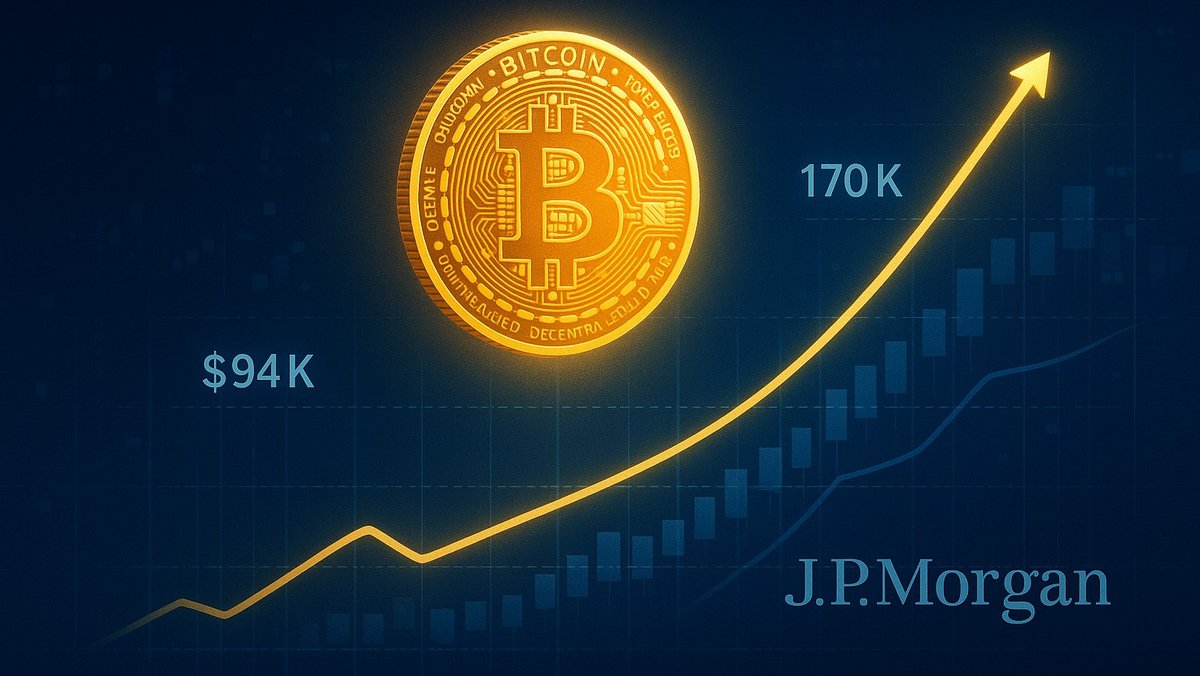
Every cycle has a number that captures the market’s imagination. In late 2025, that number is $170,000 per Bitcoin. It comes from a research note by JPMorgan, which argues that if BTC continues to behave like a digital counterpart to gold, portfolio flows could justify prices in that region over the next 6–12 months.
On social media, that line was quickly distilled into a simple headline: 'JPMorgan says Bitcoin to 170K.' The reality is more nuanced. The bank is not promising a specific outcome; it is sketching a conditional scenario based on how investors might allocate capital if Bitcoin’s role in portfolios keeps converging toward gold’s. Understanding the assumptions behind that scenario is far more useful than the headline number itself.
There are three main moving parts:
- JPMorgan’s gold-parity model for Bitcoin, which links the 170K figure to ETF-driven demand and the asset’s production dynamics.
- The behaviour of large corporate holders such as Strategy, whose sizeable treasury position effectively removes a meaningful slice of supply from the open market.
- The outcome of a looming index-provider decision by MSCI that could either trigger billions of dollars in passive outflows from Strategy stock—or cement its role as an institutional proxy for Bitcoin exposure.
Layered on top of that is a broader shift in how banks, asset managers and even national institutions engage with BTC. A recent regulatory filing indicates that a major Canadian bank has accumulated around 1.47 million shares of Strategy, worth roughly $273 million at the time of purchase, underscoring how mainstream the asset has become in certain circles.
Let’s unpack each of these elements and ask a more grounded question: What would have to happen for a 170K scenario to play out—and what are the risks that could derail it?
1. The Logic Behind JPMorgan’s 170K Scenario
JPMorgan’s starting point is not pure optimism but a comparison between Bitcoin and gold. In previous reports, the bank’s analysts have argued that BTC and gold increasingly compete for the same role in portfolios: an alternative store of value that diversifies traditional equity and bond holdings. As gold investment demand surged in the 2000s—through exchange-traded products, futures and over-the-counter instruments—its price moved to a much higher range than in the 1990s.
In their latest work, JPMorgan extends this analogy to Bitcoin. With spot ETFs now live and attracting steady inflows, the bank estimates that private-sector holdings of BTC through regulated vehicles could eventually mirror a meaningful share of the value currently parked in gold ETFs and bars. If Bitcoin’s market capitalisation were to match that share, the implied price would be in the area of $170,000 per coin, assuming a fixed supply path after the 2024 halving.
The logic can be summarised in three steps:
- Benchmark to gold. Estimate how much capital is currently invested in gold as a financial asset (excluding jewellery and central bank reserves) and assume Bitcoin captures a similar proportion of portfolio allocations over time.
- Translate flows into market cap. Map those hypothetical inflows onto Bitcoin’s capped supply and current circulating quantity.
- Solve for price. Divide the target market cap by the expected number of coins to arrive at a price level that would bring BTC into rough alignment with gold’s investment footprint.
From a teaching standpoint, the key takeaway is that 170K is not a random guess. It is a shorthand for 'the price at which Bitcoin’s role in portfolios would resemble gold’s,' given today’s data. Whether markets actually travel that path depends on a web of real-world decisions, many of which fall outside the crypto ecosystem itself.
2. Strategy’s Cash Buffer: Why One Company Matters So Much
One unusual feature of this cycle is that one listed company has become a major conduit between traditional capital markets and Bitcoin. Strategy, known globally for its large BTC reserve, now holds around 650,000 coins by most estimates—more than many countries.
That scale turns its corporate treasury into a systemic variable. If Strategy were forced to sell a material portion of its holdings to meet debt obligations or operating expenses, it could create significant short-term supply pressure, overshadowing the gradual demand that JPMorgan’s gold-parity model assumes.
This is why the bank’s 170K scenario explicitly notes that Strategy is not expected to sell. Two recent developments support that view:
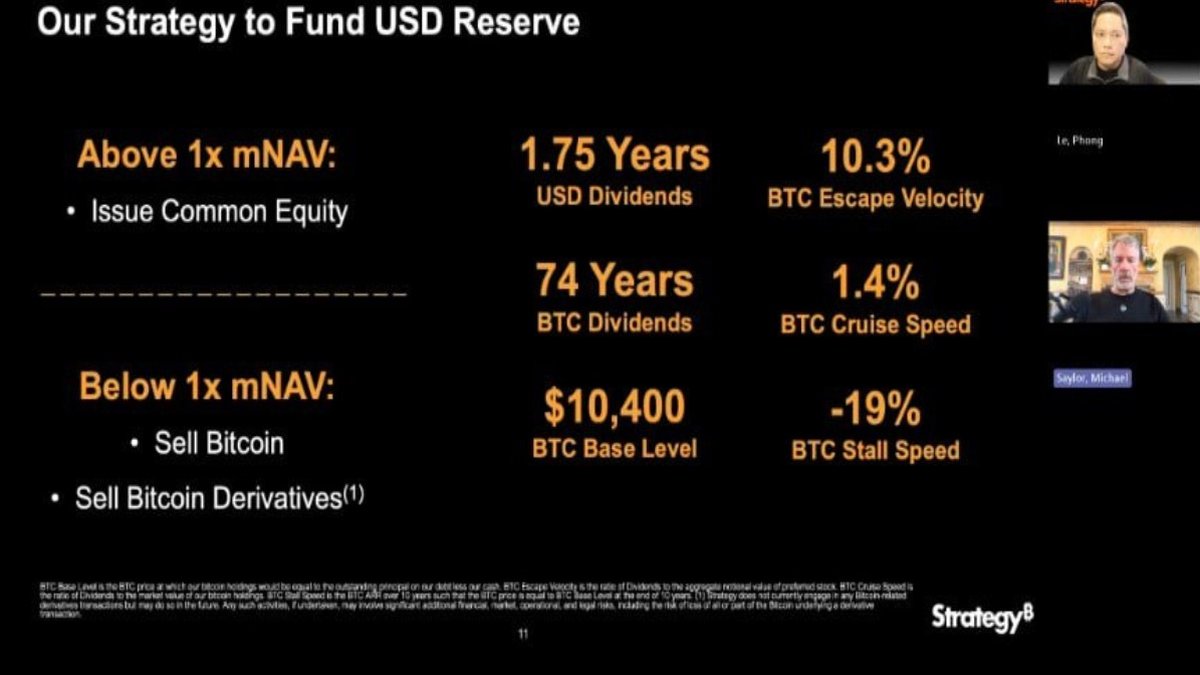
- The company raised roughly $1.4 billion in fresh capital earlier this year through equity issuance and convertible notes, giving it a sizeable USD buffer. Management has indicated that this cash runway can cover interest payments and operating costs for roughly two years without needing to liquidate BTC.
- Strategy has continued to add to its Bitcoin position even during drawdowns, signalling that, at least for now, it views BTC as a long-term core asset rather than a trading position.
From JPMorgan’s perspective, this matters because it keeps the 'effective float' of Bitcoin tighter than headline supply suggests. A company with a multi-year cash runway and a stated strategy of holding BTC through cycles is unlikely to become forced supply during ordinary volatility. That, in turn, makes it easier for ETF-driven demand and other institutional flows to impact price.
However, this assumption is not risk-free. It hinges on continued access to capital markets, stable governance and the absence of extreme regulatory or macro shocks. If any of those variables change, Strategy’s behaviour could shift, and with it the entire supply-demand balance that underpins the 170K scenario.
3. The MSCI Review: A Quiet but Powerful Catalyst
The second major pillar of JPMorgan’s analysis is an index-provider decision that is easy to overlook. MSCI, one of the world’s largest benchmark creators, is reviewing whether companies whose primary business model revolves around holding Bitcoin or other digital assets should remain in its flagship indexes. A decision is expected by mid-January 2026.
The stakes are high. JPMorgan estimates that if MSCI excludes Strategy from its equity benchmarks, index-tracking funds could be forced to sell about $2.8 billion worth of shares. If other providers follow MSCI’s lead, total mechanical outflows might climb toward $8.8 billion. Those numbers are material even for a company with a large market capitalisation.
Why would this matter for Bitcoin itself?
- Strategy’s share price is highly sensitive to BTC, often moving with even more volatility than the asset it holds.
- Forced selling by index funds could compress the company’s valuation, potentially making future capital raises more difficult or expensive.
- In an extreme case, if equity markets became a less reliable funding source, management might be more inclined to consider BTC sales during prolonged downturns.
On the other hand, if MSCI ultimately decides to keep Strategy and similar firms in its indexes, the opposite dynamic could unfold. Continued inclusion would stabilise passive ownership, keep financing channels open and reinforce the narrative that Bitcoin-heavy companies belong in mainstream equity benchmarks rather than being treated as niche vehicles.
In that sense, the MSCI review is a quiet but consequential swing factor in the 170K scenario. It does not change Bitcoin’s fundamentals, but it materially affects how smoothly one of its largest corporate holders can fund its balance sheet without touching its BTC reserve.
4. A Canadian Bank Steps In: Institutional Normalisation in Action
While the spotlight is on JPMorgan’s model and MSCI’s decision, another development illustrates how the investor base around Bitcoin is evolving. A recent regulatory disclosure shows that National Bank of Canada, one of the country’s major financial institutions, has accumulated approximately 1.47 million shares of Strategy, with an acquisition value near $273 million according to the filing.
This kind of position serves several purposes at once:
- It gives the bank indirect exposure to Bitcoin through a listed equity that is already widely followed.
- It signals to other institutions that BTC-linked assets are increasingly viewed as legitimate components of diversified portfolios, rather than purely speculative side bets.
- It deepens the connection between traditional financial infrastructure—custody, reporting, regulatory oversight—and the digital asset space.
Whether other banks follow suit remains to be seen, but the broader trend is clear: the marginal buyer of Bitcoin exposure today is not only the individual enthusiast but also regulated entities operating within strict risk frameworks. That shift is part of what JPMorgan is capturing when it compares BTC’s trajectory to gold’s multi-decade journey from fringe asset to portfolio mainstay.
5. Macro Backdrop: Why Liquidity Still Matters
Even the most elegant cross-asset model must live inside a macro environment. The 170K scenario assumes a world in which liquidity conditions gradually improve rather than tighten. That view is not purely speculative. Over the past year, several structural indicators have pointed in that direction:
- The Federal Reserve has begun to slow and then halt its balance-sheet runoff, as key liquidity buffers such as the reverse-repo facility have been largely drawn down.
- Expectations for interest-rate cuts in 2026 have firmed as growth indicators soften and the labour market cools.
- Global central banks, while not acting in lockstep, have generally moved from emergency tightening to a more neutral or mildly supportive stance.
For Bitcoin, which has historically been sensitive to broad risk appetite and dollar liquidity, this transition matters. If real yields fall and investors regain confidence that central banks will backstop major dislocations, the appeal of scarce, non-sovereign assets tends to increase. That has been a recurring pattern across multiple cycles.
However, macro is also a source of uncertainty. A sharper-than-expected slowdown, renewed inflation surprise, or geopolitical escalation could all derail risk appetite, at least temporarily. In that environment, even structurally bullish narratives—ETF adoption, corporate treasuries, index inclusion—can be overwhelmed by a simple desire to hold cash.
6. What Could Derail the 170K Scenario?
Given all these moving parts, it is worth being explicit about what would need to go wrong for the 170K path to break down. A few obvious candidates:
• MSCI excludes digital-asset treasury companies. Mechanical selling by index funds could pressure Strategy’s share price and raise questions about the long-term viability of using listed corporates as BTC holding vehicles.
• Strategy’s cash buffer proves insufficient. If Bitcoin were to experience a prolonged downturn beyond the firm’s planning horizon, and capital markets were less receptive to new issuance, the company could feel compelled to reconsider its 'never sell' stance.
• ETF flows stall or reverse. The gold-parity model assumes ongoing inflows into spot products as more advisors, pensions and institutions allocate. If adoption plateaus or reverses, the extrapolation to gold-like demand becomes harder to justify.
• Regulatory conditions tighten unexpectedly. While recent months have trended toward clearer rules and even supportive measures in some jurisdictions, a major adverse policy shift could slow institutional adoption.
None of these outcomes is guaranteed, but recognising them helps keep the debate grounded. A fair reading of JPMorgan’s note is not 'Bitcoin will be at 170K by next summer,' but rather 'If Bitcoin continues to mature into a gold-like asset and current institutional trends persist, a 170K valuation would be consistent with that role.' The difference between those two statements is where responsible analysis lives.
7. Practical, Brand-Safe Takeaways for Readers
For readers who follow crypto markets but do not live in spreadsheets all day, it can be hard to know what to do with a headline like 'JPMorgan sees Bitcoin at 170K.' A few constructive ways to frame it:
1. Treat big numbers as scenarios, not promises. Price levels derived from cross-asset comparisons are useful for thinking about long-term potential, but they are not timelines or guarantees.
2. Pay attention to structure, not just sentiment. The most interesting parts of JPMorgan’s work are the structural variables it highlights: ETF adoption, corporate treasury strategies, index inclusion and institutional balance-sheet decisions.
3. Watch how large holders behave. When companies like Strategy extend their cash runway or when major banks accumulate BTC-linked equities, they are making real capital-allocation decisions that can influence supply and demand for years.
4. Keep macro in view. Even the strongest digital-asset narratives remain sensitive to interest rates, liquidity and broader risk appetite.
5. Align analysis with your own horizon. A 6–12-month projection is almost irrelevant for someone thinking in decade-long intervals, and it may be too vague for someone whose focus is short-term. Knowing your own timeframe is as important as understanding any analyst’s model.
8. Conclusion: Beyond the Headline Number
JPMorgan’s 170K scenario has understandably captured attention. It signals that one of the world’s largest banks now treats Bitcoin not as a curiosity but as an asset that can be compared, on fairly sober terms, with gold. It also places a spotlight on the intricate network of factors—ETFs, corporate treasuries, index providers, macro conditions—that determine how quickly Bitcoin’s role in the financial system evolves.
Whether or not BTC ever trades at exactly $170,000 is almost beside the point. What matters is that the discussion has moved from 'if' to 'under what conditions'. For a technology that was born in a niche online forum, that shift alone marks a significant milestone.
For participants, the most constructive response is not to anchor on a particular price level, but to stay informed about the underlying dynamics: how regulators treat digital assets, how large institutions allocate capital, how macro conditions shape risk appetite, and how the market structure around Bitcoin continues to mature.
Disclaimer: This article is for informational and educational purposes only. It does not constitute financial, investment, legal or tax advice and should not be treated as a recommendation to buy, sell or hold any digital asset or security. Digital asset markets are volatile and carry risks, including the possible loss of principal. Readers should conduct their own research and consider consulting qualified professionals before making any financial decisions.