Investors are desperate for an altcoin melt-up, but the data disagrees: ~53,000 addresses sent alts to exchanges in the past 7 days, BTC dominance keeps rising since mid-September, and the Altseason Index sits < 25. This long-form explains the rotation mechanics, what must change, and a patient playbook that prioritizes Bitcoin—until the mosaic flips
Everyone wants the fireworks. Social feeds are crowded with hymnals to the coming Altseason—the moment breadth explodes, microcaps rip, and beta outperforms everything. But markets pay attention to what traders do, not what they tweet. The newest flow data paints a very different picture: in the last seven days, more than 53,000 addresses sent altcoins to exchanges (a classic distribution tell), Bitcoin dominance has risen steadily since mid-September, and the widely watched Altseason Index remains below 25—well short of the regime that historically accompanies broad-based alt outperformance. In other words: the rotation many expect hasn’t started. Not yet.
The Set-Up: Hope vs. Tape
On paper, the 2025 cycle has all the ingredients for drama: post-ETFs structural demand for BTC on one side, rapid innovation and speculative narratives on the other. But the tape—what prices, flows, and positioning actually show—says capital is still clustering around safety. When risk is fragile, investors default to the benchmark asset with the deepest liquidity, cleanest narrative, and the most reliable buyer base. That asset is Bitcoin. Until this preference weakens, altseason can’t sustainably begin.
Three Hard Signals That Contradict an Immediate Altseason
1. Exchange inflows from alt wallets: The 7-day count of ~53k addresses sending altcoins to exchanges is a real-time proxy for willingness to sell. That’s not what you see at the start of an alt melt-up; that’s what you see when traders look for exit liquidity or prepare to rotate into BTC strength.
2. Rising BTC Dominance since mid-September: Sustained dominance uptrends are rotations into perceived safety. Historically, altseason follows after dominance peaks and rolls over, not while it’s climbing.
3. Altseason Index < 25: Read it as “breadth is cold.” A sub-25 print means the median alt underperforms the benchmarks (BTC/ETH). That can change fast—but it hasn’t yet.
Why Altseason Lags—The Mechanics of Rotation
There is a sequence that repeats across cycles:
- BTC Impulse: Macro and structural flows push BTC higher. Perceived safety + liquidity draws capital in.
- BTC Consolidation: After expansion, BTC digests gains in a narrowing range. Volatility and funding cool.
- ETH Leadership: ETH/BTC starts trending up. Liquidity drifts outward along the quality spectrum.
- Sector Breadth: DeFi/AI/RWA baskets rally in parallel. New highs proliferate across multiple themes.
- Long Tail: Only then do microcaps fly—and usually for shorter, more violent windows.
We are somewhere between stages 1 and 2. Until ETH/BTC flips decisively and sector breadth expands, the alt party doesn’t have structural oxygen.
What Would Flip the Mosaic to “Go”
• Dominance rollover: A weekly lower high in BTC.D followed by a weekly close below its 20-week EMA. Translation: the market finally trusts non-BTC risk.
• ETH/BTC break and hold: ETH/BTC clears a multi-month ceiling and holds for 2–3 weeks. ETH is the locomotive; its relative strength is the green light for breadth.
• Breadth math: At least two sector baskets (e.g., DeFi, AI, RWA) show ≥35% of constituents hitting 90-day highs within a two-week window, with rising spot volumes.
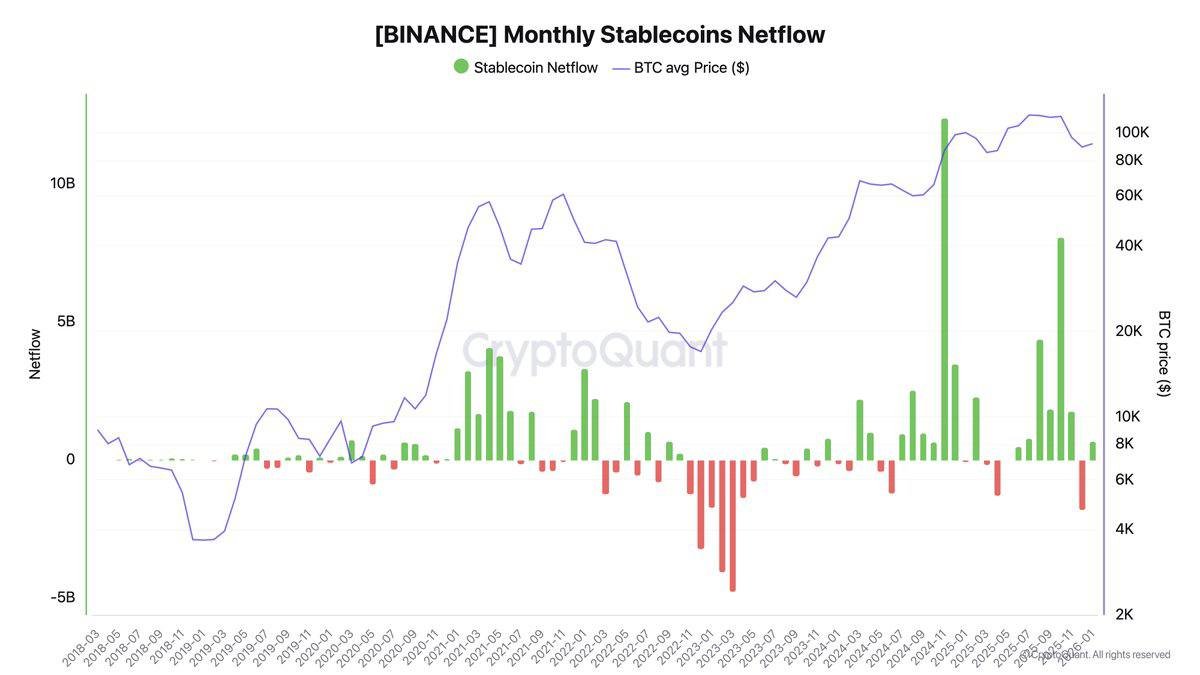
• Stablecoin fuel: Aggregate stablecoin supply growing ≥3–4% over 30 days and net inflows to spot venues—fuel that can rotate into alts.
• Derivatives balance: Open interest rising while funding stays neutralish (−0.02% to +0.06%/8h). Hot funding without spot is a trap, not a trend.
What Today’s Signals Actually Say
Alt inflows to exchanges ≈ distribution, not accumulation. Address counts don’t tell you who is selling, but they do tell you many accounts are preparing to sell. Pair that with weak breadth and rising dominance and the intent is clear: de-risking into strength, not chasing the long tail.
BTC dominance uptrend ≈ “flight to quality.” In fragile regimes, allocators rationally choose fewer moving parts—balance-sheet buyers, ETF demand, and deep derivatives markets. Alts require confidence to outperform; dominance rising means confidence is rationed.
Altseason Index < 25 ≈ not yet. You don’t need the index to be maxed to start positioning, but you do want to see it climb through the 30s/40s with ETH/BTC confirming. Right now it’s telling you breadth is still constrained.
A Patient Playbook (Prioritize Bitcoin—For Now)
1) Portfolio Lanes
- Core (50–70%): BTC spot. Add only on structure (retests, higher-low holds) rather than green candles.
- Satellite (20–30%): ETH and one leading sector basket—but scale in only if ETH/BTC improves on the weekly.
- Explorers (0–10%): Small, catalyst-driven alt positions with hard invalidations; think of them as scouts, not a standing army.
2) Execution Hygiene
- Spot first, perps later: Until breadth turns, avoid funding bleed. If you must use perps, time entries around funding neutrality.
- Wait for acceptance: Let levels prove themselves (daily/weekly closes), then add. Buying into resistance in a no-breadth regime is how you become exit liquidity.
- Keep cash optionality: Stable “dry powder” lets you buy the first real dip after a regime shift instead of pre-committing to noise.
3) A Simple Dashboard to Decide “When”
| Signal | Threshold | Implication |
|---|---|---|
| BTC Dominance (weekly) | Rolls over + closes below 20W EMA | Risk rotating out of BTC → alts |
| ETH/BTC | Breaks multi-month range & holds 2–3 weeks | Leadership baton to ETH & L2/DeFi |
| Breadth | ≥35% of DeFi/AI/RWA at 90-day highs | Alt beta becomes a portfolio tool |
| Stablecoin supply | ≥3–4% 30-day growth + CEX net inflows | Fresh fuel entering the system |
| Funding/Perps | OI up, funding neutralish | Trendable without melt-up risk |
Common Traps to Avoid Right Now
- Buying the narrative, not the regime: Great stories won’t outrun a bad structure. In no-breadth tapes, even strong projects underperform.
- Confusing green days with trend days: An alt can rally 15% intraday and still be in a multi-week downtrend vs BTC. Check relative charts.
- Funding complacency: Hot funding in alts + rising dominance is a liquidation recipe. If you must trade, trade smaller and quicker.
- Over-diversification: Spreading across 25 names in a no-breadth environment guarantees index-like underperformance with higher risk.
Scenarios: The Next 4–8 Weeks
- Base Case — BTC First, Alts Later: BTC grinds higher then ranges; ETH/BTC stabilizes but doesn’t break; breadth stays muted. Pick your spots in BTC/ETH, keep alt risk light.
- Bullish Rotation — The Window Opens: BTC ranges on declining realized vol; ETH/BTC rips; DeFi + AI baskets print clusters of 90-day highs. That’s your cue to lift satellite exposure and seed a few explorers.
- Risk Off — Deeper Air Pocket: Macro wobble pushes USD/real yields up; BTC retraces; dominance spikes further; alt exchange inflows surge. Cut explorers, keep core small and patient, let the flush complete.
FAQs for the Impatient
“If I wait for every signal, won’t I be late?” You’ll miss the first 10–15% of many alt moves—and avoid the 30–50% drawdowns that follow failed breakouts. In regimes defined by fragility, late and right beats early and wrong.
“What about microcaps that move before breadth?” Outliers exist. Treat them as trades, not theses: small size, fast invalidations, and no averaging down.
“Isn’t the crowd always wrong?” Sometimes. But the crowd allocates the liquidity you need to exit. Breadth is a liquidity variable as much as a price one.
Bottom Line
Right now the data disagree with the dream. Altcoins flowing to exchanges, a rising BTC dominance trend since mid-September, and an Altseason Index below 25 say the rotation clock hasn’t struck yet. Could that change quickly? Absolutely—if BTC ranges, ETH/BTC leads, breadth ignites, stablecoin supply expands, and perps stay balanced. Until then, the message is simple: don’t FOMO the long tail. Favor BTC, be selective with ETH and top-tier sectors, keep cash optionality, and let the market prove it wants an altseason before you speculative position like it’s already here.
Note: This article is analysis and opinion for educational purposes only—it is not investment advice. Crypto assets are highly volatile. Do your own research and manage risk prudently.