Solana Mobile’s SKR Token: Turning Phones into a Native Web3 Economy
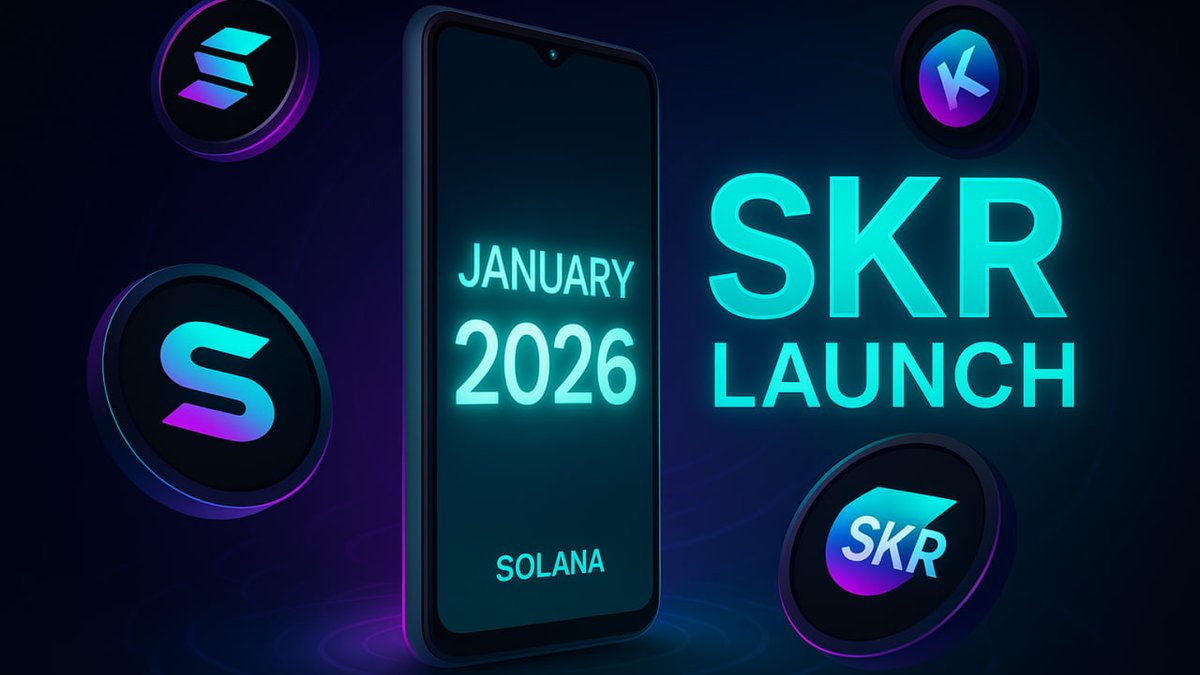
Solana started life as a high-performance base layer for decentralised applications. With the launch of Solana Mobile and its Seeker smartphone line, the project has spent the last two years pursuing a different question: what happens when the phone itself becomes part of the network, not just a passive access point? The newly announced SKR token, slated to go live in January 2026, is Solana’s most ambitious answer so far.
SKR is designed as the economic backbone of Solana’s mobile initiative. It will power a mix of incentives, governance and revenue-sharing mechanisms that sit on top of the Seeker hardware, the Solana dApp Store and a new network of independent operators called Guardians. Instead of treating smartphones as generic devices that simply run wallets, Solana Mobile wants Seeker owners, developers and infrastructure providers to plug into a shared tokenised economy.
In this deep dive, we unpack the token design, the Guardian model and the strategic implications for Solana’s broader ecosystem. The goal is not to speculate on price, but to understand what SKR is trying to achieve—and what has to go right for this experiment in mobile-native Web3 to succeed.
1. From Saga to Seeker: Why Solana Cares About Phones
The SKR story makes more sense with a quick look back at how Solana Mobile evolved. The first device, Saga, launched as a kind of proof of concept: a limited-run Android phone with deep Solana integration, a hardware-backed Seed Vault for key storage and a curated dApp Store that bypassed traditional app-store fees. Despite modest shipment numbers, Saga demonstrated three important points:
• There is real demand for crypto-native hardware. Early units frequently sold out, and the phone became a status symbol for power users who valued integrated wallets and direct access to airdrops and experiments.
• Developers want a dedicated distribution channel. The Solana dApp Store let teams ship directly to engaged users without surrendering a large share of revenue or dealing with restrictive policy changes from big-tech platforms.
• Phones can be more than passive clients. With features like local signing and Seed Vault, Solana Mobile hinted at a future where devices played a more active role in security, onboarding and even consensus-adjacent tasks.
Seeker, the second-generation phone, scales that experiment. Pre-orders have run into the six-figure range according to the project’s own disclosures, and the ecosystem now counts more than 175 integrated dApps and over 100 million USD in on-chain value processed through its tooling. Within that context, SKR is meant to transform Seeker from a niche hardware project into a full-fledged mobile economy.
2. SKR Tokenomics: Fixed Base Supply, Managed Inflation
At the core of the design is a fixed base supply of 10 billion SKR. Rather than relying solely on a capped pool, however, Solana Mobile is layering an explicit inflation schedule on top—starting near 10% in the first year and gradually decaying toward roughly 2% over the long term. That inflation is earmarked for staking rewards, Guardian incentives and ecosystem grants.
The initial 10-billion base supply is allocated as follows:
• 30% – Airdrops and early unlocks. This portion targets Seeker owners, active dApp users and select community cohorts. The aim is to ensure that people who actually participate in the ecosystem own a meaningful slice of the token from day one.
• 25% – Growth & partnerships. These tokens are reserved for strategic collaborations with app developers, infrastructure providers and commercial partners who can help extend Solana Mobile’s reach.
• 10% – Community treasury. Managed via on-chain governance, this pool can fund public goods, grants and experiments that are not tied to any single company.
• 10% – Liquidity & launch pools. This allocation is intended to seed trading venues, incentivise early market-making and provide depth for SKR pairs without relying entirely on external capital.
• 15% – Solana Mobile team. A standard mix of vesting schedules and lock-ups aligns long-term incentives for core contributors.
• 10% – Solana Labs. The parent entity retains a stake, reflecting its role in building the underlying technology and ecosystem.
What stands out here is not just the distribution, but the decision to embrace a managed inflation model. Many ecosystem tokens in recent years have tried to market themselves as ultra-deflationary, only to run into practical limits when they later needed funds for incentives or security. SKR’s designers are effectively saying: the mobile stack needs a steady stream of tokens to reward Guardians, stakers and builders, and it is better to bake that into the design up-front than to improvise later.
3. Four Jobs for a Single Token
According to the project’s documentation, SKR is meant to handle four main roles inside the Solana Mobile universe:
1. Economic engine. SKR will be used to pay fees for certain Seeker-specific services, reward device owners for participation in campaigns and potentially share a portion of revenue from dApp distribution or premium features.
2. Decentralised control. Holders will take part in on-chain governance for parameters affecting Solana Mobile’s stack: funding decisions from the community treasury, Guardian onboarding rules and policy around ecosystem incentives.
3. Developer incentives. SKR allocations will support hackathons, grants and user-acquisition campaigns, helping new dApps reach Seeker owners without relying on traditional advertising channels.
4. Community ownership. By directing a substantial share of tokens to users and builders rather than only to investors or corporate entities, Solana Mobile wants the network of phones and applications to feel less like a product line and more like an open platform.
Whether one token can successfully juggle all these responsibilities is an open question, but the intent is clear: SKR is not just a loyalty point or a governance stub. It is supposed to be the connective tissue linking hardware, software and community incentives.
4. Guardians: Decentralising Hardware Governance
The most novel component of the design is the Guardian network. Guardians are independent operators tasked with validating devices, reviewing apps and helping enforce security and quality standards within the Solana Mobile ecosystem. Early participants include infrastructure and validator teams such as Helius, DoubleZero, Triton and Jito.
In practical terms, Guardians will perform roles that, in a traditional mobile ecosystem, would belong almost entirely to a centralised app-store operator or OS vendor:
- Device verification. Confirming that a handset meets certain security and software criteria before it can access sensitive features or reward programs.
- Application review. Assessing whether apps comply with technical and policy guidelines, especially when they interact with the Seed Vault, wallets or SKR incentives.
- Policy signalling. Participating in governance decisions about what kinds of integrations and business models should be prioritised.
Users will be able to stake SKR and delegate to Guardians, earning a share of rewards while indirectly influencing who holds these responsibilities. In theory, this distributes power more widely than in current mobile ecosystems, where a small group of corporate decision-makers controls everything from app approvals to revenue splits.
If the Guardian model works, it could become one of the first large-scale examples of hardware governance via tokens. Instead of trusting a single company’s app review process, the ecosystem would rely on a competitive set of operators whose incentives are aligned through SKR staking and community oversight.
5. How SKR Fits Beside SOL
Any new token inside a major layer-1 ecosystem raises an immediate concern: does it strengthen or dilute the role of the base asset? In Solana’s case, SOL already anchors consensus, pays base-layer fees and serves as a core collateral asset across DeFi. SKR therefore needs a clear positioning to avoid being seen as just another side token.
The current design points toward a complementary relationship:
- SOL remains the asset for securing the Solana L1 and paying for on-chain computation.
- SKR is scoped to the mobile vertical: device incentives, Guardian staking, dApp distribution economics and governance decisions that only affect Solana Mobile.
- Seeker devices still interact with the broader Solana ecosystem; wallets will hold SOL, stablecoins and other tokens. SKR simply adds an extra layer of incentives specific to the hardware stack.
That separation could help minimise overlap, but it also creates a delicate balancing act. If SKR captures too much of the value generated by mobile usage, SOL holders might question whether the ecosystem is fragmenting. If SKR remains purely a rewards token without meaningful demand sinks, it risks being treated as transient.
One plausible middle ground is for SKR-based programs—such as Guardian rewards or app-store rebates—to reference activity that ultimately drives demand for SOL. For example, fee rebates might apply only to transactions that settle on Solana, and Guardians could be evaluated partly on metrics tied to L1 security and uptime.
6. Strategic Upside: Why Solana Is Betting on a Mobile Token
From a strategic standpoint, SKR serves at least three big objectives for Solana Mobile and the broader ecosystem.
6.1 Deepening user loyalty
Phones are long-lived devices; users who commit to a platform often stay within its gravitational pull for years. By issuing a token that rewards ongoing participation—rather than just a one-time discount—Solana Mobile is trying to turn Seeker ownership into an evolving membership, where users earn SKR for trying new apps, participating in quests or supporting Guardians.
6.2 Bootstrapping a developer marketplace
For developers, SKR-funded programs can act as a substitute for paid marketing. Instead of buying traditional ads, teams could direct SKR incentives to Seeker users who test new features or provide feedback. Combined with a fee-free dApp Store, this creates a relatively low-friction environment for experimentation. In the best case, Solana Mobile becomes a launchpad where new consumer crypto apps reach their first ten thousand users.
6.3 Challenging the app-store status quo
Perhaps the most ambitious goal is to challenge the current gatekeeper model in mobile computing. Apple and Google exert tight control over what can be distributed, how payments are handled and which business models are allowed. By contrast, Solana Mobile wants to move many of those decisions to on-chain governance and token-aligned Guardians. SKR is the mechanism that makes that possible: it is how the ecosystem pays reviewers, shares upside with users and coordinates long-term policy.
7. Risks, Trade-offs and Open Questions
No token design is free of trade-offs, and SKR is no exception. Several risks are worth highlighting for readers approaching this with a critical lens.
7.1 Execution risk in the hardware market
Smartphone economics are notoriously challenging. Margins are thin, supply chains are complex and consumer attention is fickle. Even with strong pre-order numbers, Seeker has to compete with well-established brands on basics like camera quality, battery life and industrial design. If device adoption stalls, the entire SKR model—airdrops, Guardian rewards, app incentives—will have a much smaller base to work with.
7.2 Inflation and long-term value
An inflationary schedule can be healthy if additional tokens are used to expand the network and reinforce security. But it can also erode value if incentives are not carefully targeted. For SKR, much will depend on how quickly the ecosystem can convert inflation into durable activity: new users, sticky apps, and Guardians that genuinely improve security and reliability. Transparent reporting on how newly minted tokens are spent will be key.
7.3 Regulatory and compliance considerations
Because SKR intertwines hardware rewards, governance and revenue sharing, regulators may look closely at how it is offered and marketed across jurisdictions. Solana Mobile will need to be careful to avoid over-promising financial outcomes and instead emphasise utility, participation and governance rights. For users, it remains important to treat SKR as part of an experimental technology stack rather than as a guaranteed store of value.
7.4 Complexity for everyday users
One of the selling points of Seeker is that it lowers the barrier to entry for Web3: wallets are pre-installed, the dApp Store curates options and Seed Vault handles key management under the hood. Introducing a new token risks re-introducing complexity if not handled well. Ideally, SKR should feel like a background signal—a quiet reward layer that enhances the experience—rather than a requirement that users must master before they can simply use their phone.
8. Metrics to Watch After Launch
For observers who want to track whether SKR is living up to its ambitions, several indicators will be more informative than day-to-day price moves:
• Active Seeker devices. Shipments matter, but daily active usage is even more important. The more people treat Seeker as their primary phone, the more meaningful SKR’s incentives become.
• Guardian participation and diversity. A healthy network should include multiple independent operators with different backgrounds, not just a handful of large validators.
• Share of dApp activity originating from Solana Mobile. If a growing portion of Solana’s consumer transactions, sign-ins and on-chain actions comes through Seeker, that would signal real traction.
• Staking and delegation rates. High participation in SKR staking suggests that users and institutions see ongoing value in the network; extremely low participation might imply that rewards do not justify the complexity.
• Clarity of governance decisions. Over time, the community’s use of on-chain proposals to shape token distribution, app-store policy and Guardian requirements will reveal whether SKR is delivering meaningful decentralisation or simply mirroring corporate decision-making.
9. What SKR Means for the Broader Solana Narrative
Zooming out, SKR’s launch illustrates how far Solana has moved beyond its original image as a fast trading chain. The project is now experimenting with payments, decentralised physical infrastructure, consumer apps—and, with Solana Mobile, the hardware layer itself. By attaching a dedicated token to that effort, Solana is effectively betting that the next wave of adoption will be device-native: people will not think of themselves as users of a blockchain, but as owners of phones where decentralised features are simply part of the operating environment.
There are precedents for this kind of strategy. Console ecosystems use proprietary currencies and reward programs to bind gamers and developers together. Loyalty programs issue points that can be earned and spent across a family of products. SKR is a Web3-era attempt to apply similar ideas to a mobile stack, with the added twist of on-chain governance and permissionless composability.
Success is far from guaranteed. Yet even if SKR only partially achieves its goals, it will generate valuable lessons for other projects exploring hardware, from wallet manufacturers to DePIN networks. Questions about how to align incentives between device makers, app builders and users are not going away. In that sense, Solana’s experiment is likely to inform the broader conversation about what a user-owned technology stack could look like.
10. Conclusion: A Long-Term Bet on Mobile-Native Web3
Solana Mobile’s SKR token is more than a new ticker symbol. It is a structural attempt to encode incentives, governance and community ownership into the very fabric of a hardware ecosystem. With a fixed base supply of 10 billion tokens, a controlled inflation schedule and a Guardian network designed to decentralise key decisions, SKR aims to turn Seeker phones into portals for a mobile-native, user-aligned economy.
The upside is clear: if the model works, Solana could become the first major blockchain to integrate deeply with consumer hardware while preserving meaningful decentralisation. The risks are equally real: hardware competition, regulatory scrutiny, token-economic missteps and the simple challenge of explaining all of this to everyday users.
As January 2026 approaches, the most productive stance may be measured optimism. Rather than focusing solely on speculative narratives, observers can watch how SKR shapes behaviour: do more people choose Seeker as their primary device, do developers treat Solana Mobile as a preferred launchpad, and do Guardians evolve into a genuinely independent governing layer? The answers to those questions will determine whether SKR becomes a cornerstone of Solana’s long-term story or a fascinating footnote in the broader evolution of mobile Web3.
Disclaimer: This article is for informational and educational purposes only. It does not constitute financial, investment, legal or tax advice, and it should not be treated as a recommendation to buy, sell or hold any digital asset. Cryptoassets are volatile and carry risks, including the possibility of total loss. Readers should conduct their own research and, where appropriate, consult qualified professionals before making decisions related to cryptocurrencies, tokens or other financial instruments.