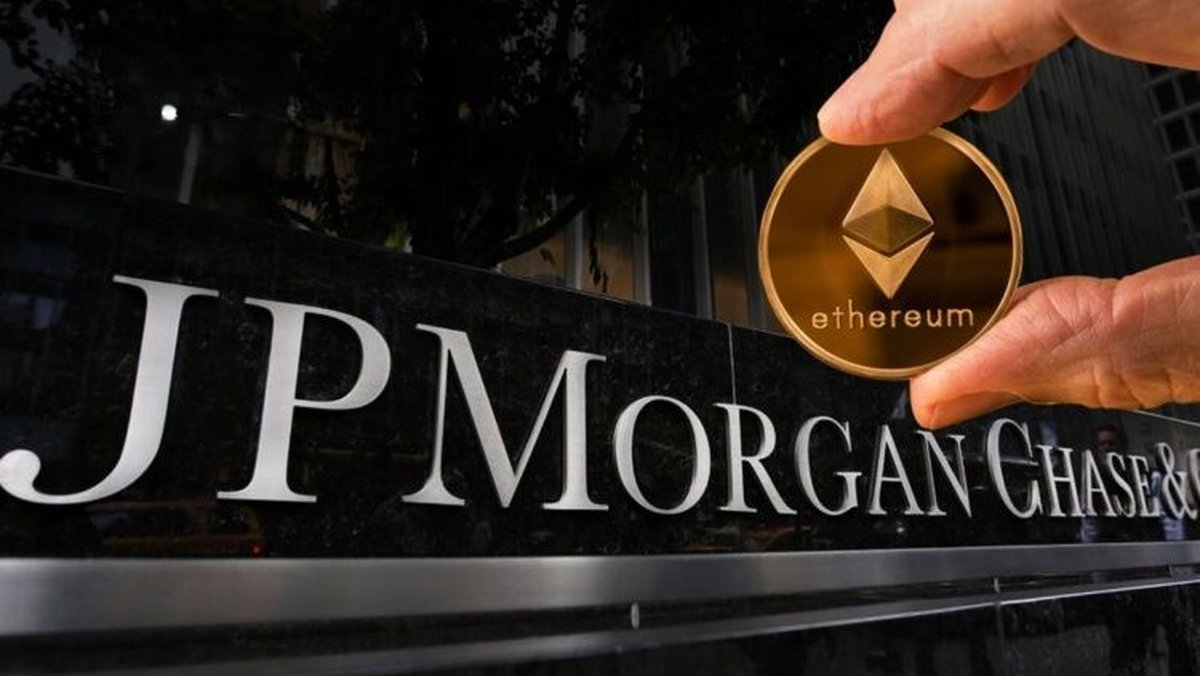
JPMorgan’s Tokenized Money Market Fund on Ethereum: What It Really Means for Crypto Liquidity
The past 24 hours have delivered a telling signal about where digital assets are headed next. JPMorgan, a bank managing roughly 4 trillion USD in assets, is preparing to launch its first tokenized money market fund (MMF) on Ethereum. At the same time, US regulators are publishing basic guidance on how retail investors should think about custodying crypto assets, while political and corporate leaders continue to link digital assets to themes like property rights, sound money and international trade.
On the surface, these headlines may look disconnected. A tokenized cash fund for institutions, an educational note from the securities regulator, comments from Michael Saylor about buying more Bitcoin, and political messaging around inflation and global relationships. Taken together, however, they describe a single story: crypto is moving further into the mainstream of global finance, with large banks and policymakers trying to shape the rules of engagement.
1. What is a tokenized money market fund and why does it matter?
Money market funds sit at the conservative end of the investment spectrum. They typically hold very short-dated government bills and high-quality instruments, aiming to preserve capital and offer a modest yield. For decades, they have been a core cash management tool for corporations, institutions and, in some jurisdictions, retail investors.
By choosing to tokenize such a fund on Ethereum, JPMorgan is not creating a new type of speculative asset. Instead, it is taking an existing, well-understood product and changing its technical wrapper:
- Shares in the fund are represented as tokens on Ethereum rather than as conventional entries in a legacy database.
- Transfers between whitelisted participants can occur on-chain, potentially with near-instant settlement and programmable rules around who is allowed to hold or move the tokens.
- The underlying portfolio, risk profile and regulatory treatment remain aligned with traditional MMF rules; what changes is the ease with which those shares can be integrated into digital workflows.
This may sound like a minor back-office upgrade, but strategically it is significant. Stablecoins already brought the idea of tokenized cash to public blockchains, with assets like USDC and USDT acting as dollar-like instruments in DeFi and centralized trading venues. A tokenized MMF offers a related, but distinct, proposition:
• Different risk profile: Stablecoins rely on the strength and transparency of their reserve management. A tokenized MMF is built directly on top of regulated money market instruments, with established disclosure requirements.
• Regulated investor base: Access will likely be limited to qualified investors and institutions that complete know-your-customer (KYC) checks, rather than anyone with a wallet.
• On-chain composability with TradFi constraints: Because the tokens live on Ethereum, they can, in principle, interact with smart contracts. At the same time, JPMorgan can constrain where those tokens are allowed to move, balancing innovation with regulatory commitments.
In other words, this fund is not a competitor to DeFi lending protocols or retail-oriented stablecoins; it is a bridge product that allows large balance sheets to live partially on Ethereum without abandoning long-standing risk frameworks.
2. Ethereum as institutional settlement layer
JPMorgan’s choice of Ethereum is another important detail. The bank has experimented with private ledgers and internal networks for years. Using the public Ethereum mainnet for a flagship tokenized cash product suggests a growing comfort with public infrastructure, provided safeguards such as permissioned access lists, institutional custody and clear compliance checks are in place.
For Ethereum, this reinforces a narrative that has been building since the first wave of tokenization pilots: the network is not only a platform for decentralized finance and NFTs, but also a candidate settlement layer for regulated assets. If large institutions can hold tokenized MMF units on Ethereum, the next logical questions become:
- Can those tokens be pledged as collateral in repo-style arrangements that are also settled on-chain?
- Will corporates eventually use tokenized MMF shares as a form of treasury cash that can move between subsidiaries in real time?
- How will DeFi protocols adapt if, in the future, they are allowed to accept these highly regulated instruments alongside conventional stablecoins, under appropriate access controls?
None of these changes will happen overnight. But the presence of a major global bank on a public chain gradually shifts perceptions. For software developers and startups, it signals that building on Ethereum is not limited to consumer-facing products; there is a growing institutional user base to consider. For regulators, it underlines that a complete separation between 'traditional' and 'crypto' rails is becoming less realistic over time.
3. The SEC’s custody explainer: risk education for the retail side
While JPMorgan is designing products for large clients, regulators are focusing on the other side of the spectrum: individual investors. The US Securities and Exchange Commission has released an introductory guide on crypto asset custody basics for retail investors. The document does not introduce new rules; instead, it lays out foundational concepts:
- The difference between self-custody, where individuals hold their own private keys, and third-party custody through exchanges or specialized providers.
- The reality that wallets do not actually “hold” coins, but secure the keys that authorize transactions on the network.
- The practical risks of losing a seed phrase, reusing passwords or clicking on malicious links.
- The trade-off between convenience and responsibility: self-custody offers full control but places the entire burden of security on the user; delegating custody is easier but relies on the robustness and integrity of the provider.
From a market-structure perspective, the timing is notable. As institutional initiatives such as tokenized MMFs gain momentum, retail investors are simultaneously being reminded that the basic operational risks of crypto — from mismanaging private keys to misunderstanding platform terms — remain very real. A more educated retail base is not only better protected; it is also more likely to engage with tokenized products in a sustainable way when those products eventually filter down from institutional pilots to broader offerings.
4. Sentiment: from 'more orange dots' to sound money narratives
Against this backdrop of infrastructure and policy, market narratives continue to swirl around Bitcoin and broader digital assets. Michael Saylor has once again hinted that his company may add to its Bitcoin holdings, posting the phrase '₿ack to More Orange Dots' — a familiar signal to followers that accumulation remains the core strategy. Coinbase CEO Brian Armstrong, meanwhile, has emphasized that crypto can help create property rights, sound money and free trade for all, framing digital assets as a long-term structural innovation rather than a short-term trading theme.
These statements highlight a useful distinction. On one side of the crypto landscape, institutions like JPMorgan are tokenizing low-risk instruments such as money market funds, focusing on operational efficiency and regulatory clarity. On the other side, companies like MicroStrategy are using Bitcoin as a strategic reserve asset, and exchanges like Coinbase are positioning crypto as part of a broader conversation about economic freedom and global capital flows.
For long-term observers, the coexistence of these narratives is not a contradiction. Tokenized MMFs bring yield-bearing cash instruments on-chain; Bitcoin represents a scarce, non-sovereign asset; and Ethereum provides a programmable settlement layer. Together, they form a spectrum of risk and return that can serve different types of investors under different macro conditions.
5. Macro signaling: inflation, diplomacy and regulatory perimeter
Macro commentary from political leaders also shaped the last 24 hours. President Trump has described inflation as 'totally neutralized' and highlighted a positive relationship with Chinese President Xi Jinping. For markets, such statements are less about precise forecasts and more about sentiment: they suggest a near-term environment where policymakers want to project stability, both domestically and in key bilateral relationships.
In a world where investors perceive inflation as under control and geopolitical tensions as manageable, demand for cash-like instruments and risk assets can coexist. Tokenized MMFs fit naturally into this mix: they allow investors to hold conservative exposures while still participating in the efficiencies of on-chain settlement. At the same time, Bitcoin and other digital assets continue to be evaluated as potential hedges against the possibility that macro conditions eventually shift again.
On the regulatory side, there are reports that a major jurisdiction is preparing new rules to more actively oversee cryptocurrency markets. The exact contours remain to be seen, but the intent is clear: bring trading activity, service providers and market data under a more explicit supervisory framework. That does not necessarily mean harsh restrictions; it can also mean formal guidance on disclosures, leverage, market conduct and consumer safeguards.
From the perspective of institutional participants, the combination of clearer rules and high-quality tokenized instruments is attractive. Large investors are less concerned about short-term price swings than about the ability to operate within a predictable legal environment. A tokenized MMF on Ethereum, supported by a major bank, and clarified regulatory expectations around custody and market conduct, are all steps in that direction.
6. What this 24-hour window tells us about the next phase
Zooming out, the news flow of the past day encapsulates the next phase of digital asset adoption in three themes.
6.1. From speculative use cases to financial plumbing
Earlier crypto cycles were dominated by retail trading, new token launches and rapid experimentation. That experimentation is still present, but the center of gravity is shifting toward the underlying financial plumbing: how cash, collateral and securities move through the system. A tokenized MMF from a 4 trillion USD bank is not a headline designed to excite day traders; it is a sign that the settlement layer of traditional finance is slowly integrating blockchain tools.
6.2. Parallel tracks for institutional and retail participation
Institutional investors are engaging via highly structured products, regulated custodians and permissioned access, while retail investors navigate a mix of self-custody and exchange-based services. The SEC’s custody explainer acknowledges that many individuals are still at the early stages of understanding key operational risks. Investor education will be critical if the benefits of tokenization are to reach a broader audience without repeating past mistakes.
6.3. Policy as a competitive differentiator
Jurisdictions that offer clear, balanced rules for digital assets are positioning themselves to host the next wave of tokenization projects. Whether it is the US approving regulated tokenized funds, or other countries designing new frameworks for supervised trading venues, policy choices are increasingly shaping where capital and innovation flow. The debate is no longer about whether digital assets will be part of the financial system, but how they will be integrated and under what conditions.
7. How market participants might interpret the JPMorgan move
For investors and builders, several practical implications emerge from JPMorgan’s decision to launch a tokenized MMF on Ethereum:
• Liquidity quality may change, not just quantity. On-chain liquidity backed by regulated cash instruments can behave differently from liquidity driven mainly by leveraged trading. It may be more stable during periods of stress, but also less reactive when markets are seeking rapid price discovery.
• Collateral frameworks will evolve. If tokenized MMF units become acceptable collateral for institutional borrowing or derivatives margining, they could sit alongside stablecoins and traditional bank balances, creating a more layered collateral ecosystem.
• Interoperability will be a key technical challenge. Developers will need to design systems that can handle permissioned assets, where only certain addresses are allowed to hold or move tokens, without breaking the composability that makes Ethereum attractive in the first place.
• Regulated yield on-chain may pressure unregulated products. As investors gain access to tokenized cash instruments with transparent underlying portfolios, the bar will rise for other yield-generating strategies that rely mainly on leverage or complex structures.
None of these developments guarantee higher prices for any specific asset, including Ether or Bitcoin. But they do suggest a future in which digital asset markets are less isolated from the broader financial system and more deeply integrated into its infrastructure.
8. Conclusion: a step toward on-chain cash, not the end of the story
JPMorgan’s tokenized money market fund on Ethereum is easy to dismiss as a niche institutional experiment. In reality, it is part of a gradual re-architecture of how financial assets are recorded, transferred and used as collateral. Combined with the SEC’s renewed focus on custody education, ongoing macro commentary from political leaders, and continuing conviction from high-profile crypto advocates, the picture that emerges is one of convergence rather than separation.
Digital assets are no longer standing outside the financial system knocking on the door. They are being woven into the fabric of that system, sometimes through public networks like Ethereum, sometimes through more controlled environments. For investors, the key questions are shifting from 'will crypto survive' to 'what role will each type of digital asset play' and 'how do we manage risk in this new architecture'.
As always, short-term market reactions can be noisy. Prices may rise or fall on headlines, funding rates and positioning. The more durable story, however, is that on-chain representations of cash, securities and alternative assets are increasingly treated as legitimate components of global finance. A tokenized MMF from a 4 trillion USD bank is not the final chapter, but it is a notable paragraph in that story.
Disclaimer: This article is for educational and informational purposes only and does not constitute financial, investment or legal advice. Investors should conduct their own research and consult licensed professionals before making any investment decisions.