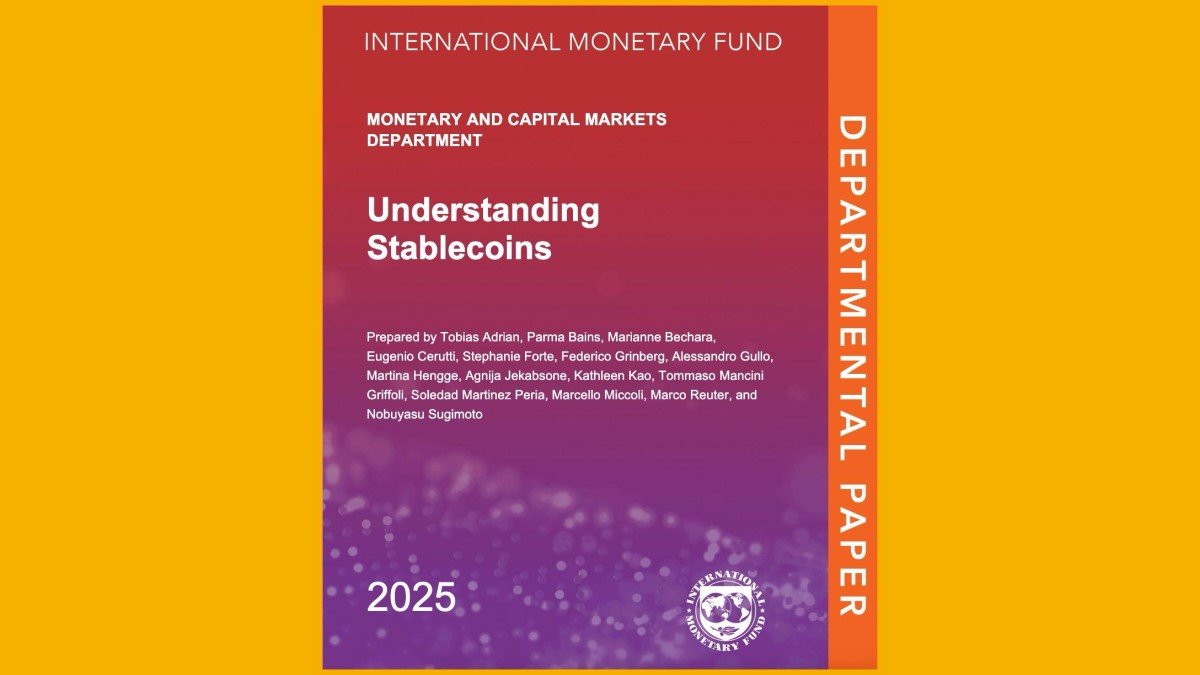
IMF, Stablecoins and Monetary Sovereignty: When Crypto Dollars Meet Fragile Currencies
Stablecoins began life as a niche tool for traders who wanted to move quickly between exchanges without relying on bank transfers. A decade later, they have become one of the most important building blocks of the digital-asset economy. Global supply is now measured in the hundreds of billions of dollars and has roughly doubled over the past two years, driven primarily by demand for dollar-referenced tokens.
That growth is forcing a difficult conversation in global policy circles. The International Monetary Fund (IMF) and other bodies such as the Bank for International Settlements (BIS) increasingly warn that widely used stablecoins could weaken monetary sovereignty, especially in emerging markets. Their concern is not only about financial crime or technical failure. It is about what happens when a critical mass of citizens quietly shift their savings and day-to-day payments into private, digital versions of a foreign currency.
The IMF’s latest commentary stresses that most of the stablecoin universe is effectively a crypto dollar zone: nearly all major tokens track the value of the US dollar rather than local currencies. Combined with the ability to move these tokens instantly through mobile phones and self-custodial wallets, this raises the prospect of fast, bottom-up dollarisation without any formal policy decision.
For people living in high-inflation economies, that possibility can look like an opportunity. For central banks responsible for monetary and financial stability, it looks more like a structural challenge. Understanding both perspectives is key to making sense of the IMF’s warnings.
1. Stablecoins 101: More Than a Trading Tool
At the simplest level, a stablecoin is a digital token that aims to maintain a stable value relative to some reference, usually a national currency. Most of the largest stablecoins today are backed by reserves such as cash, short-term government securities or high-quality liquid assets. A smaller share are backed by crypto collateral or use algorithmic mechanisms, although the latter category has lost credibility since several designs failed in 2022.
Unlike traditional bank deposits, which sit inside domestic banking systems and are subject to local regulation, many stablecoins circulate globally on public blockchains. They can be held in self-managed wallets, moved across borders at low cost and integrated into decentralised finance (DeFi) protocols, centralised exchanges and merchant payment systems.
Central bankers sometimes compare stablecoins to private banknotes from the nineteenth century: promises to pay that depend on the health and transparency of their issuers rather than on a central bank. The BIS has argued that these tokens still fall short of the qualities expected of sound money, citing concerns about reserve transparency and redemption risk. Yet even critics acknowledge that the user experience they provide – instantly transferable digital dollars – is appealing, particularly where the local currency is unstable.
2. Why the IMF Is Worried About Dollarisation 2.0
The IMF’s core mandate is to promote global financial stability. From that vantage point, a world in which households and firms increasingly hold dollar-pegged tokens instead of domestic currency creates several challenges.
First, stablecoins can accelerate de facto dollarisation. In countries with a history of inflation or currency depreciation, residents already tend to save in dollars where possible. Traditionally, this has required physical cash, foreign bank accounts or informal channels. Stablecoins lower the barrier dramatically: with a smartphone and a basic internet connection, anyone can hold tokenised dollars and move them across borders in seconds.
Second, monetary policy transmission becomes weaker. Central banks steer their economies by influencing interest rates and credit conditions in the domestic currency. If a large share of transactions and savings migrate to stablecoins, changes in policy rates may have less impact on borrowing costs and spending decisions. In an extreme case, a central bank could be left managing a shrinking domestic-currency balance sheet while most of the economy functions in private digital dollars.
Third, financial stability risk can increase. If residents lose confidence in the local currency or banking system, they may rush into stablecoins, causing a rapid drain of deposits. For emerging markets that rely on local banks to finance government debt or domestic investment, sudden shifts into crypto dollars could amplify stress in already fragile systems.
These concerns are not purely theoretical. Surveys and on-chain data show that stablecoin usage is growing fastest in regions such as Latin America, the Middle East and parts of Africa where inflation and capital-flow volatility are already a reality. From the IMF’s perspective, the risk is that stablecoins become a parallel monetary system before legal and regulatory frameworks have caught up.
3. The View From the Ground: Why People Use Stablecoins Anyway
The institutional perspective, however, is only one side of the story. For many individuals and small businesses, especially in countries with double-digit inflation or capital controls, stablecoins are not an abstract macro risk; they are a concrete tool for day-to-day resilience.
Store of value. Where local currencies have a history of rapid depreciation, holding savings in a dollar-linked token can feel safer than leaving funds in local cash. While there is issuer risk, the perceived trade-off often favours diversification into stablecoins.
Cross-border transfers. Migrant workers and freelancers increasingly use stablecoins to send money across borders, sidestepping slow or expensive traditional channels. A token sent over a public blockchain can arrive within minutes and be converted locally through peer-to-peer markets or regulated exchanges.
Access to digital finance. In regions where bank penetration is low but mobile-phone usage is high, stablecoins offer a way to participate in online commerce, savings products or lending markets without a conventional bank account.
From this bottom-up viewpoint, the idea that stablecoins weaken monetary sovereignty can sound distant compared to the immediate benefit of preserving purchasing power or avoiding high transaction fees. That tension between individual rational choices and system-level risks is at the heart of the IMF’s dilemma.
4. Why the Dollar Dominance of Stablecoins Matters
Stablecoins could, in principle, be pegged to any currency. In practice, almost all of the value in circulation tracks the US dollar rather than the euro, yen or smaller currencies. That skew is partly a reflection of existing dollar dominance in trade and finance, but the tokenised format amplifies it by making digital dollars as easy to hold as local cash in many countries.
This matters for three reasons:
• Extended influence of US monetary policy. Even in countries that do not use the US dollar officially, households holding stablecoins effectively import US interest-rate policy. When the Federal Reserve tightens or loosens conditions, the value and opportunity cost of holding dollar-linked tokens changes globally.
• Capital-flow sensitivity. In times of stress, residents may move quickly into stablecoins, buying tokenised dollars with local currency. That can create additional downward pressure on the exchange rate and complicate the central bank’s response.
• Reserve-asset concentration. Many fiat-backed stablecoins hold large portfolios of short-term US government securities. While this can support liquidity in Treasury markets, it also deepens the connection between global demand for stablecoins and the funding of US public debt.
The IMF’s warning about monetary sovereignty is therefore not only about technology; it is about the distribution of currency power in a world where digital dollars are just a tap away.
5. Policy Options: From Prohibition to Integration
Faced with these shifts, what can policy makers do? The IMF does not advocate a one-size-fits-all ban. Instead, its recent commentary emphasises the need for clear legal frameworks that define what stablecoins are, how they may be used and what safeguards issuers must follow.
Broadly, governments have four levers:
1. Clarify the legal status of stablecoins. Are they considered electronic money, investment products, bank-like liabilities or something else? Clear classifications determine which regulators have authority and what rules apply.
2. Set robust reserve and disclosure standards. Requiring high-quality, transparent reserves and regular audits can reduce the risk that a major stablecoin loses its peg, an outcome that would undermine trust and potentially trigger market stress.
3. Limit the use of stablecoins as official currency. The IMF has urged countries to avoid granting stablecoins legal-tender status or allowing them to displace local currency in taxes and public payments. Doing so helps preserve the central bank’s role at the core of the monetary system.
4. Develop public alternatives. Some jurisdictions are exploring central bank digital currencies (CBDCs) or tokenised bank deposits that offer similar technological benefits to stablecoins but remain anchored in the domestic regulatory and monetary framework.
None of these options is trivial. Setting strict rules too early can push innovation offshore; moving too slowly can allow unregulated systems to become entrenched. The IMF’s message is that ignoring the issue is no longer an option.
6. Can Stablecoins and Monetary Sovereignty Co-Exist?
It is tempting to frame the debate as a zero-sum contest: either stablecoins thrive and monetary sovereignty erodes, or regulators clamp down and innovation stalls. Reality is likely to be more nuanced.
Several paths could allow stablecoins to coexist with healthy domestic monetary systems:
• Local-currency stablecoins. Encouraging the development of well-regulated tokens denominated in the domestic currency can give residents a digital alternative without automatically pushing them into foreign units. These instruments still require strong oversight but align more closely with local policy goals.
• Hybrid models with banks. Banks and payment institutions can partner with stablecoin issuers, providing on- and off-ramps, compliance checks and consumer protection, while the tokens themselves circulate on public blockchains. This approach keeps the banking system involved rather than bypassed.
• Regional coordination. For smaller economies, coordinating standards at a regional level may help avoid regulatory arbitrage, where activity simply migrates to whichever country has the loosest rules.
From this standpoint, the IMF’s warnings are less about suppressing stablecoins and more about integrating them into a framework where their benefits – faster payments, lower remittance costs, better access to digital finance – are preserved while systemic risks are contained.
7. What It Means for the Crypto Ecosystem
Within the crypto community, reactions to the IMF’s stance are mixed. Some see it as a predictable defence of the existing monetary order; others view it as an invitation to build more robust, transparent and cooperative stablecoin structures.
On one hand, stricter regulations and licensing requirements could raise barriers to entry, favouring larger, well-capitalised issuers and potentially concentrating market power. On the other hand, clearer rules may make it easier for regulated institutions, such as banks and asset managers, to interact with stablecoins without uncertainty about their compliance obligations.
For developers and entrepreneurs, the key takeaway is that stablecoins are no longer invisible to policy makers. Decisions about reserve composition, governance, risk disclosure and cross-border access will increasingly be scrutinised not only through a micro-prudential lens ('is this token safe?') but also through a macro one ('what does this mean for our currency and financial system?').
8. Practical, Brand-Safe Takeaways for Readers
For individual readers, especially those who follow digital-asset markets more casually, it can be hard to translate high-level IMF reports into practical insights. A few points are worth keeping in mind:
1. Stablecoins are powerful tools, not risk-free instruments. They can make it easier to hold and move value, but they depend on issuers managing reserves prudently and on clear legal frameworks. It is important to understand who stands behind a token and what protections exist.
2. Monetary sovereignty debates affect long-term adoption. If governments conclude that certain stablecoin models pose systemic risks, they may impose tighter limits or push alternative designs such as CBDCs. That policy backdrop can shape which projects thrive over the next decade.
3. Local conditions matter. In high-inflation environments, stablecoins may offer practical benefits, but they also interact with sensitive economic dynamics. Users should be aware that sudden rule changes or capital-control measures can affect how easily tokens can be converted back into local currency.
4. Diversification extends beyond assets. Just as investors diversify across asset classes, it can be sensible to diversify across payment rails – banks, regulated digital wallets and, where appropriate, well-supervised stablecoins – rather than relying solely on any single channel.
5. Education is ongoing. The regulatory, technical and macro landscapes around stablecoins are evolving quickly. Following reputable sources, including central-bank reports and independent research, can help readers separate long-term trends from short-term headlines.
9. Conclusion: Navigating the Age of Crypto Dollars
The IMF’s recent warnings about stablecoins and monetary sovereignty reflect a simple reality: digital versions of the US dollar have moved from niche trading tools to everyday instruments of saving and payment for millions of people. That shift offers genuine benefits, especially where traditional financial infrastructure is weak, but it also challenges the foundations of how monetary policy and financial stability have been managed for decades.
As stablecoins continue to grow, the central question will not be whether they exist, but under what rules and in what relationship to domestic currencies they operate. Governments, international institutions and the private sector all have a stake in shaping that outcome. For now, the message from the IMF and BIS is clear: ignoring the rise of crypto dollars is no longer an option, and the choices made in the next few years will determine whether stablecoins become a bridge to a more efficient financial system or a source of new vulnerabilities.
This article is intended for informational and educational purposes only. It does not constitute financial, investment, legal or tax advice, and it should not be treated as a recommendation to buy, sell or hold any digital asset. Digital-asset markets are volatile and carry risks. Readers should conduct their own research and, where appropriate, consult qualified professionals before making decisions related to cryptocurrencies or other financial products.