$1.5T Evaporates From U.S. Stocks; ~$19B in Crypto Liquidations — What Just Happened?

2025-10-11

Written by:David Chen
$1.5T Evaporates From U.S. Stocks; ~$19B in Crypto Liquidations — What Just Happened?
⚠ Risk Disclaimer: All information provided on FinNews247, including market analysis, data, opinions and reviews, is for informational and educational purposes only and should not be considered financial, investment, legal or tax advice. The crypto and financial markets are highly volatile and you can lose some or all of your capital. Nothing on this site constitutes a recommendation to buy, sell or hold any asset, or to follow any particular strategy. Always conduct your own research and, where appropriate, consult a qualified professional before making investment decisions. FinNews247 and its contributors are not responsible for any losses or actions taken based on the information provided on this website.

A tariff shock from Washington and fresh China rare-earth frictions set off a cross-asset rout: the Dow fell 1.9%, S&P 500 2.7%, Nasdaq 3.6%, while crypto suffered a record ~$19B liquidation wave within hours

Markets lurched into a global risk-off late Friday after U.S. President Donald Trump threatened a “massive” hike in tariffs on Chinese imports and blasted Beijing’s tighter controls on rare-earth exports. Equities, crypto and high-beta plays fell in tandem as traders rushed to de-risk into the weekend.

Wall Street’s fast fade

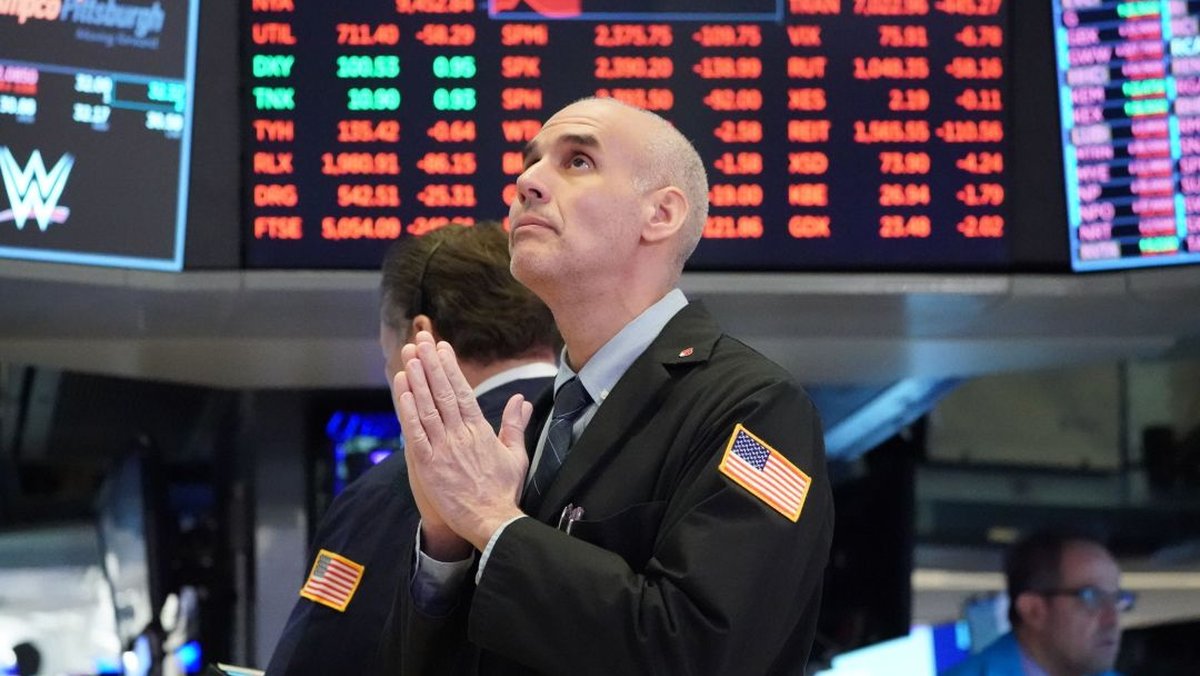
U.S. stocks logged their worst session since April: the S&P 500 sank 2.71%, the Nasdaq Composite dropped 3.56%, and the Dow slid 1.90%. Tech and semiconductors led declines as supply-chain sensitivity to rare-earths came back into focus. By several media tallies, the move erased more than $1.5 trillion in U.S. market value in a matter of hours.

Crypto’s ‘largest ever’ liquidation day

Digital assets mirrored the shock but with leverage: data trackers and multiple outlets estimated ~$19 billion in crypto positions were liquidated over 24 hours — the biggest single-day wipeout on record. Bitcoin (BTC) plunged under $119,000 and printed lows near $104,800 intraday; Ether (ETH) dropped toward the $3,600–$3,800 band as forced unwinds cascaded.

Beyond BTC and ETH, altcoins bled hard: baskets tracked by crypto desks showed double-digit losses across dozens of names, with SOL, XRP, DOGE, LINK and others slumping before staging partial rebounds as books thinned into the close.

Why the macro headline hit so hard

Traders framed the move as a classic policy-shock → liquidity-shock chain. The tariff threat arrived alongside talk of scrapping or downgrading a Trump–Xi meeting and followed Beijing’s expanded export restrictions, reviving the 2018–2019 trade-war playbook. With volatility jumping and some market makers reducing size, slippage widened and liquidation loops accelerated.

Tape checks: what the numbers say

  • U.S. indices: S&P −2.71%, Nasdaq −3.56%, Dow −1.90% (worst day since April).
  • BTC/ETH lows: BTC printed near $104.8K; ETH slipped into the $3.6Ks–$3.8Ks.
  • Liquidations: Roughly $19B in 24h — a new high-water mark — with billions flushed in the first hour alone.
  • Crypto market cap: Initial drawdown of ~$125B as the headline hit, per market trackers.

What to watch next (48–72 hours)

  1. Policy specifics: Any formal tariff docket — size, scope, timing — plus signals of Chinese retaliation on rare-earth licensing. Details, not slogans, will steer risk premia.
  2. Cross-asset stress: Equity breadth and semis; if weakness persists there, crypto beta typically stays capped.
  3. Derivatives health: Funding, basis and OI rebuild; another multibillion liquidation print without macro relief would argue for patience rather than knife-catching.

Bottom line

A single geopolitical shock turned a calm tape into a cross-asset rout. U.S. stocks gave back more than $1.5T in value and crypto endured a record ~$19B liquidation day. This was macro-led, not a crypto plumbing failure. With leverage partially cleansed, expect two-way volatility and headline-sensitive ranges until the tariff path is clarified.

Further Reading and Resources

Altcoin Analysis | Exchanges | Apps & Wallets

More from Crypto & Market

View all
South Korea Re-Opens the Corporate Door to Crypto: Why the Guardrails Matter More Than the Headline

South Korea’s corporate crypto thaw is less about a bullish headline and more about market plumbing: guardrails, custody, compliance, and how a retail-driven venue learns to absorb process-driven capital. The most durable impact will show up in liqui

The 10% Credit Card APR Cap Debate: Consumer Protection, Credit Rationing, and the Hidden Cost of “Affordable” Money

A proposed 10% cap on credit card interest rates frames a classic policy tradeoff: reduce household burden today, or risk shrinking access to unsecured credit—especially for high-risk and low-income borrowers. The real question isn’t whether 20%–30%

When Compliance Becomes an Attack Surface: France’s Crypto Safety Problem Isn’t On-Chain

As crypto integrates into mainstream finance, the biggest risk shifts from private keys to identity databases. France’s recent incidents expose a new kind of vulnerability: compliance itself.

Crypto’s Real 2026 Battleground: Market Plumbing, Not Narratives

The last 24 hours didn’t just move prices—it exposed where crypto’s center of gravity is shifting: from hype cycles to infrastructure, legality, and the plumbing that routes real money.

a16z’s $15B Signal and the New Defense‑Tech Cycle: When Venture Capital Starts Pricing Geopolitics

Andreessen Horowitz’s reported $15B raise isn’t just a big number—it’s a clue about what kind of risk capital wants in 2026: infrastructure, AI capability, and security-adjacent cash flows shaped by policy.

Crypto Is Quietly Becoming a Real Estate Rail in Europe — Not Because Banks Are Bad, but Because Settlement Is Broken

Wealthy buyers are increasingly using crypto to purchase property across Europe via intermediaries like Brighty. The story isn’t “crypto replaces banks”—it’s that crypto offers faster settlement and a new way to prove source-of-funds when traditional