
From Niche to Normal: Visa Survey Shows AI and Crypto Enter the U.S. Holiday Mainstream
For years, artificial intelligence and digital assets were framed as technologies of the future. They appeared in keynote presentations and tech blogs, but most holiday shopping still happened the same way: browsing websites or walking into stores, swiping a card, and wrapping physical gifts. The latest survey from Visa suggests that moment has quietly passed. AI and crypto are no longer just talking points for conferences—they are starting to shape how people search, choose, and pay during the busiest shopping season of the year.
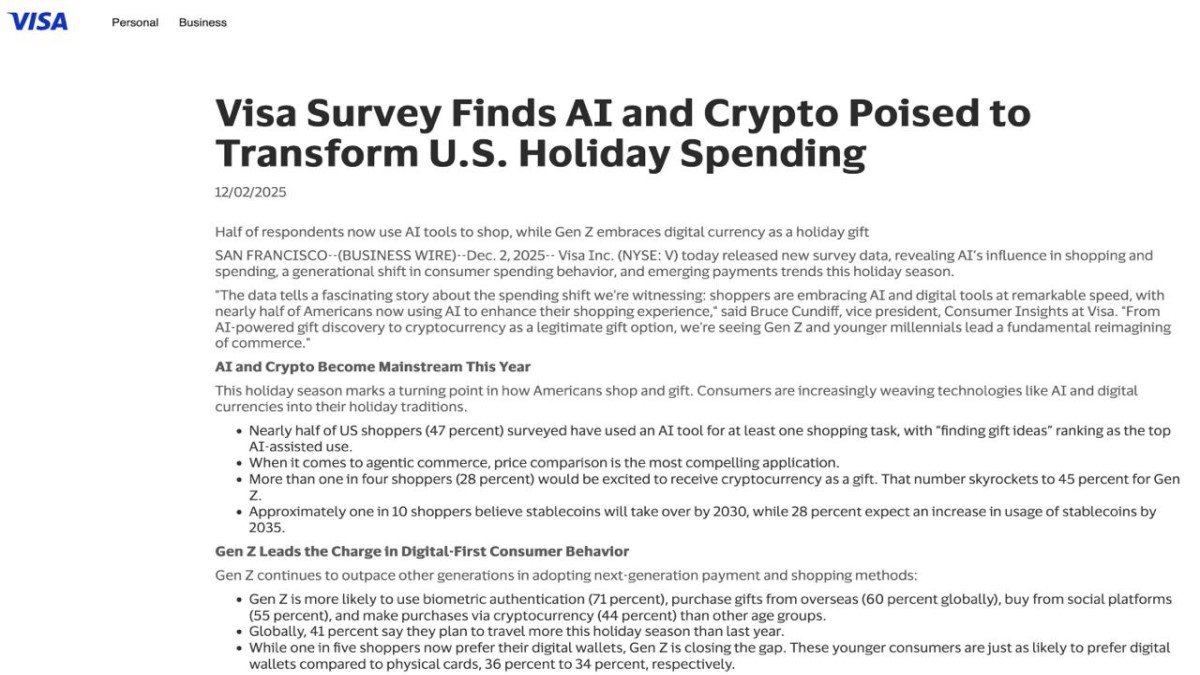
According to Visa’s research, nearly half of U.S. shoppers have used some form of AI assistance while shopping, especially for finding gift ideas and comparing prices. At the same time, a growing share of consumers—around 28% of respondents, and 45% of Gen Z—say they would be pleased to receive digital currencies as a gift. Stablecoins, in particular, are increasingly viewed as a serious candidate for everyday payments over the coming decade.
This article looks beyond the headline and asks a deeper question: what does it actually mean for AI and crypto to become “mainstream” in holiday spending? We will break the survey down into several themes: the rise of AI-assisted shopping, the cultural shift that treats crypto as a normal gift, the unique role of Gen Z, and what this all implies for merchants, payment networks and regulators.
1. AI as a Shopping Companion, Not Just a Tech Demo
Visa’s survey indicates that almost one in two U.S. shoppers have used an AI tool for at least one holiday shopping task. The most common use case is surprisingly practical: people are asking AI to help them come up with gift ideas. Instead of scrolling endlessly through product pages, shoppers type natural-language prompts such as “ideas for a friend who loves travel and photography” and receive curated suggestions.
As AI tools become more capable, the next stage of adoption is price discovery and comparison. Consumers want to know not only what to buy, but where to buy it. An AI agent that can search multiple retailers, factor in shipping time, and highlight current promotions offers clear value. That is why Visa’s data shows price comparison emerging as the most compelling advanced use case for AI in shopping.
From an industry perspective, this represents a shift in power:
• Search is moving from single websites to cross-platform agents. Instead of visiting individual stores, shoppers increasingly rely on AI interfaces that sit above retailers and route attention where the best combination of price, reputation and convenience exists.
• Brand visibility becomes a data problem. Merchants who want to appear in AI-generated recommendations need more than eye-catching ads—they need structured product data, clear pricing, and consistent fulfilment records that automated systems can evaluate.
• Payment choice can be embedded at the suggestion layer. An AI that proposes a gift can also show which payment methods offer additional rewards, instalment plans, or digital-currency options. That turns the AI interface into a potential discovery channel for new forms of payment, including stablecoins.
Yet the survey also highlights a crucial nuance: consumers still want human support at key points, especially for dispute resolution or complex issues. AI may suggest the gift and help process the transaction, but when something goes wrong—delayed shipments, wrong sizing, unexpected charges—many shoppers prefer to speak with a person. For payment providers, the winning model is therefore not “AI instead of humans,” but AI plus human-in-the-loop service.
2. Crypto as a Holiday Gift: From Novelty to Legitimate Option
Perhaps the most striking data point from the Visa survey is that 28% of shoppers would be excited to receive digital currency as a gift, and this number rises to 45% among Gen Z respondents. What used to be a niche idea—sending a friend some digital tokens instead of a sweater—is quickly becoming normalised.
There are several reasons for this change:
• Digital-native wealth storage. Younger users, in particular, are comfortable with the idea that value can be stored and transmitted in purely digital form. A token in a secure wallet feels no less “real” than funds inside an app-based bank account.
• Global families and cross-border ties. Many people now have relatives or friends living abroad. Sending digital assets that can be converted locally—or used directly as a medium of exchange—removes friction from cross-border gifting.
• Programmable utility. Digital currencies can carry additional features: time locks, spending categories, or even on-chain notes. A parent might send a teenager a holiday allowance that can only be spent after a certain date or on specified merchants.
The survey also reveals that a notable portion of respondents expect stablecoins to become widely used for payments by 2030, and that many anticipate further growth through 2035. That expectation matters because it shapes behaviour today. If consumers believe that dollar-referenced digital tokens will eventually be as standard as debit cards, they are more willing to start experimenting with them in low-stakes situations like small gifts.
From a market-structure perspective, treating digital currency as a normal gift has two important side effects:
- It deepens the base of retail holders. People who might never open an exchange account or on-chain wallet on their own can still become users when they receive a gift. Over time, some portion of them will move from passive holding to active participation in the ecosystem.
- It creates demand for user-friendly custodial experiences. If grandparents are sending digital assets to grandchildren, the tools must be simple enough for both groups to use without advanced technical knowledge. That puts pressure on wallets and payment apps to abstract away complexity while preserving security.
3. Gen Z at the Core of the Digital-First Shift
The Visa report underscores what many industry observers already suspected: Gen Z is the engine behind the adoption of both AI and crypto in consumer spending. Compared with older generations, these users are more open to new payment methods, more willing to shop through social platforms, and more likely to blend digital and physical experiences.
Some of the patterns highlighted in the survey include:
• Extensive use of biometric authentication. Around seven in ten Gen Z shoppers reportedly use features such as fingerprint or facial recognition when logging into apps or confirming payments. This makes digital spending feel natural and secure, which in turn lays the groundwork for them to adopt novel instruments like stablecoins.
• Cross-border and social commerce. Gen Z is more likely to purchase from international merchants and to discover products through social networks. For these buyers, currency conversion and traditional bank wires feel outdated; digital wallets and instant settlement are more aligned with how they already communicate and consume content.
• High engagement with digital currencies. The survey notes that a meaningful share of Gen Z has already used crypto for payments at least once. That does not mean they pay for everything this way, but it does suggest a lower psychological barrier to treating digital assets as spendable money instead of purely speculative instruments.
Perhaps the most telling detail is that Gen Z’s overall spending intentions remain resilient. Globally, a significant percentage say they plan to spend more this holiday season than last year, even amid economic uncertainty. For payment networks, this means that winning over Gen Z is not just a technology play; it is also a growth strategy for transaction volume.
4. The Double-Edged Sword of Digital Convenience
While the survey paints an optimistic picture of AI and crypto adoption, it also points out that concerns about online safety have not gone away. Families remain wary of identity theft, unauthorised transactions and deceptive schemes that target less tech-savvy users. AI can help detect suspicious activity, but it can also be misused to generate convincing messages or websites that trick people into sharing credentials.
This tension creates several design challenges:
• Transparency of AI-driven recommendations. When an AI tool suggests a product or a payment option, users should know whether that suggestion is neutral or influenced by commercial partnerships. Clear labelling and accessible explanations will become increasingly important as AI agents handle more of the shopping process.
• Stronger customer-support frameworks. If issues arise after an AI-assisted transaction, users need quick paths to dispute resolution and refunds. Payment providers that combine automation with responsive human support will likely stand out.
• Education around self-custody and wallet security. As more people receive digital assets as gifts, they must understand basic practices such as safeguarding recovery phrases and verifying transaction details. This is especially true for younger users who may be very comfortable with technology but less experienced in risk management.
In other words, mainstream adoption does not make risk disappear; it simply changes its shape. The more payment flows move into digital formats, the more important it becomes to design secure user journeys and accessible educational content.
5. Stablecoins and the Rewiring of Holiday Payments
Beyond gifts, the survey hints at a larger transformation: stablecoins are on track to become part of the everyday holiday spending toolkit. Respondents who expect stablecoins to be widely adopted by 2030 are not only thinking about speculative trading; they are envisioning a world where a portion of online checkouts, subscriptions and peer-to-peer reimbursements settle in tokenised dollars.
Consider a common holiday scenario. A family living in the U.S. wants to send money to relatives abroad so they can join in the festivities. Traditionally, this might involve a wire transfer or a dedicated remittance provider, with fees and delays along the way. With stablecoins, the same family could:
- Purchase tokens through a regulated platform using a bank account or card.
- Transfer those tokens to a relative’s wallet within minutes.
- Allow the recipient to either spend them directly with compatible merchants or convert them into local currency at a convenient time.
From a macro perspective, these patterns have important implications:
• Payment networks evolve from closed rails to multi-rail orchestrators. Companies like Visa are increasingly positioning themselves as connectors between traditional card-based systems and digital-asset networks, rather than protecting a single rail.
• Regulation moves to the foreground. As more consumers use stablecoins for real economic activity, regulators focus on reserve quality, disclosure and anti-money-laundering controls. Clear frameworks can encourage responsible growth; ambiguous rules may slow adoption.
• Holiday spending becomes a data-rich laboratory. Each December offers a snapshot of how new payment technologies are performing under stress, as volumes peak and households experiment with new tools. Lessons from these seasons often influence product roadmaps for the rest of the year.
6. Why Holiday Surveys Matter for Long-Term Crypto Adoption
It is tempting to treat holiday surveys as light reading, useful mainly for retailers deciding how much inventory to order. But the Visa data carries a deeper message: when AI tools and digital currencies show up in the most emotionally charged shopping season of the year, it signals a durable shift in consumer norms.
Buying gifts is a surprisingly conservative activity. People care about getting it right, avoiding friction, and ensuring the recipient feels appreciated. If a technology can succeed in that context—helping someone find the right present, or moving money across borders so a family can celebrate together—it stands a good chance of sticking around in daily life.
From that perspective, the survey can be read as an early confirmation that:
• AI is becoming the default interface for commerce. Instead of replacing human choice, it organises information and surfaces options in a way that saves time and mental energy.
• Crypto, especially in the form of stablecoins, is being normalised as a legitimate way to store and send value. It may not replace traditional money, but it is increasingly treated as a complementary tool rather than a speculative novelty.
• Gen Z’s preferences are setting the direction of travel. As they move into higher-earning years, their comfort with digital-first methods will influence which payment products grow and which fade.
7. Takeaways for Investors, Builders and Everyday Users
What should different groups take from the Visa survey?
For investors
The data reinforces the idea that payments and infrastructure may offer more durable value than short-lived speculative narratives. Platforms that power AI-driven shopping, secure digital wallets, stablecoin settlement and cross-border transfers stand to benefit from these behavioural shifts. Evaluating such projects means asking questions about regulation, business models and user experience, not just token price charts.
For builders
The survey highlights the importance of designing around real-world moments. A gifting workflow, a family remittance journey, or a holiday checkout experience can be the decisive point where someone forms a lasting impression of AI or crypto tools. Simplicity, clarity and strong customer support matter just as much as technical sophistication.
For everyday users
Finally, the research is a reminder that you are not an outlier if you are experimenting with AI shopping assistants or digital assets. A substantial portion of the population is already doing the same. The key is to move at a pace that matches your comfort level, pay attention to security best practices, and view new tools as ways to enhance—not replace—your financial judgement.
As Visa projects U.S. holiday spending to rise by around 4.6% year over year, the headline numbers will still be measured in traditional dollars. But underneath, the rails over which those dollars move are changing. AI helps decide what we buy. Digital currencies and stablecoins offer new ways to send, store and spend value. And a new generation of consumers is treating both technologies as part of everyday life.
Disclaimer: This article is for educational and analytical purposes only. It does not constitute financial, legal or tax advice, and it is not a recommendation to use any specific product or asset. Digital payments and crypto assets involve risks, and readers should conduct their own research or consult qualified professionals before making financial decisions.