Comparing Fiat On-Ramps: Bank Transfers, Credit Cards & More

2025-09-20

Written by:Haland Rose
Comparing Fiat On-Ramps: Bank Transfers, Credit Cards & More
⚠ Risk Disclaimer: All information provided on FinNews247, including market analysis, data, opinions and reviews, is for informational and educational purposes only and should not be considered financial, investment, legal or tax advice. The crypto and financial markets are highly volatile and you can lose some or all of your capital. Nothing on this site constitutes a recommendation to buy, sell or hold any asset, or to follow any particular strategy. Always conduct your own research and, where appropriate, consult a qualified professional before making investment decisions. FinNews247 and its contributors are not responsible for any losses or actions taken based on the information provided on this website.

Comparing Fiat On-Ramps: Bank Transfers, Credit Cards & More

Fiat on-ramps are the gateways between traditional money and cryptocurrencies. Choosing the right on-ramp determines how quickly, cheaply, and securely you can start investing in digital assets. In this article, we compare the main options—bank transfers, credit/debit cards, and third-party providers—highlighting their pros, cons, and trends shaping the future of fiat-to-crypto conversions.

Bank Transfers

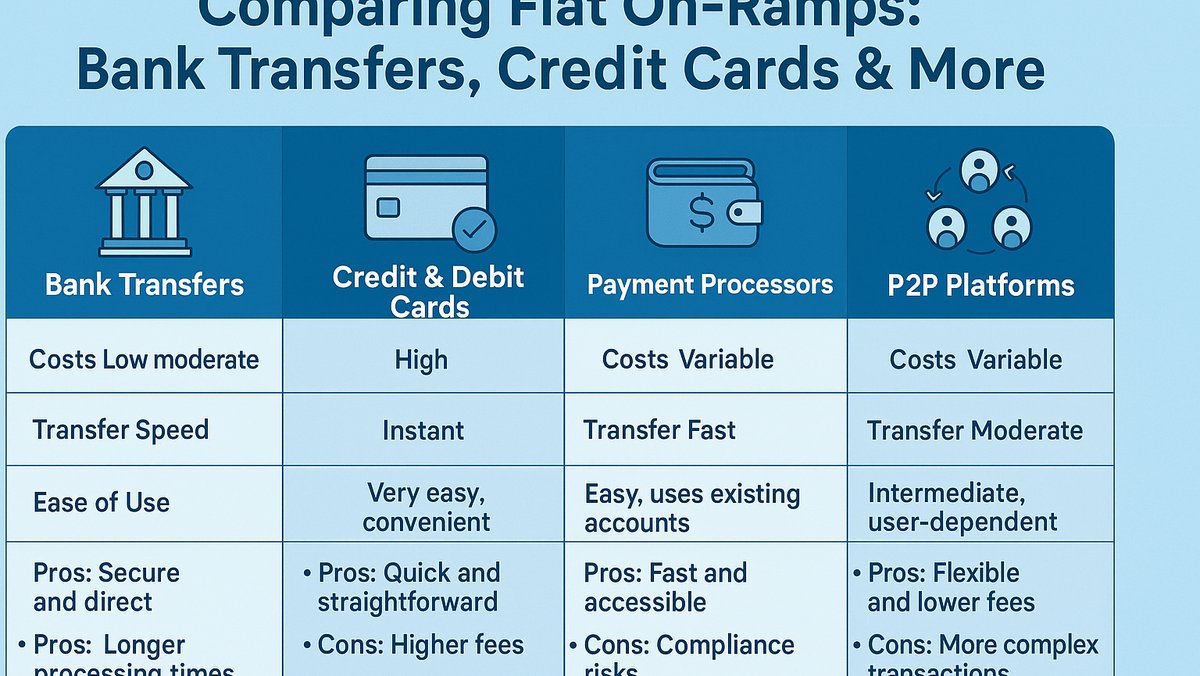
Bank transfers are the most common method, often supporting large amounts with lower fees. They integrate with exchanges via ACH (U.S.), SEPA (Europe), or SWIFT (international).

Pros:

  • Low fees compared to cards.
  • Suitable for large transfers.
  • Direct link to verified bank accounts adds security.

Cons:

  • Slower settlement (1–5 business days).
  • May require strict KYC and banking compliance.

Credit and Debit Cards

Cards provide near-instant deposits, making them ideal for beginners who want fast access to crypto. However, they often come with higher fees (2–5%) and purchase limits.

Pros:

  • Instant access to funds.
  • User-friendly and widely accepted.

Cons:

  • High fees.
  • Risk of chargebacks or declined transactions.
  • Spending limits.

Third-Party Payment Providers

Services like PayPal, Revolut, and fintech wallets have entered the crypto on-ramp space. They offer convenience but may limit withdrawals to external wallets.

Future Trends

By 2025, regulators are encouraging standardized KYC processes, while blockchain-based payment rails are enabling instant settlement. Stablecoins are increasingly being used as a fiat alternative, bridging gaps in underbanked regions.

Frequently Asked Questions

Which fiat on-ramp is cheapest? Bank transfers generally have the lowest fees, though they are slower.

Are credit cards safe for buying crypto? Yes, but they involve higher costs and may restrict withdrawals depending on the exchange.

What’s the best option in 2025? For speed, cards win. For cost efficiency, bank transfers are superior. Many traders use both depending on circumstances.

More from Exchanges

View all
Perp DEX 2026: The Quiet Flip from Exchanges to Embedded Trading

Perp DEXs didn’t just “grow” in 2025—they changed where trading lives. In 2026, the winning battlefield won’t be UI. It will be distribution, risk, and liquidity.

Coinbase Pauses Fiat Rails in Argentina: A “Small” Change That Reveals the Real Business Model

Coinbase is pausing peso-based rails in Argentina while keeping crypto-to-crypto services live. The headline sounds operational—but the deeper story is about where exchanges actually take risk: not on-chain, but in the messy middle layer between bank

Coinbase Bets on Information: Why the Acquisition of The Clearing Company Matters for Prediction Markets

By acquiring The Clearing Company, Coinbase is not just adding another product line. It is positioning itself at the center of a new market where opinions about future events trade as liquid contracts, and where compliance and infrastructure matter a

Bybit Returns to the UK: What Its Second Act Says About Crypto Regulation in London

After leaving the UK in 2023 when new financial promotion rules landed, Bybit has quietly returned with a spot-only offering approved through licensed exchange Archax. This article explains how the structure works, why the UK’s approach to crypto mar

Perp DEX: Rebuilding Wall Street On-Chain

Perpetual futures exchanges built on public blockchains are starting to resemble a fully fledged Wall Street stack: exchange, clearing house, prime broker and lending desk compressed into smart contracts. By comparing their cost structure with tradit

PancakeSwap and YZI Labs Incubate Probable: What an On-Chain Prediction Market Could Mean for BNB Chain

PancakeSwap and YZI Labs are incubating Probable, a new prediction-market protocol on BNB Chain that lets users express views on sports, politics, digital assets and major events by trading outcome tokens collateralised in USDT. We examine how the de