Coinbase vs Gemini: Which Offers Better Security?

2025-09-20

Written by:Shang Ha
Coinbase vs Gemini: Which Offers Better Security?
⚠ Risk Disclaimer: All information provided on FinNews247, including market analysis, data, opinions and reviews, is for informational and educational purposes only and should not be considered financial, investment, legal or tax advice. The crypto and financial markets are highly volatile and you can lose some or all of your capital. Nothing on this site constitutes a recommendation to buy, sell or hold any asset, or to follow any particular strategy. Always conduct your own research and, where appropriate, consult a qualified professional before making investment decisions. FinNews247 and its contributors are not responsible for any losses or actions taken based on the information provided on this website.

Coinbase vs Gemini: Which Offers Better Security?

Security is one of the most critical factors for crypto investors. With billions in digital assets at stake, choosing a secure exchange can mean the difference between protecting wealth and losing it overnight. In 2025, Coinbase and Gemini are two of the most trusted U.S.-regulated exchanges. But which one offers better security? Let’s break it down.

Regulatory Standing

  • Coinbase: Publicly traded on NASDAQ, regulated by U.S. authorities, with transparency reports published quarterly.
  • Gemini: Licensed under New York’s BitLicense and subject to one of the strictest regulatory frameworks in the world.

Custody of Assets

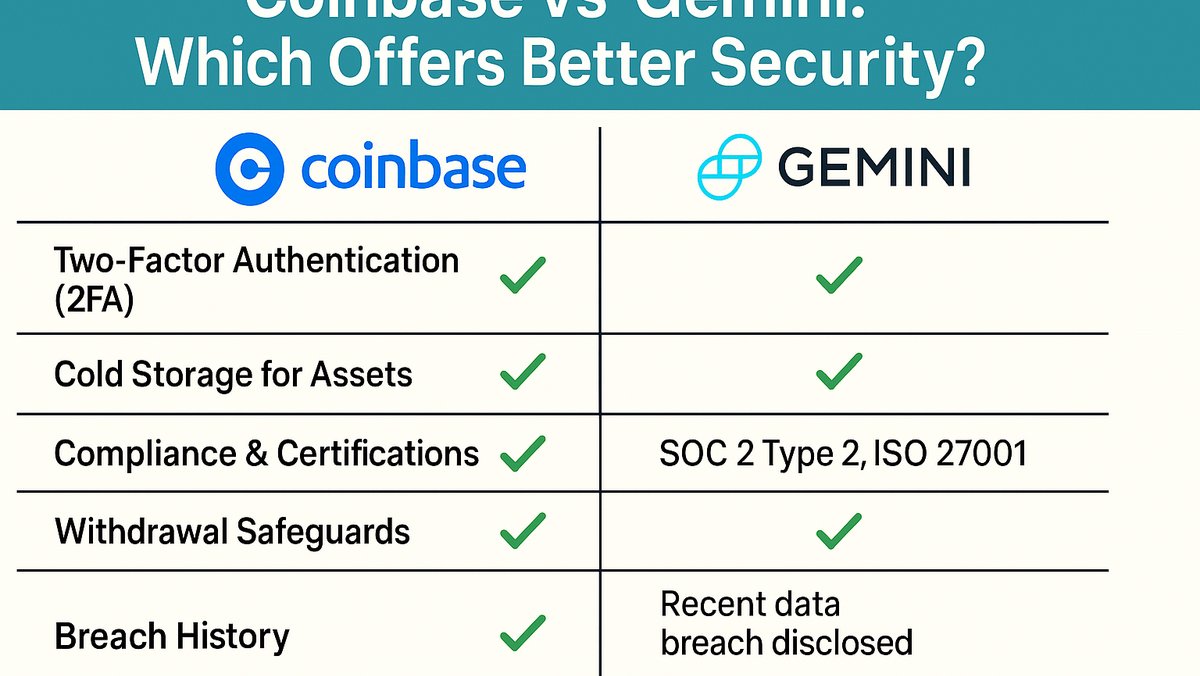
  • Coinbase: 98% of customer assets are stored in offline cold storage, with insurance for hot wallet balances up to $250M.
  • Gemini: SOC 2 certified with institutional-grade Gemini Custody, offering up to $200M in insurance coverage.

Account Security

  • Both exchanges enforce mandatory two-factor authentication (2FA).
  • Support for hardware security keys (YubiKey).
  • Biometric logins available on mobile apps.

Transparency and Audits

Gemini is known for undergoing independent SOC 1 & SOC 2 audits, demonstrating strong operational security. Coinbase provides detailed quarterly financial disclosures and has begun implementing proof-of-reserves reporting to improve user trust.

Comparing User Protections

  • Coinbase: Backed by corporate balance sheet, FDIC insurance for USD balances, and insured custody.
  • Gemini: Strong focus on compliance and institutional protections, particularly for high-net-worth clients.

Which Is Better for Retail Users?

Coinbase is often favored by beginners due to its ease of use, insurance policies, and wide educational resources. Gemini, while slightly more complex, appeals to users who prioritize institutional-grade security and regulatory oversight.

Risks and Considerations

  • Both platforms remain custodial, meaning users don’t directly control private keys.
  • Regulatory pressures could affect available assets.
  • No platform is immune to insider illegal deception or cyber threats.

Investment Outlook

Both Coinbase and Gemini set the standard for security among U.S. exchanges. For beginners and retail investors, Coinbase may be the safer entry point. For institutions and compliance-driven traders, Gemini provides stronger assurances. Ultimately, investors should combine exchange use with self-custody solutions for maximum protection.

Frequently Asked Questions

Which exchange is safer in 2025? Both are highly secure, but Gemini’s regulatory framework is slightly stricter, while Coinbase offers broader insurance protections.

Do they both offer proof-of-reserves? Coinbase has begun rolling out proof-of-reserves, while Gemini continues to undergo third-party audits.

Which is better for institutions? Gemini, due to its focus on custody and compliance.

Which is better for retail? Coinbase, due to its user-friendly interface and insurance-backed hot wallets.
More from Exchanges

View all
Perp DEX 2026: The Quiet Flip from Exchanges to Embedded Trading

Perp DEXs didn’t just “grow” in 2025—they changed where trading lives. In 2026, the winning battlefield won’t be UI. It will be distribution, risk, and liquidity.

Coinbase Pauses Fiat Rails in Argentina: A “Small” Change That Reveals the Real Business Model

Coinbase is pausing peso-based rails in Argentina while keeping crypto-to-crypto services live. The headline sounds operational—but the deeper story is about where exchanges actually take risk: not on-chain, but in the messy middle layer between bank

Coinbase Bets on Information: Why the Acquisition of The Clearing Company Matters for Prediction Markets

By acquiring The Clearing Company, Coinbase is not just adding another product line. It is positioning itself at the center of a new market where opinions about future events trade as liquid contracts, and where compliance and infrastructure matter a

Bybit Returns to the UK: What Its Second Act Says About Crypto Regulation in London

After leaving the UK in 2023 when new financial promotion rules landed, Bybit has quietly returned with a spot-only offering approved through licensed exchange Archax. This article explains how the structure works, why the UK’s approach to crypto mar

Perp DEX: Rebuilding Wall Street On-Chain

Perpetual futures exchanges built on public blockchains are starting to resemble a fully fledged Wall Street stack: exchange, clearing house, prime broker and lending desk compressed into smart contracts. By comparing their cost structure with tradit

PancakeSwap and YZI Labs Incubate Probable: What an On-Chain Prediction Market Could Mean for BNB Chain

PancakeSwap and YZI Labs are incubating Probable, a new prediction-market protocol on BNB Chain that lets users express views on sports, politics, digital assets and major events by trading outcome tokens collateralised in USDT. We examine how the de