Gemini Titan Wins CFTC License: Regulated Prediction Markets Come to U.S. Crypto
Gemini has cleared a regulatory hurdle it has been working on quietly for years. Its affiliate, Gemini Titan, LLC, has received approval from the U.S. Commodity Futures Trading Commission (CFTC) to operate as a Designated Contract Market (DCM) focused on event contracts. In practical terms, this gives Gemini permission to list regulated, yes/no contracts on future events for U.S. customers, under the same statutory framework that governs major futures exchanges.
The move does not just add another product line to a crypto exchange. It marks a shift in how event-based markets, derivative regulation and digital-asset infrastructure are starting to converge. Rather than living in a grey zone or offshore, a portion of the prediction-style market structure is being pulled into the core of U.S. market regulation, with a crypto-native firm providing the technology and distribution.
1. What exactly did Gemini get from the CFTC?
The CFTC’s decision grants Gemini Titan the status of a Designated Contract Market. A DCM is a formally registered exchange under the Commodity Exchange Act, subject to a long list of “core principles” covering governance, surveillance, transparency, technology resilience and market integrity. This is the same category of license used by traditional futures venues such as CME and ICE, even though Titan’s first products will focus on event contracts rather than standard interest-rate or commodity futures.
The approval closes a multi-year loop. Gemini first began pursuing DCM status around 2020, when it submitted documentation laying out how a separate entity, Gemini Titan, would operate an exchange listing event contracts on real-world outcomes. From there, the application went through multiple amendments, public filings and regulatory reviews before the CFTC finally moved Titan from “pending” to “designated” in late 2025.
In its public communication, Gemini has framed Titan’s mandate in two layers:
- Phase one: list classic yes/no event contracts – essentially questions with a binary outcome at a defined expiry date (for example, whether an index crosses a level, whether a data release exceeds a threshold, or whether a specific policy decision is announced by a deadline).
- Optional future phase: use the same DCM infrastructure to support other CFTC-supervised derivatives, including crypto-linked futures, options and perpetual-style products, provided they are individually approved under the CFTC rulebook.
The important nuance is that Titan is not just another “section” on Gemini’s existing spot exchange. It is a legally distinct exchange operating under the derivatives regulator’s jurisdiction, with its own rulebook, compliance obligations and supervisory relationship with the CFTC.
2. How Gemini Titan’s event contracts are designed to work
At launch, Gemini Titan will focus on what the firm describes as binary event contracts – contracts whose payoff depends only on whether a defined event happens or does not happen, according to pre-agreed criteria. While the underlying mechanism is conceptually simple, it is worth unpacking how this works in a regulated setting.
Each contract is tied to a single clearly phrased question about the future. Examples in public filings and commentary include questions like whether a benchmark asset will end the year above a certain price, or whether a specific macroeconomic indicator will print above a threshold in an upcoming release. The contract has:
- A settlement date: the moment at which the outcome is evaluated.
- An objective source of truth: such as an official data release, index level or clearly documented announcement.
- A payoff structure: positions in the “yes” side receive a fixed amount if the event occurs (and zero if it does not), while the “no” side receives the same fixed amount if the event does not occur (and zero if it does).
Prices for these contracts typically trade between 0 and 1 (or 0 and 100 if quoted in currency units). A price of 0.65, for example, can be interpreted as the market implying roughly a 65% chance that the event happens, after taking into account risk, fees and other frictions. As market participants update their expectations, prices move, and that price history becomes a live, continuously updated forecast of collective expectations.
What makes Titan distinctive is not the existence of event contracts themselves – on-chain platforms and offshore venues have offered similar structures for years – but the combination of:
- Formal CFTC oversight of contract design, listing standards and risk controls.
- Integration with a crypto-native exchange that already runs custody, onboarding and account infrastructure for digital assets.
- Alignment with the derivatives rulebook, including position limits, surveillance tools and reporting obligations aimed at reducing market manipulation and protecting participants.
From a market-structure perspective, Titan attempts to fuse two ideas: the informational value of prediction-style markets, and the governance framework of a traditional U.S. derivatives exchange.
3. Why regulators are willing to approve this now
The timing of Titan’s approval is not accidental. It comes against a broader backdrop in which the CFTC has become more active in shaping how digital-asset and event-based products can trade on U.S. soil, rather than simply reacting to offshore developments.
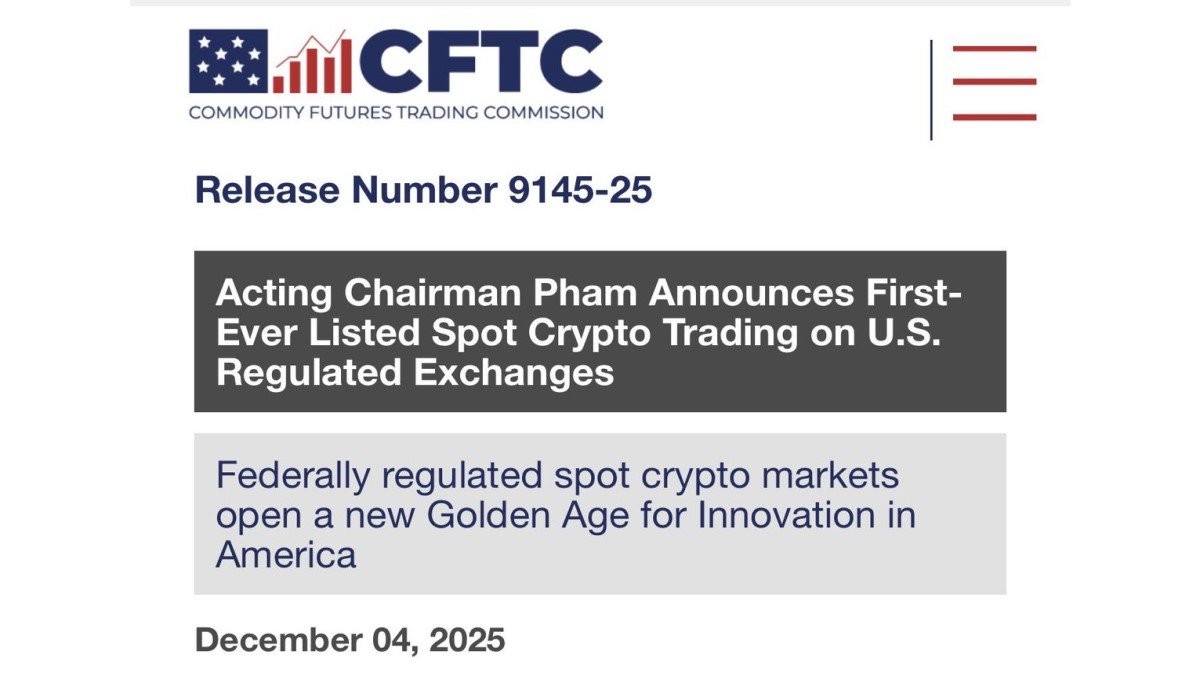
In early December 2025, the CFTC also signalled that spot crypto products would start trading on CFTC-registered futures exchanges for the first time, under tailored market-structure rules. That decision reflects a shift toward bringing crypto activity into supervised venues, instead of leaving critical markets to offshore platforms.
Within this context, Gemini Titan can be viewed as part of a larger strategy:
- Channel demand for event-based forecasting into a transparent, supervised setting.
- Set a precedent for how yes/no contracts on economic and financial outcomes can be structured inside the existing derivatives framework.
- Demonstrate that crypto-native infrastructure firms are willing to operate under the same regulatory expectations as traditional derivatives exchanges.
For regulators, there are also pragmatic reasons to prefer licensed exchanges over unregulated alternatives. A DCM must maintain surveillance systems, cooperate with information-sharing agreements and enforce rules that prohibit abusive behaviour, giving supervisors more visibility into how markets are used and by whom.
4. Strategic logic for Gemini: beyond spot trading
For Gemini itself, Titan is more than a regulatory trophy. It is a strategic response to several pressures the firm has faced since going public:
• Revenue diversification: spot trading volumes are cyclical and highly sensitive to sentiment in digital-asset markets. Building a derivatives and event-contracts franchise can add fee streams that are less directly tied to the day-to-day volatility of token prices.
• Differentiation: in a world where many exchanges offer the same list of assets, a regulated event-contract market gives Gemini a product that is harder to replicate and creates potential network effects around specialised order flow and data.
• Institutional positioning: some institutional clients are more comfortable interacting with products that sit inside a traditional regulatory perimeter. A CFTC-supervised DCM makes it easier for those clients to justify participation to investment committees, boards and risk managers.
The long, five-year path from initial application to approval also shows that Gemini is willing to invest in regulatory processes that do not pay off immediately. In a sense, Titan is the product of patient “regulatory capital” accumulated over multiple years of documentation, dialogue and compliance work.
5. What this could mean for crypto derivatives more broadly
While Titan’s first focus is on event contracts tied to economic, financial and other measurable outcomes, the DCM framework leaves the door open to crypto-linked derivatives in future phases. Public commentary from Gemini has already mentioned the possibility of listing futures, options and perpetual-style contracts with digital-asset underlyings, subject to CFTC review and approval.
If that trajectory plays out, Titan could become one of the first crypto-native venues to offer a substantial derivatives menu to U.S. users squarely inside the CFTC perimeter. That would place it somewhere between two existing poles:
- On one side, large traditional exchanges listing a limited set of Bitcoin and Ethereum futures under conservative margin and product rules.
- On the other side, offshore venues offering a wide range of crypto derivatives but operating under different regulatory expectations.
A CFTC-supervised DCM that is comfortable with both event contracts and crypto underlyings could, over time, form a third category: a venue that experiments with innovative product design but still sits within the mainstream U.S. legal framework.
From a market-design standpoint, there is also an interesting possibility that the two sides cross-pollinate. For example, event contracts on future crypto-related metrics (such as network activity thresholds, protocol upgrade milestones or macro events that historically correlate with digital-asset cycles) could coexist alongside more conventional futures and options, creating a richer set of tools for risk management and research.
6. How prediction-style markets can be used constructively
Because event contracts are often associated with entertainment-driven narratives, it is important to emphasise the more constructive ways they can be used when they are well designed and supervised.
At a basic level, event markets are forecasting tools. They translate dispersed information and views into a price that can be interpreted as an implied probability. For policy-sensitive outcomes – interest-rate decisions, inflation readings, regulatory announcements – this can add a useful layer of information on top of traditional surveys and analyst reports.
Some potential use cases in a regulated environment include:
• Risk management for businesses: firms can look at prices of event contracts related to economic indicators or policy decisions that materially impact their operations, using those implied probabilities as inputs for scenario planning.
• Research and education: academics, think tanks and financial-education platforms can use contract prices as live data for studying how expectations form, how they adjust to news and how markets process uncertainty.
• Portfolio construction: institutional investors might use event markets to complement their macro assumptions, especially around central-bank policy paths or key economic thresholds.
Should Titan achieve meaningful scale, its event-contract order book could become part of the broader information set that fixed-income, equity and digital-asset investors monitor when mapping out possible future paths for growth, inflation and policy.
7. Risks, open questions and what to watch
Despite the promising narrative, there are still multiple risks and uncertainties around Gemini Titan’s long-term role.
Regulatory scope and boundaries. The CFTC has historically been cautious about certain categories of event contracts, especially those touching on highly sensitive social or political outcomes. The Commission will continue to draw lines around what can and cannot be listed, and those boundaries may evolve over time. Market participants will need to pay attention to how Titan defines its product universe and how the CFTC comments on specific contract types.
Market depth and sustainability. Receiving a license does not automatically guarantee liquidity. Titan will have to attract market makers, research shops and end users willing to provide and consume liquidity on a continuing basis. Early contracts may see episodic spikes in activity around specific headlines, but long-term viability will depend on whether a stable base of participants views these markets as useful tools rather than short-term novelties.
Technology and operational resilience. As a DCM, Titan must meet stringent requirements for system capacity, uptime, data integrity and incident handling. Any prolonged outage or mis-settlement of an event could undermine confidence quickly. Gemini will have to demonstrate that its exchange technology and control framework are robust enough to handle both normal conditions and stress events.
Interaction with onchain ecosystems. For now, Titan is a traditional, centrally run exchange even if it is operated by a crypto-native firm. The interesting question is whether, and how, data from Titan’s markets might eventually interact with onchain protocols – for example through compliant data feeds used by DeFi applications that want to reference implied probabilities from a regulated venue. That would raise new questions about data licensing, timing, and standards for using off-chain information in onchain contracts.
Reputation and alignment. Because Titan is closely branded with Gemini, any issue around governance, contract design or perceived fairness could spill over into how users view the broader group. Conversely, a track record of transparent operations could strengthen Gemini’s positioning as a long-term institutional player rather than a purely cycle-driven trading venue.
8. A new chapter in the convergence of crypto and regulated derivatives
Taken together, Gemini Titan’s approval is another sign that crypto-originated firms are moving deeper into the core plumbing of regulated finance. Instead of only listing digital-asset pairs on spot order books, exchanges like Gemini are seeking to operate full-fledged derivatives venues under the same legal framework that governs more established markets.
For the broader ecosystem, several high-level implications stand out:
- Event-based markets are no longer confined to experimental or offshore settings; they are being formalised as part of the U.S. derivatives landscape.
- Digital-asset infrastructure providers increasingly see value in building long-horizon regulatory assets – licenses, governance frameworks, compliance track records – rather than only focusing on short-term trading volume.
- Data generated by regulated prediction-style markets could become a useful complement to existing macro and market indicators, especially for investors who bridge traditional and digital-asset portfolios.
As always, the most important questions will not be answered in the first days of trading. They will play out over quarters and years: Does Titan manage to attract deep, diverse liquidity? Do its contracts become reference points for serious forecasting, or remain niche? And does the platform successfully expand into the crypto-linked derivatives it has flagged as a longer-term goal?
Those answers will ultimately determine whether Gemini Titan becomes a small, specialised experiment in regulated event contracts – or a foundational piece of how crypto and traditional derivatives increasingly share the same regulatory and technological rails.